
Bangladesh, a world model for hilsa production
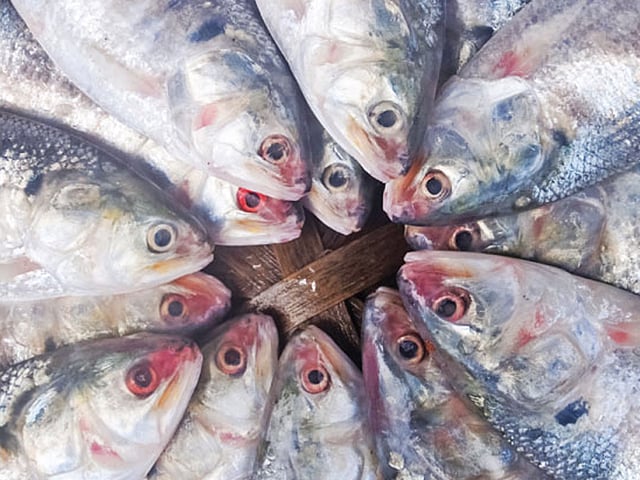
Among the 11 countries where hilsa is found, Bangladesh is the only country where production of this silver fish is on the rise.
According to World Fish, hilsa production is on the wane along the coasts of India and Myanmar, Bahrain and Kuwait’s Arabian Sea, the West Mid Pacific adjacent to Malaysia and Indonesia, Vietnam and Cambodia’s Mekong, as well as China and Thailand’s China Sea waters.
Yet hilsa production has been increasing at the rate of 8% to 10% every year in Bangladesh.
World Fish says, Bangladesh is the leading country in hilsa production with 65% of all hilsa, while India contributes with 10-15% and Myanmar 8-10%. The remaining hilsa comes from other countries.
Bangladesh government started identifying breedings spots of hilsa since 2002.
The government initiated a project to conserve jatka (hilsa less than 10 inches long) in 2004. Initially, raising awareness and dissuading fishermen from catching hilsa fry was the target.
Nextm the government slapped a ban on fishing jatka and mother hilsas in five breeding zones including Chandpur, Lakkhipur, Barisal, Bhola, Patuakhali, Cox’s Bazar and Chittagong for eight months between November and June from the 2007-08 season.
The government provided identity cards to around 224,000 hilsa fishermen in a bid to give them a three-month access to social security during the ban period.
Research organisations think these measures to safeguard the fish have been very effective. Bangladesh has almost doubled its hilsa production just in 12 years.
According to the directorate of fisheries, Bangladesh will catch around four tonnes of hilsas this year.
India and Myanmar have already started following Bangladesh model to increase their hilsa production.
Fish experts said hilsa production can be maximised in adjacent areas of the Bay of Bengal. For this, India and Myanmar have to stop netting mother hilsas and jatkas along Bangladesh which will increase hilsa in these areas.
Fish experts from Kuwait and Bahrain contacted with researchers of the Bangladesh Fisheries Research Institute (BFRI) to understand Bangladeshi strategy to enhance hilsa production. Following Bangladesh, both the countries have taken measures to identify hilsa spawning spots and slap a ban on hilsa catching during the time of spawning.
Hilsa expert Sugata Hazra, of the School of Oceanographic Studies at Jadavpur University in India, told Prothom Alo over phone that the number of hilsa is increasing in Bangladesh as the sweet water of Padma and Meghna rivers is still fine and hilsas get enough food there.
Another reason that boosted hilsa production in Bangladesh is the jatka conservation project initiated in 2005 that imposed a ban on hilsa fishing for its spawning period.
According to India’s fisheries department, the country produced 80,000 tonnes of hilsa in 2011 that came down to 14,000 tonnes in 2014.
On the contrary, Bangladesh saw 2 lakh tonnes of hilsas in 2009-10 that increased to 3.85 lakh in 2014.
Sugata Hajra said, West Bengal also declared three areas as safe hilsa breeding zones, but could not stop overfishing of mother hilsas and catching of jatka. The number of hilsa is down in the areas as West Bengal failed to take any social security programme for the poor fishermen of the area like Bangladesh did.
Hilsa researcher Anisur Rahman of Chandpur Fisheries Research Centre told Prothom Alo that hilsa has no borders. They can swim up to 70-75 kilometers every day. The number of hilsa would not be satisfactory if the other neighboring countries fail to take initiatives to restrict hilsa fishing like Bangladesh did during the time of breeding. The number of hilsa would increase in Bangladesh, India, and Myanmar, if the three countries jointly ban hilsa fishing at the same time. The people of the three countries would benefit.
According to the ministry of fisheries and livestock, hilsa contributes one percent of the country’s total gross domestic product (GDP) and 11 percent of the country's total fish production. A total of half a million fishermen are directly involved with hilsa catching. The livelihood of another 2 million people is involved with this fish.
According to the international fish research organization World Fish, hilsa is available along the coasts of India, Myanmar, Pakistan, Sri Lanka, Malaysia, Iran and also some other countries of the world. However, the fish selects the Ganges basin of Bangladesh for breeding.
Mother hilsas gather in the rivers of the country to lay their eggs in monsoon. Hilsas are available from 1200 to 1300 kilometers upstream of the river and up to 250 kilometers away from the coast. The hilsa gets even tastier when they swim into the fresh water, washing away the salinity.
Pointing out that hilsa contains Omega-3, Professor Abdul Wahab of the fisheries department of Bangladesh Agriculture University said this is a kind of oil which is used worldwide as a medicine for several ailment including heart disease. Only a number of fish has Omegs-3. Hilsa soup is sold at a high price in the US, New Zealand, and several European countries. Almost all the countries in the world, as a result want to increase hilsa production. Bangladesh is leading the way.
Allegations are there that the hilsa price is high despite good production. However, the national hilsa preservation project director Zahid Habib told Prothom Alo that the most interesting and delicious foods of any country in the world are a bit costly. The price of hilsa is quite stable over the last 4-5 years compared to other foods. Hilsa might have been restricted to rich people if production was not increased. The middle the upper middle class can enjoy the fish too because of the increased production.