
Making a difference
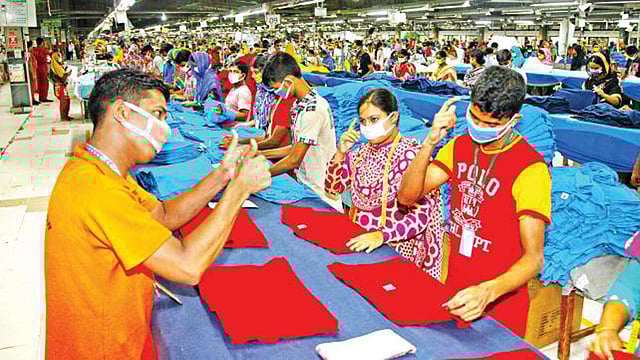
The small-built man is busy sorting out T-shirts, checking them for defects and making sure they are stitched to perfection. He can neither hear nor speak. When approached, he points to the ID card around his neck which identifies him as Sajjad (hearing impaired), quality inspector appointed on 3 January 2010.
Sajjad works at the Keya knit composite factor of Keya Group. There are several speech and hearing impaired men and women working along with him at this factory. In fact, of the 6461 workers here, 966 are differently-abled. They have been working for years diligently alongside the other workers of the garment factory.
The Keya knit composite factory is located a few kilometers down a beaten road from Konabari, Gazipur. When we reached there on the morning of 19 May, we were greeted at the gate by hearing and speech impaired security guards. They are accompanied by guards of a private security company.
The factory is the largest structure located on the 300 bigha area of Keya Group. It covers an area of 9 lac 20 thousand square feet. Opposite the factory are Keya Cotton Mills, Keya Spinning Mills and Keya Yarn Mills. A wide 60 ft road runs through the area, lined with krishnachura, coconut, cherry and nut trees.
A few workers are seen loading some old sewing machines onto a truck. Compliance manager Sohail Rana points out that they are all deaf and mute.
These disabled workers cannot be differentiated from the others. They communicate in sign language, though not all are mute and not all are deaf, said Keya Group senior executive director Akkas Ali Pathan.
In the same area, 48 visually impaired persons work at the Keya cosmetics factory. Sohail Rana says the disabled works have a higher production capacity than the others. While the others are in a hurry to leave exactly at five, these workers are not so impatient.
Shefali Begum is stitching T-shirts on a machine. She says, “I’ve been working here for nine years and it has never been a problem working with the disabled. Sometimes they might have an outburst, but then we explain things and calm them down.”
She has picked up sign language too. She calls over hearing and speech impaired Mukta. Mukta looks up at us and then turns back to folding the sleeves of a T-shirt.
Rozina Khatun has been working for three years at the quality control department. Working alongside her are the disabled Murad and Abul Khair. She says she is pleased to work with them. They are pleasant and polite.
Rozina too has picked up sign language and helps us communicate with Murad. Murad is married and his two children.
Abul Khair comes forward too and through Rozina informs us that he has passed his Dakhil exam and has been working at the factory since 2009. He has one daughter and two sons. He earns 10,000 taka a month and has no problem with his job. He says he would have suffered without a job, perhaps just spent time sleeping at home.
The young interpreter Rakibul Islam helps us communicate further. Through him Sajjad tells us he is from Naogaon and studied up to class eight. He has two brothers and two sisters and his father is a bus driver’s helper. Sajjad is married and earns 13,000 taka a month. He saves a bit from his wages every month so eventually he can set up something in his village home. Meanwhile, he is happy to work here as the employers treat him well.
Sohail Rana takes us to the sewing section. A woman worker and her husband, both disabled, work in the factory. The woman writes down her name for us: Sheuli (hearing impaired). She has been working here since 27 February 2012. In English she writes her husband’s name, Abdullah.
Sheuli has four sisters and two brothers. She lives in a rented house with her husband. She gets a monthly wage of 9000 taka. She says she has no problem in getting around inside or outside of the factory. Everyone understands her.
Akkas Ali Pathan says, “Disabled persons have been working in our factory for almost 13 years now. The local people are helpful too and even the shopkeepers have picked up sign language. They have no social problems.”
Keya Group officials say that the factory produces on average 260,000 to 270,000 T-shirts a day. These are exported under Keya Group’s own brand name to Europe and America. Their exports amount to about USD7million a month. They manufacture yarn from cotton, fabric from the yarn and then readymade garments.
Chairman and managing director of Keya Group Abdul Khaleq Pathan is basically the one behind employing disabled persons.
Speaking at his Gulshan office, Abdul Khaleq Pathan relates his own tale. After passing his SSC in Chittagong in 1977, he took up a job in a brick factory in Gazipur. After a few years he leased some land and set up his own brick factory in 1984. While supplying bricks to Quasem Cotton Mills, he took a look around the factory. That’s when he began to dream of owning a textile mill himself.
His dream finally materialised in 1991 when he set up Khaleq Garments and Knitting. Five years later he set up Keya Cosmetics. Then on a 300 bigha plot of land he established the Keya knit composite factory which began production in 2003. He then shut down the previous garment factory.
Things were not always easy in employing the disabled. At one point of time in 2009 when differences between the disabled and the other workers reached a height, the other workers refused to work with the disabled. They were simply told they could leave if they wanted, but the disabled would remain.
“The workers were agitated,” recalls Khaleq, “they went on a rampage, damaging the factory, beating up the officers. Finally the administration managed to bring things under control and reach an understanding with the workers. I put forward two conditions. One was that everyone had to learn sign language. The other was that any trouble-maker, able or disabled, would be sacked. Things settled down from then.”
Khaleq goes on to say, “The disabled workers have a higher production capacity than the general workers, but need regular counseling. Even the general workers need counseling and I have ensured that regularly.” He feels if entrepreneurs take the time and efforts, it is not difficult to employ the disabled.
He now dreams of setting up another garment factory, employing 400 to 500 blind workers. “I have seen such a factory in New York. It is possible. Sewing machines will be fitted with special devices and the visually impaired workers will be trained.”
According to Bangladesh Garment Manufacturers and Employers Association (BGMEA) states that Beximco Fashion employs 576 disabled workers.
Disabled workers are also employed by Fakhruddin Textiles, Interstoff, Vintage Denim Studio, Interfab, Abanti, Colour Tex, Fakir Fashion, Pandora Sweaters, Tarsima, Onus Group, Givenchy Group and Pashami Sweaters.