
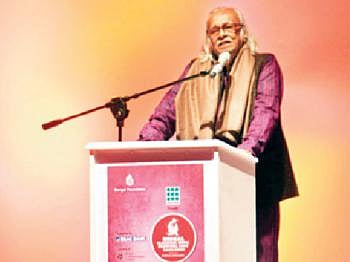
He had wanted to say something. He had taken his seat after delivering his speech and then returned to the microphone, saying, “There’s something more I wanted to say.” But he never got to say that something. Artist Qayyum Chowdhury fell to the ground before he could utter those words. It was on this day last year, the fourth day of Bengal Foundation’s classical music festival.
A year has passed. Yet again the army stadium fills with the strains of classical music. Artistes and music lovers bask in the coolness of the autumn night. He is not there, but his presence is palpable. The festival has been dedicated to artiste Qayyum Chowdhury.
I wasn’t at the festival that fateful night. I heard the heart-rending news of Qayyum bhai’s death the next morning at Bangkok airport. Returning to Dhaka I was engulfed in his absence. I feel his presence every day. He will remain with us in the days to come.
Qayyum Chowdhury, our dear ‘Qayyum bhai’, not only enriched the country’s arena of art during the five decades of his artistic work, but he filled the world of culture and life with a burst of colour. He played a vital role in refining public taste. He opened the doors to an aesthetically amazing world through his work on canvas, paper, thousands of book covers, innumerable posters, invitation cards, company and media logos and other designs and decorations. We are awestruck by the array of colour, the dazzling hues of red, blue, green and yellow. There are plants, flowers, birds, boats, fish, palm-leaf fans, rivers meandering through the emerald expanse, endless sky and the evergreen beauty of Bengal. Just as poet Jibananda Das revealed the natural wonders of Bengal in the lines of his poetry, artist Qayyum Chowdhury tirelessly wielded his brush to display Bengal in all its beauty and cultural glory. If fact, he is often referred to as the Jibananda of art. Once he said to me, “I love wandering down the rivers and canals of Bangladesh. I gather inspiration for my paintings from here.”
On the occasion of Qayyum bhai’s 70th birthday, his fourth solo art exhibition was held on 6 March 2004 at Bengal Gallery. He told me, “I had to learn about my heritage, the background of my art. The ancient paintings, sculptors and folk art are all a part of our heritage.” He had this fine artistic awareness. He wanted to create paintings of good times. He dabbled with oil paints, water colours, pastels, acrylic, ink, etchings and all sorts of media in creating his unique artistic style.
He had a deep interest in all forms of art. He was an avid bookworm and music lover. He enjoyed good cinema. He built up an enviable collection of books, records and videos down the years. He had virtually inherited his artistic strain. His father used to have a gramophone and a good collection of records. He had watched his first movie with his father. And this elevated sense of art and culture never left him.
Qayyum Chowdhury had a heightened sense of social reality and political consciousness. He was born in 1933 in Noakhali. In 1949 he passed his SSC and joined the second batch of Dhaka Art College established by artist Zainul Abedin. He passed out from here in 1954. His student life was spent in the glorious years of the language movement. He was closely associated with the leading poets, writers and film makers of the day. He was particularly close to Zahir Raihan and sketched the cover of his first book Shesh Bikeler Meye. He later designed posters for his films. He wrote articles, poetry and children’s rhymes. He has three books of rhyme.
I met Qayyum Chowdhury during the mass uprising of 1969. One February morning that year I went along with my friend Asaduzzaman Nur to Qayyum Chowdhury’s house in Azimpur, to ask him to draw the cover for Ekusher Kabita, a collection of writings being brought out by Dhaka University cultural council. He designed a three-colour cover for the issue. In those days of mass uprising, I saw Qayyum bhai joining in the protest rallies along with teachers, students and artists. Artist Murtaza Bashir and Qayyum Chowdhury were joint convenors of the artists action committee formed before the liberation war.
Qayyum bhai and I grew very close and our ties remained firm till the very end. He had an indomitable spirit. The inspiration I gained from him during the days of 1969-70, remained unchanged all through his life. He had a deep bond with the Prothom Alo. When we took initiative to launch the Prothom Alo in mid-1998, I consulted Qayyum Chowdhury about every detail. He took keen interest in designing Prothom Alo’s logo, designing the various pages, the logo for the supplements and so on. Even later, we never changed any of these without consulting him at first. I still feel his absence every single day and sense his presence in every task we undertake.