
Bangladesh-born USA professor invents bacteria detecting e-sensor
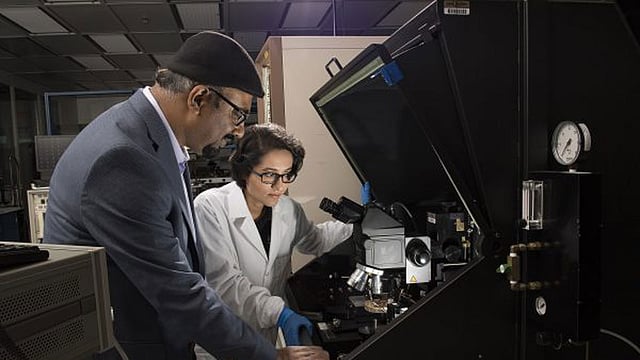
A Bangladeshi American professor at Purdue University in USA has created a new type of electronic sensor that might be used to quickly detect and classify bacteria for medical diagnostics and food safety, said The American Bazaar on Monday.
Muhammad Ashraful Alam, Jai N Gupta professor of electrical and computer engineering at the university, is working with a doctoral student Aida Ebrahimi.
The American Bazaar, an online publication that covers the Indian and South Asian American community, came up with a report styled, “Bangladeshi American Prof. at Purdue creates electronic sensor that tells dead bacteria from live” on 13 June.
According to the report, findings of the invention are detailed in a research paper appearing this week in Proceedings of the National Academy of Sciences.
The online report added that discovery has passed a key hurdle by distinguishing between dead and living bacteria cells.
Conventional laboratory technologies, according to the report, require that samples be cultured for hours or longer to grow enough of the bacteria for identification and analysis to determine which antibiotic to prescribe.
The new approach might be used to create arrays of hundreds of sensors on an electronic chip, each sensor detecting a specific type of bacteria or pinpointing the effectiveness of particular antibiotics within minutes, according to Purdue, the report added.
“We have taken a step toward this long-term goal by showing how to distinguish between live and dead bacteria,” said Muhammad Ashraful Alam was quoted to have said.
“This is important because you need to be able to not only detect and identify bacteria, but to determine which antibiotics are effective in killing them,” he also was quoted to have said.
The paper was authored by doctoral student Aida Ebrahimi and Alam. The droplet sensor evolved from a device originally designed to detect small concentrations of negatively charged DNA molecules in research that began about four years ago, Ebrahimi said.
“To see if someone is alive,” Alam was quoted to have said, “We can either count the grandchildren many generations later, which is analogous to the traditional growth-based techniques. Or, we can directly measure the person’s pulse, analogous to the proposed ‘osmoregulation-based’ detection of bacteria. Needless to say, immediate physiological measurement is faster and far superior.”