Handicrafts play second fiddle
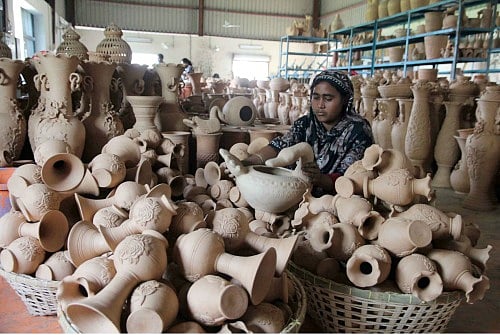
With the arrival of Pahela Baishakh marked by traditional reds and whites, it has been a day of indulgence with a clay bowlful of panta-ilish, all in the name of Bangaliyana.
While the fashion houses and hilsa traders are having their heyday with this celebration, handicrafts, a key aspect of Bangladeshi culture, has ended up being as an add-on to the Baishakhi shopping, an afterthought.
Handicrafts, a major source of income for many rural women, is trying to redeem itself with Pahela Baishakh after a heavy blow it was dealt with during the recent political unrest.
Customers are purchasing handicraft items mostly to complement their Baishakhi attires.
"Baishakh essentially increases sales, but the handicraft items are not the first preference for the customers. They come here looking for nakshi saree, kurta, kameez with traditional motifs, and buy one or two handicraft items that may catch their fancy," said Rita Singha Ray, a sales representative at the Kawran Bazar showroom of Karupalli, a traditional rural craft sales centre run by Bangladesh Rural Development Board (BRDB).
Handmade clay ornaments and jute bags, too, have good demand among girls and women who want to accessorise their Baishakhi attire, she said.
A few customers are also buying stitched and well-designed bed sheets, pillow and cushion covers, wall mats, fabric dolls, jute coasters and many other decorative pieces to give their homes a festive look on and around the day of Pahela Baishakh.
The sales persons and women entrepreneurs at Joyeeta, a showroom at Dhanmondi Rapa Plaza where grassroots-level women entrepreneurs and women organisations showcase and market handicraft products, have almost the same story. The showroom is maintained by the Ministry of Women Affairs and Children Welfare.
There, Ayesha, a sales representative of Banani Mahila Samity, said along with clay ornaments, bags have a good demand during the Baishakh festival. “Bags made up of jute, wool, beads and threadwork, are very popular among young women, mostly students,” she said.
“Baishakh brings business, but mostly for those who are selling dresses and sarees,” said Sajeda Begum, proprietor of Sanjibani Handicrafts and Boutiques. She has a collection of pottery and clay utensils in Stall-A 38 at Joyeeta. “We are selling 52-piece dinner sets at Tk 3500, but only a few enthusiasts buy these items," she said.
Clay utensils can add a nice touch to the festive mood of Pahela Baishakh, said Sajeda. She mentioned that the recent political unrest has caused significant damage to their business.
“Due to the turmoil, a lot of our products were damaged and the supply chain was disrupted as well. We are still reeling from that loss,” she said.
A number of entrepreneurs and sales representatives say lack of promotion is holding back the local market of handicrafts, which have high potential abroad as well.
"During the trade fair this year, we got a very good response from customers. However, most of them didn't even know that we exist," an entrepreneur said.
However, there are a steady number of handicraft enthusiasts who are keeping the local handicraft business afloat, said a number of sales persons and entrepreneurs.
Sadia Jahan, a handicraft enthusiast and a regular customer at Joyeeta, said, "I prefer handicrafts not only because they are beautiful and inexpensive, but also because it helps in the empowerment women in the country."