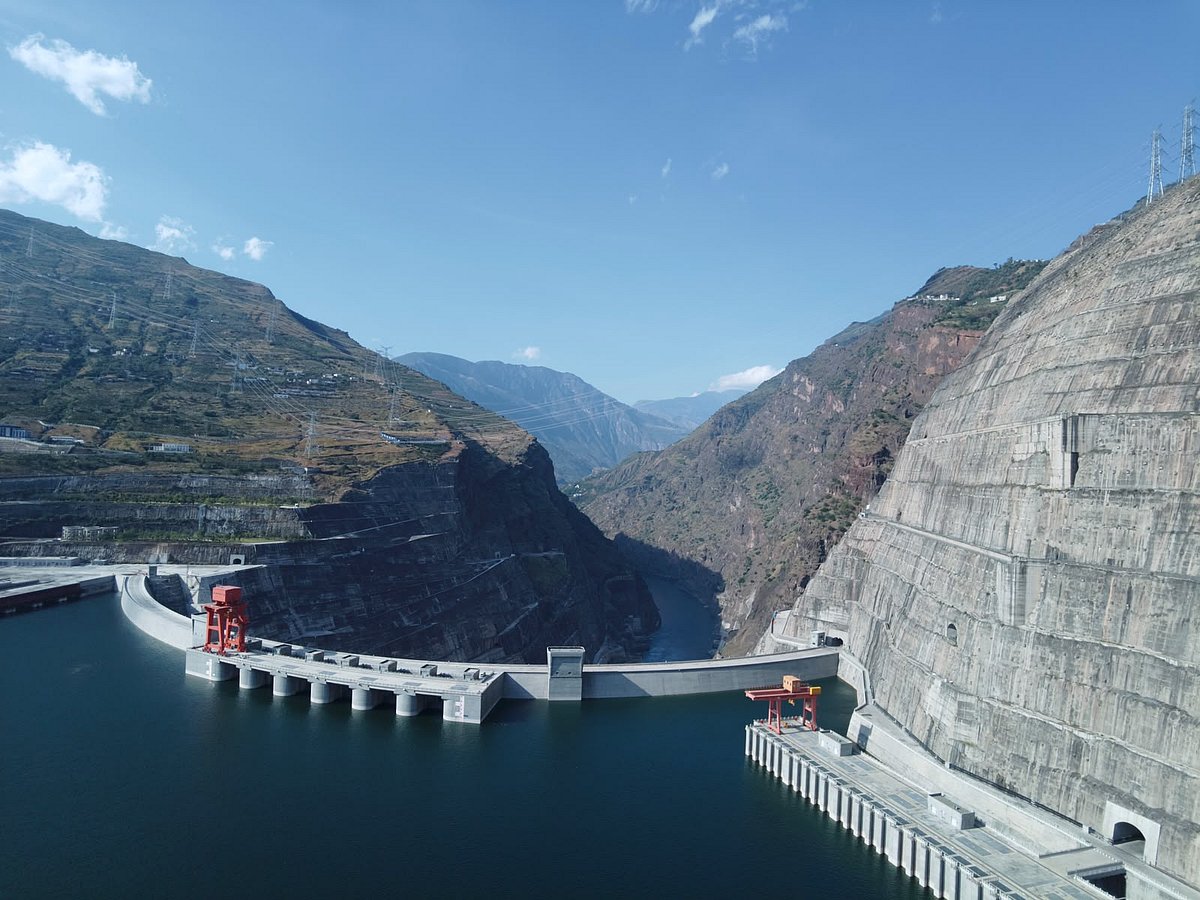
Wedged into a steep gorge on the Jinsha River, China’s Baihetan Hydropower Station had generated more than 250 billion kilowatt-hours (kWh) of electricity by June 2026, according to its operators. They call it the world’s largest clean energy corridor, one that has met the household demand of 75 million people.
“This is the largest clean energy corridor of the world, which met the household demand of 75 million people,” Luo Yuanwang, Shift Supervisor of Shift 1 in the station’s Operations Department, told Prothom Alo on Wednesday.
Electricity generation is the main purpose, but the station also provides flood control and navigation benefits and supports economic and social development in the surrounding region
Luo spoke during a visit by this correspondent to the project. He said the station’s annual generating capacity is around 62 billion kWh and that about 400 people currently work there.
Location and purpose
Baihetan sits on the border of Ningnan county in Sichuan province and Qiaojia county in Yunnan province. It is the second of four hydropower stations in the downstream cascade of the Jinsha River. It comes after Wudongde, about 182 km upstream, and before Xiluodu, 195 km downstream, and Xiangjiaba. The project controls a catchment area of 430,300 square kilometres, 91 per cent of the Jinsha basin upstream of the dam site.
Electricity generation is the main purpose, but the station also provides flood control and navigation benefits and supports economic and social development in the surrounding region. The reservoir holds 20.627 billion cubic metres of water in total. Of this, 10.436 billion cubic metres is regulating storage and 7.5 billion cubic metres is reserved for flood control.
The numbers
The station has an installed capacity of 16,000 megawatts (MW) and a design average annual output of 62.443 billion kWh. Its guaranteed output is 5,500 MW.
The centrepiece is a concrete double-curvature arch dam, 289 metres high at its maximum, with a crest elevation of 834 metres. Flood-discharge and energy-dissipation facilities include six surface outlets in the dam body, seven deep outlets and three flood-discharge tunnels on the left bank.
The underground powerhouses are arranged symmetrically on the two banks. Each houses eight 1,000 MW Francis turbine-generator units, 16 in all.
From planning to power
The project took decades. Preliminary work began in 1991, and China’s National Development and Reform Commission approved preparatory work in October 2010. The Sichuan and Yunnan provincial governments issued their construction approvals in December 2010 and January 2011. The China Three Gorges Corporation began preparations in June 2011, and the river was closed off in November 2015.
Concrete placement for the main dam started in 2017. Reservoir impoundment began in 2021, and the first generating units went into operation the same year. All units were commissioned by December 2022, and the project was completed in June 2023.
Building in a difficult landscape
The site posed formidable challenges, according to project documents. Air temperatures there can reach 43 degrees Celsius, ground-surface temperatures approach 70 degrees, and winds can reach Beaufort Force 13.
The dam sits in an asymmetrical V-shaped valley, which made planning and layout exceptionally difficult. For the first time, engineers built a dam foundation on columnar-jointed basalt, a hard, brittle and highly fractured rock.
The underground powerhouse complex has the largest cavern span in the world, making the stability of the surrounding rock a major concern. The hub area also faces risks from landslides and debris flows. The project required stringent seismic design and fortification.
Clean energy push
Officials and operators at the site present Baihetan as a symbol of China’s push towards large-scale clean energy. Hydropower of this scale, they say, supplies stable, low-carbon electricity to distant load centres while also helping manage floods on one of the country’s major rivers.
Luo Yuanwang, Shift Supervisor of Shift 1, Operations Department of Baihatan Hydropower Station told Prothom Alo on Wednesday: This is the largest clean energy corridor of the world which met the household demand of 75 million people. With the annual capacity 62 billion kilowatt, until June 2026, the cumulative power generation exceeding 250 billion kilowatt.
While talking to him during the visit of the Baihetan Hydropower Station, he told this correspondent that currently some 400 people working in the project.
Project overview
Baihetan Hydropower Station is the second of the four hydropower cascade projects downstream of the Jinsha River, following Wudongde and preceding Xiluodu and Xiangjiaba. It is located in Ningnan county, Sichuan province, and Qiaojia county, yunnan Province, approximately 182 km from Wudongde and 195 km upstream of Xiluodu Hydropower Station. The project controls a catchment area of 430,300 km², accounting for 91 per cent of the Jinsha River basin upstream of the dam site.
The primary purpose of Baihetan Hydropower Station is electricity generation, while also serving flood control and navigation functions and promoting local economic and social development. The reservoir has a total storage capacity of 20.627 billion m³, including 10.436 billion m³ of regulating storage and 7.5 billion m³ of flood-control storage. The power station has an installed capacity of 16,000 MW, with an average annual power generation of 62.443 billion kWh and a guaranteed output of 5,500 MW.
The project’s major structures comprise the river-blocking dam, flood-discharge and energy-dissipation facilities, and the water-conveyance and power-generation system. The dam is a concrete double-curvature arch dam, with a crest elevation of 834.00 m and a maximum height of 289.00 m. Its foundation includes a cushion slab and two auxiliary dams. The flood-discharge and energy-dissipation facilities consist of six surface outlets in the dam body, seven deep outlets, and three flood-discharge tunnels on the left bank.
The underground powerhouse is symmetrically arranged on the left and right banks, with each powerhouse containing eight 1,000 MW Francis turbine-generator units. During construction, diversion through tunnels was maintained throughout the year.
In October 2010, the National Development and Reform Commission (NDRC) approved preliminary work on Baihetan Hydropower Station. In December 2010, the Sichuan Provincial People's Government issued the project’s construction approval document, followed by the Yunnan Provincial People's Government in January 2011.
In June 2011, China Three Gorges Corporation began preparatory work for the project. River closure was achieved in November 2015. Concrete placement for the main dam began in April 2017, and reservoir impoundment was scheduled to begin in May 2021. The first generating unit was commissioned in July 2021, and the project was completed in June 2023.
Baihatan Hydropower Station stats
• Construction milestones and challenges: Perseverance over half a century, building a major national project
* 1991: Preliminary work on Baihetan Hydropower Station commenced in full.
* October 2010: The National Development and Reform Commission (NDRC) approved preliminary construction activities for Baihetan Hydropower Station.
* August 2017: Full-scale construction of the main works commenced.
* May 2021: Concrete placement for the main dam was completed to the crest, and reservoir impoundment began.
* June 2021: The first batch of generating units was commissioned.
* December 2022: All generating units were commissioned.
• Harsh natural conditions, complex geology and formidable construction challenges
* Complex climatic conditions: The project site experiences extreme weather, with maximum air temperatures reaching 43°C, ground-surface temperatures approaching 70°C, and maximum wind forces reaching Beaufort Force 13.
* Steep terrain at the dam site: The site lies within an asymmetrical V-shaped valley, making project planning and layout exceptionally difficult.
* Unprecedented foundation geology: For the first time, a dam foundation was constructed on columnar-jointed basalt characterized by hard, brittle and highly fractured rock, making excavation relatively easy.
* World-leading underground powerhouse scale: The underground powerhouse cavern complex ranks first in the world in terms of span. Surrounding rock stability posed particularly significant challenges.
* High geological disaster risks: The project hub area faces substantial risks from geological hazards, including landslides and debris flows. The project is also subject to stringent seismic design and fortification requirements.