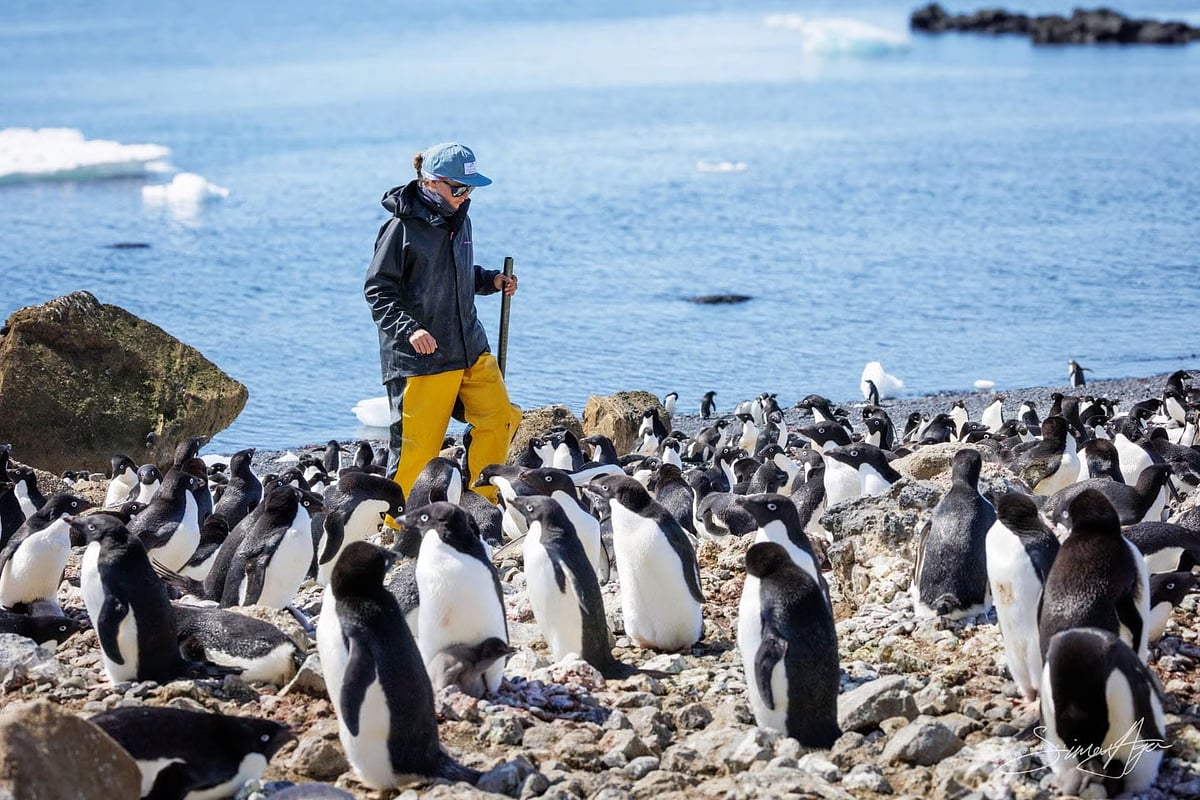
The UK-based organisation UK Antarctic Heritage Trust (UKAHT) recruits staff every year for this extraordinary job. Employees must travel to Port Lockroy in Antarctica during the southern summer.
Their duties include welcoming tourists, stamping postcards and counting penguins. Each year, the organisation selects a small team of just four or five people for the role.
The workplace is Goudier Island in the Palmer Archipelago. This small island is roughly the size of a football pitch and is covered entirely in rocks and ice. It is home to Port Lockroy, which the British established as a military base in 1944 as part of Operation Tabarin during the Second World War.
The base closed in 1962 and underwent restoration nearly 30 years later. Today, it is a protected historic site under the Antarctic Treaty System.
The site houses a small museum, a gift shop and a penguin post office. It is the southernmost operational post office in the world. Every year, thousands of tourists visit the island on cruise ships between November and March.
The selected team welcomes visitors, explains the history of the base, runs the gift shop and sorts and stamps more than 80,000 postcards each season.
The most enjoyable part of the job is counting penguins
Staff must keep a close eye on the gentoo penguins living on the island. According to UKAHT, around 1,000 penguins live there and have inhabited the island for more than 30 years.
The British Antarctic Survey (BAS), the UK's polar research institute, has carried out regular monitoring since 1996.
The main purpose is to monitor penguin breeding patterns and assess whether the presence of tourists has any adverse impact on the birds. Port Lockroy is the only place in Antarctica where researchers can study penguins throughout the entire breeding season.
Staff take great care to ensure that the penguins are not disturbed. During the first few weeks, they remain within designated boundaries. Once eggs appear in around 95 per cent of the nests, the entire team works together to count every penguin on the island.
In December 2024, they recorded 571 nests and 938 eggs. At the end of the season, they count the penguins again when the chicks have grown and begin moving around together in groups.
The counting process continues at regular intervals until two consecutive counts produce almost identical or closely matching results.
Salary and benefits: Everything you need to know
Salaries vary depending on the nature of the job. Alongside general assistant positions, there are also roles such as base manager and shop manager. Employees can earn between 1,700 euro and 2,500 euro a month, equivalent to approximately Tk 250,000 to Tk 350,000.
However, employees do not receive the entire amount as a straightforward salary. This is because those working there are classified as independent contractors or self-employed workers and receive payment based on their work.
They must therefore calculate and pay their own taxes in accordance with the relevant regulations. However, there is no need to worry about accommodation, food or protection against the extreme cold, as the organisation provides these free of charge, including the necessary warm clothing.
Living conditions on the island are challenging. There is no running water, so staff must carry drinking water in 20-litre containers from boats arriving from outside the island.
As a result, they can shower only once a week. If bad weather prevents boats from reaching the island, the team may have to go without a shower for up to two consecutive weeks.
Solar panels provide the island's only source of electricity. Consequently, staff cannot use power-hungry appliances such as hairdryers and microwave ovens.
There is also no conventional mobile phone network. For calls and communication, they must rely on limited-speed satellite internet or Wi-Fi provided by larger ships anchored nearby.
The island has a portable toilet facility, which staff must clean themselves every day. They sleep in bunk beds, while the temperature inside the barracks generally remains between 14 and 15 degrees Celsius. Outside, temperatures fluctuate between minus 5 and plus 5 degrees Celsius.
There is no upper age limit for applicants, but candidates must be at least 18 years old. A scientific academic background is not necessary either. However, applicants must be in excellent physical condition.
Daily duties include clearing snow and ice, unloading supplies from boats on slippery, rocky terrain and carrying heavy boxes weighing up to 15 kg.
Smoking is strictly prohibited on the island. Applicants must also be eligible to reside in the United Kingdom and hold valid permission to work there. Applications for these positions are expected to reopen early next year through the official website of the UK Antarctic Heritage Trust (UKAHT).
An opportunity to adopt a penguin from home
For those who cannot travel to Antarctica but love penguins and want to support them, UKAHT offers another wonderful opportunity. Anyone can adopt a gentoo penguin from the comfort of their home.
The special adoption package includes the opportunity to adopt a penguin for 12 months, a postcard sent from Antarctica, a cute penguin soft toy, an information booklet containing interesting facts, a welcome pack, an adoption certificate and regular updates about penguins at Port Lockroy.
All proceeds from this scheme go directly towards penguin care and conservation. The fund also helps cover the cost of sending a wildlife researcher to the island during the summer season.
Anyone can access all the research data on penguins through the Port Lockroy Data Portal.