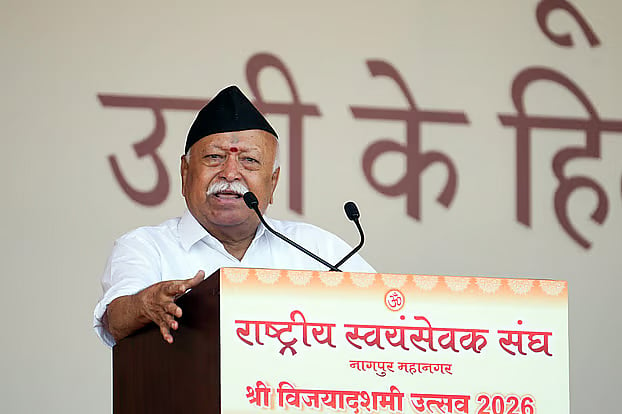
Firecrackers in the past did not pollute the environment. Instead, the smoke killed insects and purified the air, claimed Mohan Bhagwat, chief of India’s Rashtriya Swayamsevak Sangh (RSS).
Amid the ongoing debate over pollution during Diwali Mohan Bhagwat offered a "scientific explanation" for the importance of traditional festival rituals and the necessity of firecrackers.
Bhagwat made the remarks recently at a gathering in Nagpur, Maharashtra. RSS headquarters is also located there. Speaking at a Diwali get-together organised by the Maheshwari Panchayat, he indirectly defended the bursting of firecrackers through his statements.
At the event, Bhagwat said that ingredients used to make firecrackers in the past did not contain chemicals. They were natural and safe. The smoke from those crackers functioned as a pesticide, purifying the air by driving away insects, mosquitoes and flies, particularly during the monsoon and harvest seasons. He described the effect of the smoke as environmentally friendly.
Bhagwat also claimed there is scientific logic behind lighting lamps during Diwali. Lamps are lit with oil and ghee. The flames from burning oil and ghee create a layer of purified air in the surroundings. He described this air as beneficial to both the environment and human health.
Bhagwat added that "pure science" underpins the traditions practiced during festivals since ancient times. Lately, firecrackers are being blamed for environmental pollution alongside many other factors.
The National Green Tribunal, environmental experts and the environment ministry have all expressed concern over pollution. In particular, pollution levels in Delhi, rise sharply every year from November through the end of January, causing severe environmental damage. The Supreme Court has also favoured measures, including restrictions on firecrackers, to address the problem.
However, the Bharatiya Janata Party (BJP) has been opposing such measures for several years. Top party leaders have argued that the custom of bursting crackers during traditional Hindu festivals is an ancient, integral part of religious practice that must not be disrupted under any circumstances.
Yogi Adityanath, chief minister of BJP-ruled Uttar Pradesh, has also defended the use of firecrackers. He said bursting them for a few days during Diwali will not cause significant harm. Pollution might occur, he argued, but it would dissipate within two or three days.
Ahead of this year’s Diwali, Supreme Court judges also remarked that issuing directives which the police and administration cannot enforce is meaningless.
By citing historical practices to explain the supposed benefits of firecrackers through a scientific lens, Mohan Bhagwat appeared opposed to bans on firecrackers during Diwali and other Hindu festivals. Instead, he favored upholding traditional rituals, stating that festivals should be celebrated with an understanding of their true significance. This would benefit both people and the environment.
Bhagwat acknowledged that the materials currently used to manufacture firecrackers could be altered. However, he emphasized that festival celebrations will not stop despite hundreds of objections. He claimed that festivals keep society vibrant and energised. No one will be able to stop them, no matter how hard they try.
Courts have banned the use of loud firecrackers during Diwali and Kali Puja. Although the Supreme Court and environmentalists have advocated the use of “green crackers”, or less-polluting firecrackers, highly polluting varieties continue to dominate the market.
Efforts to curb their use have failed to make a significant difference. With the ruling party firmly backing firecrackers, initiatives to ensure cleaner air are being undermined.
Reports from the Central Pollution Control Board and the Indian Institute of Tropical Meteorology show that firecrackers were responsible for a sharp rise in fine particulate matter, including PM2.5, in Delhi's air between 1am on Diwali night and 9am the following morning.
Firecrackers accounted for 71.1 per cent of the pollution during that period. Two days earlier, on 7 November, their contribution to air pollution had been just 5.6 per cent. It rose to 43.4 per cent between the evening and night of 8 November, Diwali. By the morning of 9 November, it climbed to 71.1 per cent. On 10 November, the contribution of firecrackers fell to 29.8 per cent.
If the ruling party continues to defend firecrackers and the police and administration fail to stop the production and supply of polluting varieties, Delhi's air pollution is likely to remain severe during festivals.