Opinion
Pakistan-United States relations: Why Trump is sending “Thank You Pakistan” messages to Islamabad
When the slogan “Thank You Pakistan” rang out in the Iranian parliament, most Pakistanis were delighted. But after trade with Iran was halted, Donald Trump began sending “Thank You Pakistan” messages to Islamabad. Public discontent in Pakistan is evident as these tactically worded expressions of gratitude have sparked fresh tensions with its neighbour. Hamid Mir has written about the matter.
In June 2025, "Thank You Pakistan" slogans rang out in the Iranian Parliament. The reason was obvious: Pakistan had not only condemned Israeli aggression against Iran but also supported it at every international forum. Pakistan again played a key role in brokering a ceasefire between Iran and the United States in April 2026, and once more several Iranian TV channels aired Persian songs saying "Thank You Pakistan." Iranians waved Pakistani flags at anti-US rallies in Tehran. The two countries opened several border crossings to promote trade, but this love affair came to an end on 17 October 2026.
The newspapers of October 18 carried the troubling report that Pakistan had temporarily closed its border crossings with Iran, including Gabd-Rimdan. Gabd lies in Pakistani Balochistan and Rimdan in Iranian Balochistan, and the crossing is just 87 kilometers from Gwadar Port. A few months ago, when tensions between Iran and the United States disrupted trade through the Strait of Hormuz, traffic at Gwadar suddenly increased.
As Gwadar grew in importance, trade between Pakistan and Iran also began through Gabd and Rimdan. Iranian companies and traders started ordering goods to Gwadar, and from there the cargo reached Iran in two hours. The crossing was also busier because it was safer than the Taftan-Zahedan border.
Now a spokesperson for the Balochistan government says the crossing was closed because of the poor law and order situation and smuggling. Iran's Foreign Ministry gave a cautious statement, saying the border has been closed temporarily for "technical reasons." Reports indicate that the situation is the same at Taftan-Zahedan, and thousands of containers are stuck at both crossings. Trade routes between Pakistan and India, and between Pakistan and Afghanistan, were already closed. With Iran's routes now shut as well, Gwadar Port will suffer the most. The closure may also raise liquefied gas prices in Pakistan, as more than 4,000 tonnes of LPG were entering the country daily through Gabd-Rimdan.
Gwadar is only 400 kilometers from the Strait of Hormuz, through which 20 percent of the world''s oil trade passes. Tensions over Hormuz temporarily increased Gwadar''s importance, but sadly the Pakistani government seems to be struggling to sustain it. The port is needed not only by Iran but also by many countries of South Asia, Central Asia, and West Asia. In 2019, Saudi Arabia's Aramco expressed interest in building a ten-billion-dollar oil refinery here. The Saudi company wanted China to join the project as a partner, but the talks did not progress. The Chinese have been under attack in Balochistan since 2013, and Pakistan accuses India and Afghanistan of cross-border terrorism there. Pakistan shares more than 2600 kilometers border with Afghanistan and 900 kilometers border with Iran.
The Saudis wanted Chinese partnership in Gwadar to address security concerns, but China declined for several reasons, not least that it never wanted to offend Iran. Since the Iran-America war the refinery project has been stalled, and after the recent Houthi attacks on Saudi Arabia its prospects have diminished further. Gwadar is only 87 kilometers from Iran, and Pakistan is part of a joint defense alliance with Saudi Arabia and Turkey. Iranian-backed Houthis have targeted Aramco in Saudi Arabia many times. They could do the same in Pakistan.
Ever since work began on Gwadar Port under the China-Pakistan Economic Corridor (CPEC), terrorism in Balochistan has increased. Not just one enemy country is behind it; some friendly Gulf countries also have a hand, as they fear Gwadar's development will affect their own ports. To put an end to these conspiracies, Pakistan some time ago offered the United States the chance to develop Pasni Port, only one hundred kilometers from Gwadar. But US authorities seem more interested in the mineral wealth of Balochistan than in developing Pasni. The Makran coast has not only Gwadar and Pasni but also the ports of Jiwani, Ormara, and Sonmiani. Balochistan has both coastline and resources, yet because of bad governance and terrorism, no improvement in its situation is visible.
I still remember that when Dr. Shireen Mazari was head of the Institute of Strategic Studies Islamabad, President General Pervez Musharraf told us there that he was handing over the blue waters of Gwadar to China, and that it would now be for China and India to deal with each other. Former Foreign Minister Agha Shahi was not at all pleased to hear this. Puffing vigorously on his pipe, he told me that China was certainly our friend, but if Gwadar Port were handed over without an effective strategy, Balochistan would become a center of international conspiracies.
One great tragedy of Pakistan is that our rulers have no knowledge of the history of its provinces and important regions. History is deeply connected with geography, and if lessons are not learned from history, geography changes. Our rulers must read the history of Gwadar and the Makran coast. Sahil-e-Makran, by Professor Dr. Hameed Baloch of Lasbela University, Uthal, Balochistan, should be read by every policymaker and every student of history in Pakistan. This two-volume work is a treasure not only of knowledge but also of historical documents, which show that British forces used small airfields along the Makran coast to attack Japanese forces.
Many years ago, when I first went to Gwadar, the elders showed me their old passports issued by the Sultanate of Oman. Gwadar remained part of Oman until 1958, when, on 6 September, a weak political government under Malik Feroz Khan Noon paid three million British pounds to bring it into Pakistan. The Khan of Kalat, Nasir Khan I, had given Gwadar in 1783 to a rebel prince of Muscat, and later tried to take it back without success. The Omani government earned considerable profit from the taxes levied at Gwadar Port. The Khan of Kalat then reduced taxes at the ports of Pasni and Jiwani, which diminished Gwadar's importance, after which the British government began to consider handing Gwadar over to Kalat. Some British oil companies, unhappy with the rulers of Oman, also played an important role in this.
Dr. Hameed Baloch also writes that, after the creation of Pakistan, All India Radio one day broadcast a false report that the Khan of Kalat had decided to merge his state with India. The Khan, Ahmad Yar Khan, immediately sent a telegram to Viceroy Lord Mountbatten asking that the report be denied. Reacting to this false news, he decided to accede to Pakistan in March 1948, and with the accession of Kalat, Pasni and Jiwani also came under Pakistan's control. In 1954, the US Geological Survey declared Gwadar a great port of the future.
The Omani government wanted to hand Gwadar over to India, but India was then more interested in Goa. India took Goa by military action, while Pakistan acquired Gwadar from Oman through negotiation. The political government that brought Gwadar into Pakistan was removed within weeks, when General Ayub Khan imposed martial law in October 1958. Gwadar was incorporated into Pakistan, but the fortunes of Gwadar and Balochistan have not changed to this day. A few days ago the establishment imposed Governor's rule in Khyber Pakhtunkhwa to fight terrorism, yet the situation in Balochistan is worse than in KP.
The sudden decision to close the Gabd-Rimdan crossing has caused turmoil and uproar not only in Gwadar but all over Balochistan. The cries of Baloch businessmen have reached me through officials of the Gwadar Chamber of Commerce and Industry, but perhaps they have not reached the rulers in Islamabad. There is an impression that Pakistan closed its trade routes with Iran under American pressure. This closure may help the US, but it is definitely hurting Pakistan.
Remember: until there is stability on the Makran coast, Balochistan will not be stable, and if Balochistan is not stable, Pakistan cannot move forward. Pakistan should not act like a proxy of the US, nor become a source of pleasure for Israel. Tension between Pakistan and Iran will please Israeli Prime Minister Netanyahu. When "Thank You Pakistan" slogans were raised in the Iranian Parliament, the majority of Pakistanis were very happy.
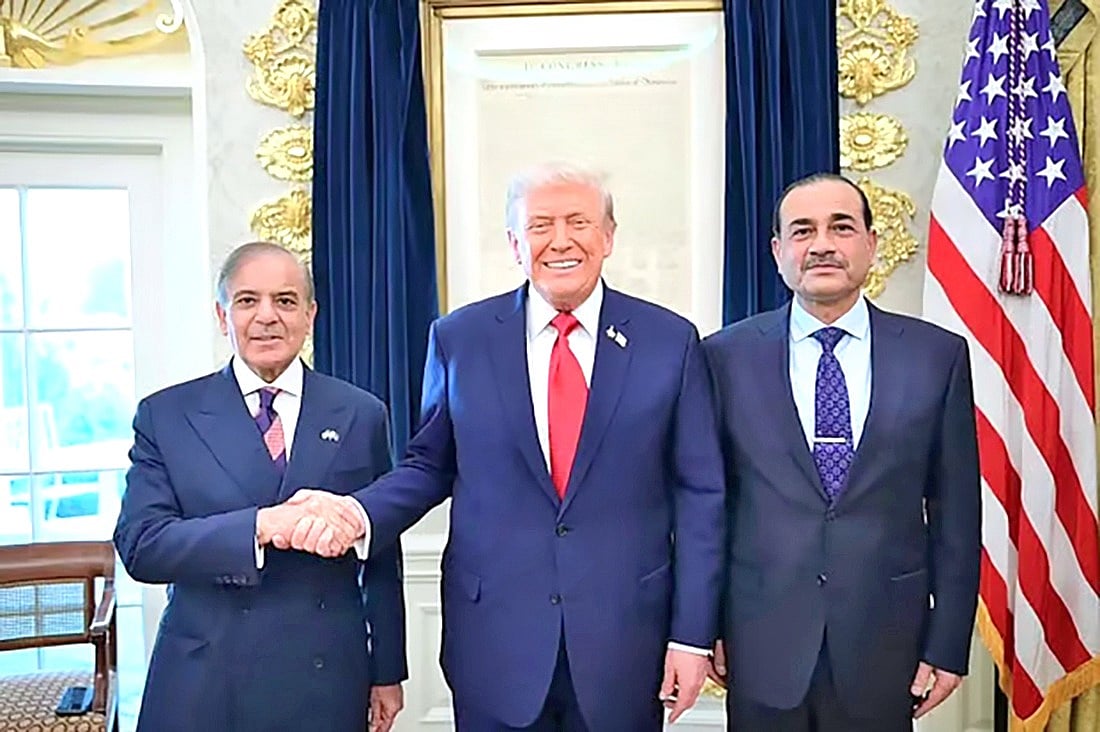
After the closure of trade with Iran, Donald Trump is sending "Thank You Pakistan" messages to Islamabad. We cannot hear this mischievous thank-you, but we can see the unhappiness in Pakistan over a new tension with another neighbor. Pakistanis were happy to mediate between Iran and US but they will not accept collaboration with US against Iran. I hope that recent visit of Pakistani head of the Armed Forces Field Marshal Asim Munir to Iran will remove misunderstandings between the countries and Pakistan will restrict only to a mediator.
*Hamid Mir is a Pakistani journalist.
#The opinions expressed here are the author's own.