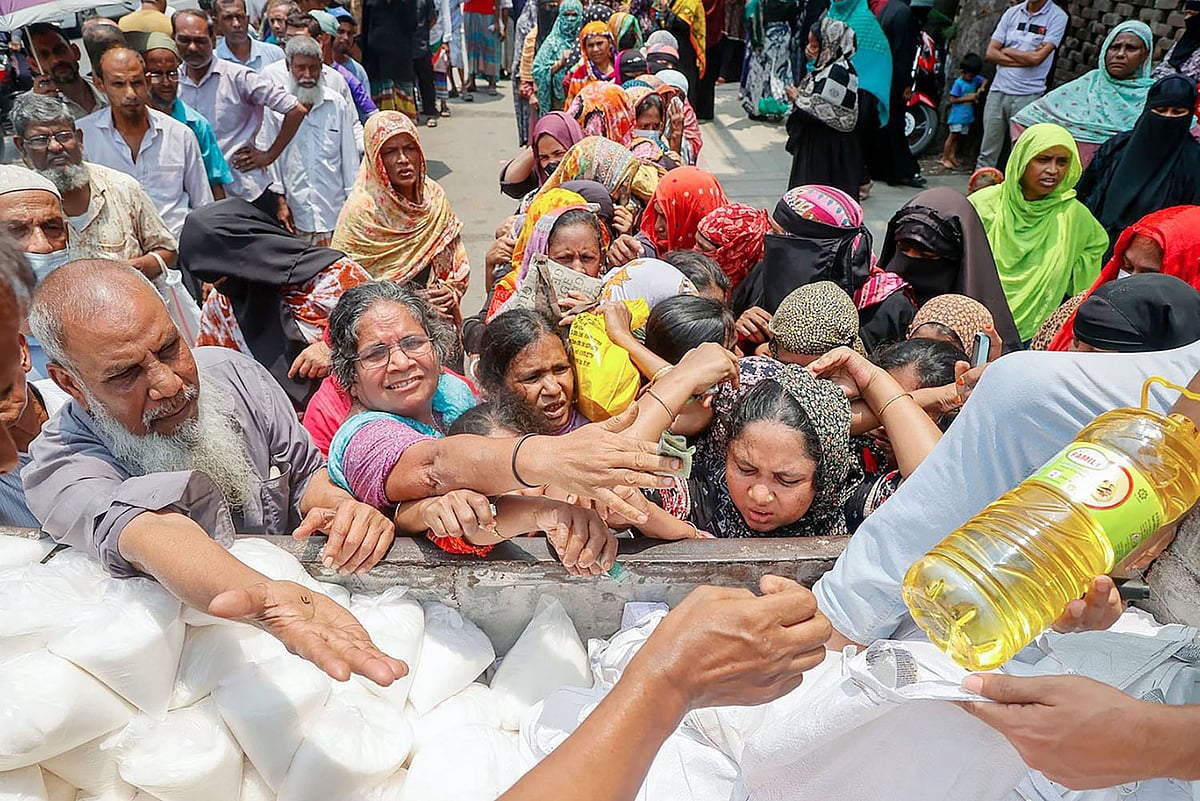
A recent report published in Prothom Alo was titled, "Stockpiles of Rice and Wheat are High, but Distribution has Decreased." It wouldn't be wrong to call this concerning. In a developing country like ours, the government essentially needs to strengthen its food stockpile system for two main reasons. On one hand, food needs to be distributed at subsidised prices or, in some cases, free of charge to low-income people in society. On the other hand, to prevent a drop in prices during the harvesting season, the government has to purchase crops from farmers at incentive prices and store them.
The report mentions that the distribution of food has decreased primarily because the TCB's (Trading Corporation of Bangladesh) truck sales have been suspended for some time, leading to increased stockpiles. Since the storage capacity in government warehouses is limited and cannot be increased overnight, the quantity collected this Aman season will be significantly less compared to the previous season. It goes without saying that if the distribution system is not operational alongside collection, it puts pressure on the stockpile situation.
To build silos, CSD (Central Storage Depot), and LSD (Local Supply Depot) for stocking food grains, land with access to waterways, roads, highways, and railways is essential. In Bangladesh, alongside the rising land prices, there is a shortage of such suitable land.
Several silo construction projects taken during the past Awami League government's tenure were financed by the World Bank. For some of these projects, the site selection was not proper. For instance, a steel silo was constructed in Madhupur, where there is no facility for communication via waterway or railway. The interim government had to accept responsibility for nearly completed projects during the previous government's tenure.
However, those who determined the location for such installations may find self-satisfaction, and the associated contractors and individuals may profit more, but a considerable amount of electricity is required to keep these operational. Additional funds are needed for goods transportation and storage. The current government canceled such a project in Naogaon, taken by the previous government, and decided to construct a CSD there instead. In other parts of the country as well, the construction of these structures, repair of current structures, and in some cases, reconstruction is required.
Currently, our capacity to store food is close to 2.4 million tonnes, with constraints on increasing this capacity quickly. However, it will increase slightly once several ongoing projects are completed. We must keep this limitation in mind when considering our collection and distribution system.
One could now examine the sectors where food distribution takes place. Primarily, organisations like the police and military are regularly under the rationing system. There has been a long-standing demand to include lower-level employees of the civil administration in this system. However, the recent rise in salaries for all classes of employees has increased government expenditures significantly. Expanding this sector at this time would not be logical; rather, there is scope for significant expansion in sectors like OMS (Open Market Sale), the Food-Friendly Programme, Food for Work, VGF, and self-employment initiatives for women.
The OMS programme is managed by two institutions—the Directorate General of Food and TCB. The news of TCB's activities being halted for a few months is disheartening. It could be considered urgent to restart this and further expand the ongoing activities of the food department. Under these programmes, consumers get rice at Tk 30 per kg and flour at Tk 22 per kg. Similarly, the Food for Work and VGF programmes can also be expanded, operated by the Ministry of Disaster Management and Relief.
It should be noted that regardless of which ministry or agency has food-related programmes, if included in their budget, the responsibility of food supply lies with the food department. Assistance is provided in the VGF sector during the two Eids and Durga Puja. The expansion of this programme is necessary to support the poor population due to population growth and inflation.
Public Food Distribution System (PFDS)—the main activity—includes the Food-Friendly Programme. Under this programme, beneficiary families receive 30 kg of rice per month at a rate of Tk 15 per kg.
After the uprising in August 2024, the scope of the Food-Friendly Programme was slightly expanded. Previously, 5 million families were provided with assistance for five months. In 2025, arrangements were made to provide assistance to 5. 5 million families for six months. A policy decision of the Social Security Advisory Council Committee in January 2026 was to increase the number to 6 million beneficiaries. However, after a change in government, it was not possible to implement it.
We understand the government's financial constraints. The government is also setting up a social safety net called "Family Card". It's a good initiative. It will require substantial expenditure. The Food-Friendly Programme could be connected to it even if its name is changed.
If that happens, the programme's expansion would be possible. Increasing the supply of rice and flour under various programmes like this would help ensure food security for low-income people. Beneficiaries would be better protected against the risk of falling below the poverty line due to inflation. Increasing the supply of rice and flour in the government's distribution programmes would also reduce the pressure to purchase these items from the market, keeping prices stable. This would reduce the chance of private millers, wholesalers, or retailers hiking prices suddenly.
However, increasing the amount of such food distribution gradually will also increase subsidy expenses. Every country's government has financial limitations. So do we. We know that certain donor organisations are against such subsidies. However, many countries provide various types of incentives to keep food prices stable. We also need to provide them. For that, dependence on domestic and foreign loans needs to be slightly reduced, and the government has to be as conservative as possible regarding tax exemptions. Because we cannot reduce subsidies in our agriculture sector and food security. Of course, every government has always given importance to food security, and it remains ongoing.
Expanding the distribution system would also necessitate an increase in collection. Everyone related to agriculture will enjoy the benefits. If the prices of paddy and rice remain somewhat good, that would work as an incentive to increase production.
In conclusion, the necessity of expanding the PFDS is beyond debate. Similarly, doing so requires gradually increasing the existing storage capacity and extent. But we see that the current stockpile is becoming more of a hassle rather than a source of comfort. We are unable to collect the usual amount of food grains locally or from abroad. Because collection and distribution are interlinked matters. The current situation might risk food security for the extremely poor and poor population. On the other hand, a slump in the local collection campaign would harm producers. The hope is that the government will swiftly manage to overcome this crisis effectively.
#Ali Imam Majumder is former advisor to the interim government.
majumderali1950@gmail. com
*The opinions expressed here are the author's own.
#This article, originally published in Prothom Alo print and online editions, has been rewritten in English by Rabiul Islam