July Charter: Implementation recommendations to be submitted to govt Tuesday
The National Consensus Commission is set to submit its recommendations to the government on the implementation of the July National Charter on Tuesday.
“The formal handover of the recommendations will take place at 12:00 pm tomorrow, Tuesday, at the State Guest House Jamuna in the capital, in the presence of members of the Council of Advisers,” said the Chief Adviser’s Press Wing said on Monday evening.
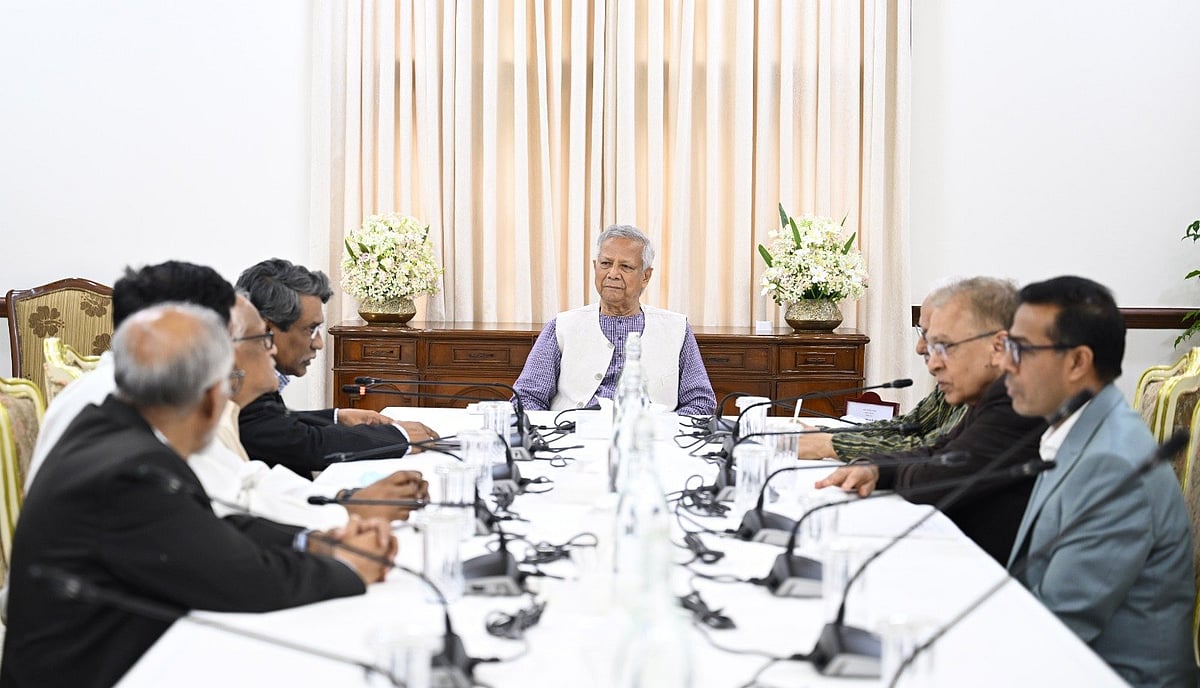
The development came at the concluding meeting of Consensus Commission held at the Jamuna this afternoon with Commission Chairman Chief Adviser Professor Muhammad Yunus in the chair.
Commission Vice-Chairman Professor Ali Riaz, members Justice Md Emdadul Haque, Iftekharuzzaman, Badiul Alam Majumder, Mohammad Ayub Mia, Safar Raj and Special Assistant to the Chief Adviser on National Consensus Building Process Monir Haider were present in the meeting.
At the meeting, the Chief Adviser emphasised the importance of preserving all documents, videos, audios, and photographs related to the commission’s activities-from its formation to the final recommendations.
“These are invaluable assets. As a nation, it is essential to preserve and be open to everyone in the long term to understand in what context and through what process, we reach what decisions,” Professor Yunus said.
All documents, including photographs, videos and correspondences, must be preserved and categorised properly, the Chief Adviser said, adding, all discussions broadcast live on television must be preserved in episodes.
These will serve as living historical records and vital resources for future researchers, he said, adding, “These documents will remain for generations to come. These documents will be at the center of future political discussions”.
All documents, including photographs, videos and correspondences, must be preserved and categorised properly, the Chief Adviser said, adding, all discussions broadcast live on television must be preserved in episodes.
Professor Yunus expressed gratitude to political parties, officials of the commission, researchers, and members of the media for their contributions to the commission’s work.
At the concluding meeting, the commission finalised its framework for implementing the July National Charter and urged the government to take measures to implement the recommendations that came from other reform commissions as well.
Noting that the National Consensus Commission has worked to lay the foundation for a “permanent, accountable state” in Bangladesh, Professor Ali Riaz said, the recommendations have been finalised for implementing the July National Charter following consultations with political parties, legal experts, judges, academics, and civil society representatives.
He said the structural reform was one of the three core responsibilities-justice, reform, and election-of the interim government formed after the 2024 July Uprising.
Despite differences, all political parties demonstrated a genuine willingness for reform. They always extended all-out cooperation to us. Day after day, they engaged in discussions with patience and prudenceProfessor Ali Riaz, National Consensus Commission vice-chairman
The key responsibility of the Consensus Commission was to chart a roadmap for reforms, Professor Riaz said, adding, “Despite differences, all political parties demonstrated a genuine willingness for reform. They always extended all-out cooperation to us. Day after day, they engaged in discussions with patience and prudence.”
“We should not lose the opportunity given to us by the students-workers-people’s uprising of July in 2024,” he said, adding, the commission prioritized reforms so that citizens can witness expected changes in future.
“With this, the commission has completed its responsibility . . . the commission’s tenure will expire on 31 October. However, if the government requires, we will continue to support you personally as citizens of this country,” the Vice-Chairman of the commission said.
Electoral Reform Commission Chairman and member of the Consensus Commission Badiul Alam Majumder said everyone expects the government to show commitment and courage in implementing the July National Charter.
“Required reforms should be ensured keeping in mind that so many lives were lost and so many were injured during the people’s uprising. We should not lose this opportunity,” he said.
Consensus Commission member Justice Md Emdadul Haque said, “The spirit of unity among political parties during the uprising was also reflected in meetings of the commission. That is a very positive sign.”
Police Reform Commission Chair and member of the Consensus Commission Safar Raj noted, “For the first time, political parties sat together and held discussions with patience. We hope this spirit of amity will continue in the future.”
Anti-Corruption Commission (ACC) Reform Commission chief and member of the Consensus Commission Iftekharuzzaman urged the government to take firm action to reform the Anti-Corruption Commission along with implementing the July National Charter.
Special Assistant to the Chief Adviser on National Consensus Building Process Monir Haider said, “The families of the martyrs we have spoken with all expressed the same concern—that without reforms, the sacrifices of their loved ones would be in vain. Their sacrifice is the foundation of these reforms.”