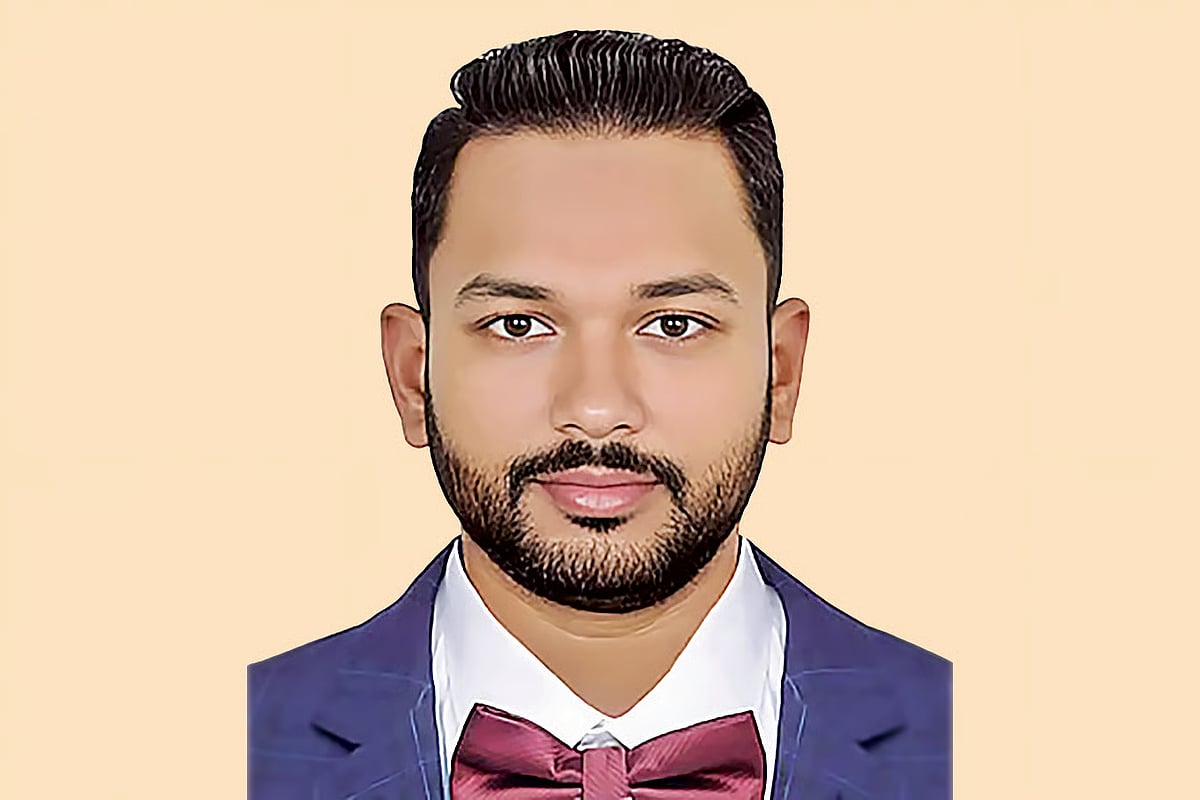
‘Shadow MP’ allegedly wields influence in Sonargaon-Siddhirganj
While the father serves as a government-party Member of Parliament (MP), the son reportedly exercises influence across the entire constituency.
He allegedly controls not only local party politics but also various sources of illegal income in the area.
He also faces allegations of establishing a monopoly over extortion linked to industrial establishments, the scrap material trade, control of development project tenders, extortion in the waterway and transport sectors, and illegal sand extraction.
The individual facing these allegations is Khairul Islam Sajib, son of BNP Member of Parliament Azharul Islam Mannan, who represents the Narayanganj-3 (Sonargaon–Siddhirganj) constituency.
He was detained by the Detective Branch (DB) of police on Sunday but was released approximately 12 hours later after obtaining a written undertaking. Police stated that they had detained him for questioning regarding “a number of allegations”.
Sajib, the MP’s son, had served as joint convener of the Narayanganj district Jubo Dal. Following his detention on Sunday, the organisation expelled him.
In a press release, the organisation stated that it had expelled him on the basis of clear allegations linking him to various irregularities.
Neither the police nor the organisation disclosed the specific allegations or irregularities. However, several local sources, including law enforcement agencies, said that allegations of extortion involving industrial establishments spread across large parts of Sonargaon and Siddhirganj prompted the authorities to detain Sajib.
Owners of several major industrial enterprises also conveyed the same allegations to Prothom Alo.
Over the past several days, these reporters investigated the extent of the MP’s son’s sphere of influence through field visits and discussions with various sources.
During this period, they spoke with local residents, businesspeople, individuals associated with industrial enterprises, and 25 BNP leaders and activists from different organisational levels in Sonargaon and Siddhirganj. For security reasons, most of them agreed to speak only on condition of anonymity.
A senior leader of Narayanganj district BNP told Prothom Alo, “No one has been able to control Khairul Islam Sajib. Although his father is the MP, he has effectively become a ‘shadow MP’ in Sonargaon and Siddhirganj. News of his detention initially brought relief among local residents. However, many were surprised when the authorities later released him.”
Over the past several days, these reporters investigated the extent of the MP’s son’s sphere of influence through field visits and discussions with various sources. During this period, they spoke with local residents, businesspeople, individuals associated with industrial enterprises, and 25 BNP leaders and activists from different organisational levels in Sonargaon and Siddhirganj.
However, Mamun Mahmud, convener of Narayanganj district BNP, told Prothom Alo, “The party has taken organisational action in response to the allegations raised against Sajib. If law enforcement agencies believe that he has been involved in any criminal offence, they may take action in accordance with the law.”
Meanwhile, reporters asked district police why authorities had released Sajib despite the allegations of extortion.
Tarek Al Mehdi, additional superintendent of police in Narayanganj told Prothom Alo, “There are a number of allegations against Sajib, but no one has submitted a written complaint or filed a case. As a result, we could not take legal action against him.”
Several sources within the upazila administration stated that, despite holding neither an elected public office nor any government position, Sajib regularly attends monthly law-and-order meetings and development coordination meetings held at the office of the upazila nirbahi officer (UNO).
He reportedly speaks at these meetings and offers opinions on various matters. Local administrators have also continued to receive all messages from the local Member of Parliament through his son.
However, Sonargaon upazila nirbahi officer Asif Al Jinat told Prothom Alo, “The upazila coordination committee has not yet been fully constituted. As there is no formally established committee, various prominent local individuals attend the meetings. Khairul Islam Sajib participates in the meetings as one of those individuals.”
How they became influential
Local residents said that Azharul Islam was once involved in the sand extraction business. He later left that trade and entered the land buying and selling business.
Subsequently, he became involved in BNP politics. In the mid-1990s, he became general secretary of Sonargaon upazila BNP and currently serves as the president of the upazila unit.
During the previous Awami League government, he also served one term as upazila chairman. He later won election as a Member of Parliament under his party’s nomination in the 13th parliamentary election.
BNP leaders and activists said that throughout the Awami League’s long period in power, Azharul Islam maintained contact with local party leaders and activists and provided financial assistance to many of them.
However, following the fall of the Awami League government during the mass uprising of 2024, local residents began to view his family in a different light.
They alleged that on the day Sheikh Hasina’s government fell, followers of Azharul’s son, Sajib, took control of the Meghna Bridge toll plaza. They reportedly collected toll money from transport operators for four consecutive days.
A leader of Sonargaon upazila BNP told Prothom Alo that Sajib began expanding his influence after 5 August 2024.
In addition to intervening in various factories and business establishments, he allegedly started exerting pressure on individuals and party leaders and activists whom he regarded as opponents.
According to the same source, Sajib became even more reckless after his father was elected as a Member of Parliament. His followers subsequently established a powerful network across Sonargaon and Siddhirganj. Allegations suggest that many BNP leaders and activists also became marginalised as a result.
Momtaz Begum, a former reserved-seat member (female member) of Pirojpur Union Parishad in Sonargaon upazila, alleged that followers of Sajib seized her 23 per cent plot of land, including her four-storey house, in the Protaper char area after 5 August 2024.
She claimed that they targeted her because she refused to sell the property to a company.
Momtaz Begum said, “They did not just seize our house; they left us destitute. We now have to live in rented accommodation. They have filed one case after another against my husband, Tamiz Uddin, and my two sons, Mahbub and Mujibur. They are now trying to seize more of our land.”
Two local BNP leaders, speaking to Prothom Alo on condition of anonymity, said that the incident involving the seizure of Momtaz Begum’s house had embarrassed them.
They claimed that authorities or influential groups had filed cases against dissenting individuals and party leaders and activists, carried out attacks, and applied various forms of pressure. They also alleged that several senior leaders had become victims of attacks.
Wahid Bin Imtiaz, former vice-president of the Central Committee of Jatiyatabadi Swechchhasebak Dal, told Prothom Alo that he had been interested in contesting the parliamentary seat from the Sonargaon–Siddhirganj constituency. This led to a dispute with Azharul Islam and his son.
As a consequence, he alleged, authorities named him as an accused in robbery and looting cases. He said, “I am an associate professor at a college. I have a reputation in the area. Yet they turned me into a robber.”
A senior local BNP leader alleged that, following the election, Sajib’s followers openly assaulted and abused individuals in front of the Sonargaon upazila office.
Several party leaders and activists, speaking to Prothom Alo on condition of anonymity, said that the office had originally been established in the name of the Narayanganj district BNP and remained open to all party members. In their view, rebranding it as the office of a single individual constituted a breach of political etiquette.
Local residents further alleged that several influential groups operate across different unions and municipalities in Sonargaon upazila under the leadership of individuals close to Sajib.
Prothom Alo visited various areas of Mograpara union and spoke with local residents as well as BNP leaders and activists.
According to them, a group led by Ataur Rahman, joint secretary of Sonargaon thana BNP and widely regarded as a close associate of Sajib, has been exerting influence in the area.
Since 5 August 2024, that group has faced allegations of extortion, land grabbing, and collecting money through informal arbitration processes.
In response to these allegations, a joint force detained Ataur Rahman in late September 2024.
However, Ataur Rahman told Prothom Alo that the detention resulted from a misunderstanding and that he had no involvement in any criminal activity.
Reporters attempted to contact Sajib by mobile phone and WhatsApp for three consecutive days, from Monday until Wednesday, to obtain his comments regarding the allegations against him.
His mobile phone remained switched off. Although a message sent via WhatsApp was delivered, he did not respond.
Reporters also made several attempts to obtain a statement from Member of Parliament Azharul Islam. Most recently, they called his mobile phone at 3:32 pm on Wednesday.
The person who answered said, “The honourable MP is busy in a meeting. He will be free after the evening.”
Reporters later called his mobile phone and WhatsApp and sent multiple messages after the evening, but he did not respond.
Takeover of BNP office
Another example of internal party unease regarding the influence of Khairul Islam Sajib and his father, Member of Parliament Azharul Islam Mannan, emerged over the Narayanganj BNP office.
On 10 January, party leaders inaugurated the district BNP office in front of the Adamjee Moon Light Cinema Hall in Siddhirganj.
The office displayed photographs of Narayanganj District BNP Convener Mamun Mahmud and the district’s four Members of Parliament.
On the morning of 18 June, followers of MP Azharul Islam removed the office signboard and replaced it with a new one bearing the words, “Siddhirganj thana office of the honourable member of parliament, Narayanganj-3.”
At the same time, they removed the photographs of the other three Members of Parliament and retained only the photograph of Azharul Islam.
Several party leaders and activists, speaking to Prothom Alo on condition of anonymity, said that the office had originally been established in the name of the Narayanganj district BNP and remained open to all party members.
In their view, rebranding it as the office of a single individual constituted a breach of political etiquette.
Party sources said that the issue came to the attention of central BNP leaders after Prothom Alo published a report on the incident on 18 June.
Two days later, in the early hours of 20 June, workers restored the original district BNP signboard and reinstated the photographs of the three Members of Parliament that had been removed.
Narayanganj District BNP convener Mamun Mahmud told Prothom Alo that the office had been established as the district BNP office and would continue to operate in that capacity.
Influence in industrial areas and extortion
According to local industrialists and businesspeople, Sajib’s influence became even more visible after his father was elected as a member of parliament.
They alleged that he began exerting pressure on various industrial establishments from Kanchpur to Sonargaon. In some instances, groups allegedly stopped trucks carrying factory goods in order to demand money.
Local sources also stated that several networks have emerged around the scrap materials trade, the sale of discarded factory materials (waste products), goods transportation, and various supply contracts in the Meghna Industrial City, Kanchpur BSCIC Industrial Estate, and areas adjacent to the Adamjee Export Processing Zone (EPZ). Allegations suggest that Sajib acts as a patron of these networks.
Prothom Alo spoke with at least 10 individuals associated with various industrial enterprises. They stated that Selim Hossain (Dipu), personal secretary (PS) to MP Azharul Islam; Md Jalil, secretary for Volunteer Affairs of Sonargaon thana BNP; and BM Dalim, former joint secretary of Kanchpur Union Jubo Dal, worked as Sajib’s associates in collecting extortion payments from industrial establishments.
However, Selim Hossain and Md Jalil told Prothom Alo that they had no involvement in extortion and that Sajib was likewise not involved in any extortion activities.
An official of an industrial enterprise, who requested anonymity for security reasons, said that companies face various forms of pressure if they attempt to award scrap-related or transportation contracts outside the preferred groups.
A senior official of another industrial enterprise alleged that Sajib had collected Tk 3 million (30 lakh) in extortion from their company.
According to the official, the company initially refused to pay, but Sajib later obtained the money through threats of attacks and intimidation.
River-based extortion and sand trading
Local residents have accused Sajib and his close associates of collecting extortion payments from fishing boats, sand-laden trawlers, and other vessels operating on the Meghna River.
They also claim that an organised group actively carries out these activities. On 25 June last year, River Police conducted operations at various checkpoints along the Meghna River and arrested 11 individuals.
River police officials said that the arrested individuals had spent a long period forcibly collecting money from fishing boats, sand-carrying trawlers, and various watercraft.
Among those arrested were Ali Noor, a cousin of MP Azharul Islam and a member of Sonargaon BNP, and Hasan Bashir, a member of the Pirojpur union Swechchhasebak Dal.
Sajib also faces allegations of controlling the loading, unloading, handling, and transportation of sand, stone, and other cargo transported by vessels through the landing station operated by the Bangladesh Inland Water Transport Authority (BIWTA) in Kanchpur.
Local residents further stated that illegal sand extraction has continued for a long period in the Meghna River near Anandabazar Market in Baidyerbazar union of Sonargaon upazila. They allege that Sajib’s influence also lies behind these activities.
Allegations of tender manipulation
Local sources alleged that Sajib has also established control over tenders for development projects undertaken by the Sonargaon Folk Art and Crafts Foundation, the upazila administration, and various government institutions.
Several local contractors alleged that, in most cases, Sajib determines who will receive a contract even before the authorities invite tenders.
Most recently, although contractors purchased tender documents for the operation of a vehicle parking facility and a children's recreation centre at the Bangladesh Folk Art and Craft Foundation, none of them submitted a bid. Sunday was the deadline for tender submission.
Prothom Alo spoke with at least three contractors regarding the matter, including two BNP office-bearers. Speaking on condition of anonymity, they said that no one could submit a tender without the approval of MP’s son Sajib.
According to them, he decides who may submit bids. However, because police detained him last Sunday, no decision was made on the matter. Consequently, no contractor submitted a tender.
Sakhawat Hossain, assistant director of the Bangladesh Folk Art and Craft Foundation, told Prothom Alo, “We sold more than 50 tender documents. However, no tenders were submitted by the deadline. I do not know why no one submitted a bid.”
Local residents urge swift action
According to local BNP leaders, businesspeople, contractors, cultural activists, and several individuals associated with the administration, Sajib’s influence in Sonargaon and Siddhirganj now extends beyond BNP politics to include the local administration, industrial zones, waterways, and the resolution of local disputes.
Shahed Kayes, a cultural activist from Sonargaon, told Prothom Alo, “Sonargaon is one of the country’s most important archaeological and economic regions. If social and political instability increases in this area, it will affect both the lives of ordinary people and the local economy. The authorities need to take swift and effective action against those whose activities are creating instability. Otherwise, the situation may become even more complicated.”