On 16 September, a flash procession was held in Shyamoli, Dhaka, by the Awami League whose activities are currently banned. Several individuals were detained during the protest. According to police, another group of Awami League activists had prepared in advance and attempted to rescue the detainees by detonating crude bombs (cocktails).
As flash processions by the Awami League continue to increase across Dhaka, the attempt to forcibly free detainees has intensified pressure on the police. In response, top levels of the government and police hierarchy have instructed field-level officers to take proactive measures to stop such unauthorised gatherings.
The rising number of Awami League rallies has also been discussed in recent meetings at the home ministry and the police headquarters. Officials have pointed out not only weaknesses in police enforcement but also the high number of arrested individuals who are being released on bail. They believe many of those released are re-engaging in anti-government activities.
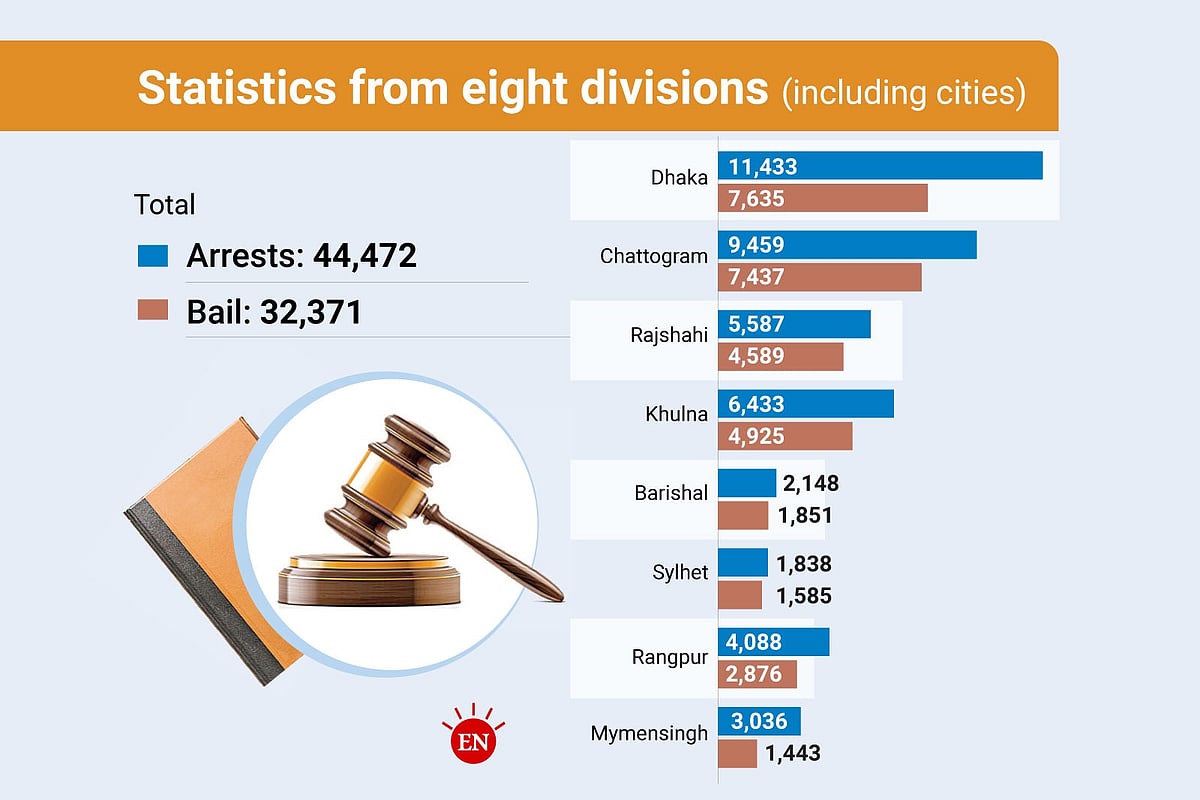
Against this backdrop, the police headquarters reviewed arrest and bail data from 5 August 2024 to 3 September 2025. A report titled 'Data on Arrests and Bail of Individuals Involved in Fascism' stated that 44,472 individuals had been arrested during this 13-month period. Of them, 32,371 received bail—about 73 per cent of the total.
According to police sources, these individuals were arrested under various cases related to the anti-discrimination student movement and anti-government activities following the fall of Sheikh Hasina’s administration.
Among those arrested are both former leaders and individuals accused of working as collaborators with the previous regime. Data was compiled from eight police ranges and eight metropolitan areas across the country.
The police headquarters does not have separate data on how many were arrested directly from Awami League flash processions, but the Dhaka Metropolitan Police (DMP) maintains its own records. According to DMP statistics, 97 cases have been filed under the Anti-Terrorism Act related to illegal protests and programmes organised by the Awami League, its affiliates, and the now-banned Chhatra League. These cases led to the arrest of 1,123 people, of whom 403 have already received bail. These figures date back to 23 October 2024, the day Chhatra League was officially banned.
The issue of flash processions and the rising number of bail grants was discussed in two recent meetings (14 and 21 September) of the core law and order committee under the home ministry. In light of this, on Wednesday, 24 September, after receiving intelligence about planned Awami League protests in Dhaka, police deployed forces in several locations and arrested 244 people during a flash protest. Security agencies now fear potential chaos in Dhaka in the coming days.
The repeated flash processions have also caused discomfort among senior police officials. Some believe the high rate of bail releases is making it increasingly difficult to control the situation. However, senior officials at the home ministry and police headquarters also acknowledge weaknesses in field-level police work, particularly in presenting sufficient evidence in court. They point out that without adequate documentation and proof, it’s not unusual for courts to grant bail. In some cases, there are even allegations of police making arbitrary arrests for personal gain or harassing innocent individuals as 'suspects'.
In the 14 September meeting, a four-member committee was formed to monitor the issue of bail. It is headed by a joint secretary of the home ministry and includes representatives from the law ministry, the attorney general’s office, and the police. The committee will investigate how individuals arrested under the Anti-Terrorism Act are obtaining bail so quickly.
One committee member, speaking anonymously to Prothom Alo, said: "Whether an accused person receives bail is up to the court. However, if genuine offenders are being released due to negligence by relevant authorities, we need to investigate that. The committee will examine weaknesses in police procedures, including the information submitted to court such as forwarding reports and other documentation."
Arrests and bail: Regional breakdown
Following the mass uprising in July, the Awami League government fell on 5 August 2024. At that time, almost all key leaders of the party went into hiding, with many fleeing the country. Despite this, law enforcement agencies arrested over 100 ministers, MPs, and central leaders from Sheikh Hasina’s 15-and-a-half-year regime. In addition, many grassroots leaders—at the district, sub-district, union, and ward levels—were detained.
There have also been reports of ordinary citizens being arrested and later labeled with party positions. Widespread allegations suggest that cases related to the July uprising were used to harass people by arbitrarily naming them as accused.
According to data from police headquarters, the Chattogram Range saw the highest number of arrests related to attacks and violence surrounding the uprising and post 5 August Awami League activities. Over a 13-month period, Chattogram reported 7,823 arrests, with 6,275 granted bail (80pc). The Sylhet Range reported the lowest number of arrests—1,398, of whom 1,174 (approx. 84pc) were released on bail.
Here is a breakdown of arrests and bail across the other six police ranges:
Dhaka Range: Arrested 7,355, bail 4,806 (65pc), Rajshahi Range: Arrested 5,018, bail 4,221 (84pc), Khulna Range: Arrested 5,992, bail 4,554 (76pc)
Barishal Range: Arrested 1,776, bail 1,555 (88pc), Rangpur Range: Arrested 3,891, bail 2,714 (70pc), Mymensingh Range: Arrested 3,036, bail 1,443 (48pc).
Metropolitan police data:
Among the country’s 8 metropolitan police departments, Dhaka Metropolitan Police (DMP) made the highest number of arrests related to 'involvement in fascism':
DMP: Arrested 3,856, bail 2,498 (65pc)
Rangpur Metropolitan Police: Lowest arrested: 197, bail 162 (82pc)
Chattogram Metropolitan Police: Arrested 1,636, bail 1,162 (71pc)
Khulna Metropolitan Police: Arrested 441, Bail 371 (84pc)
Rajshahi Metropolitan Police: Arrested 569, bail 368 (65pc)
Barishal Metropolitan Police: Arrested 372, bail 296 (80pc)
Sylhet Metropolitan Police: Arrested 440, bail 411 (93pc)
Gazipur Metropolitan Police: Arrested 672, bail 361 (54pc)
Among all 64 districts, the highest number of arrests occurred in Dhaka District, with 1,606 people detained—of whom only 385 received bail.
Concerns over arrest legitimacy and bail rates
Sources indicate that in many cases, field-level police are failing to arrest actual offenders. Some are said to be working carelessly or lacking proper oversight. As a result, many suspects are being arrested arbitrarily and falsely accused of being involved in 'fascist' activities. When these cases reach court, the lack of evidence often leads to the suspects being granted bail.
According to police headquarters spokesperson AHM Shahadat Hossain, Assistant Inspector General (Media & Public Relations), “The police are working with utmost sincerity when making arrests. However, bail decisions are entirely at the court’s discretion. There may be minor shortcomings in how evidence is presented, but there have been no major procedural deviations. Senior officers are regularly supervising these matters. After all, if actual criminals are released on bail and return to crime, it only increases the burden on the police.”
Lack of adequate evidence
Several public prosecutors from Dhaka courts have identified four main reasons for the high rate of bail among those arrested in connection to Awami League activities: Arrests made based on suspicion, not from active participation in programmes. Weak case reports submitted to courts after arrests. Failure to mention the political position or prior activities of the accused. No photographic, documentary, or official evidence (e.g., committee papers) linking the accused to the crimes.
Omar Faruq Faruqi, Chief Public Prosecutor of the Dhaka Metropolitan Sessions Court, told Prothom Alo, “Most of the accused are arrested as suspects, not directly from Awami League processions. In most cases, police submit vague or incomplete forwarding reports to the court. Without sufficient information, many of the accused are granted bail within two to three months.”
Proper filing and investigation of cases is essential
In most cases involving individuals who held significant positions during the past three governments and within the Awami League, bail petitions are being denied. However, there has also been criticism regarding the denial of bail in certain murder cases, where the accused were arrested despite weak or unclear links to the crimes. In such instances, asset investigations and corruption cases would have been more appropriate.
Human rights activists and legal professionals emphasise that bail is a citizen’s right until proven guilty. However, if someone is genuinely involved in a crime, it is important that the evidence is properly presented to the court.
Speaking on the issue, human rights activist Nur Khan said that many of the cases filed since 5 August of last year have involved the arbitrary arrest of ordinary people, often as a form of harassment. Naturally, many of them will be granted bail. He added that every individual has the right to a fair trial.
He further stated that if judges believe granting bail under the current law is appropriate, then there is no justification to override that decision. What is essential, he stressed, is to file cases properly and conduct thorough investigations.