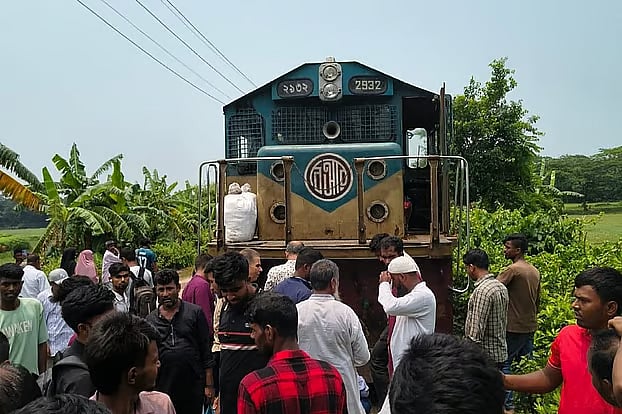
Mymensingh rail route faces regular engine failures, fires and derailment; why?
Engine failures, fires, decoupling and frequent derailments have become a routine on the Dhaka–Mymensingh–Jamalpur railway route. A series of such incidents has disrupted train schedules, leaving thousands of passengers in distress.
According to Railway data , in June alone this year, two trains were derailed and three experienced engine failures. In May, eight trains faced engine breakdowns, while in April the number stood at six.
Most recently, on 15 June around 12:30 pm, the coupling hook between the locomotive and coaches of the Jamalpur Express broke near Gafargaon, detaching the engine from the compartments. The incident suspended rail traffic on the Dhaka-Mymensingh line for nearly two hours.
Later that same evening, the engine of the Bijoy Express bound for Jamalpur from Chattogram caught fire near Aitbaradi station in Ishwarganj. Train services were suspended for about three hours due to the engine failure. Later, although the train was resumed with an alternative engine, it broke down again at Sararchar in Bajitpur, Kishoreganj.
Due to engine shortages, the Chattogram-bound Mymensingh Express mail train was also cancelled that day.
Earlier, on 13 June, a fire broke out in an air-conditioned (AC) chair coach of the Teesta Express while it was stationed at Mymensingh railway station. On 10 June, a power car of the Brahmaputra Express bound for Dhaka from Dewanganj in Jamalpur derailed near the Anand Mohan College railway crossing. During recovery operations, the rescue train also derailed in the Krishtopur area.
“Old engines, weak tracks to blame”
Masum Ahmed, in-charge of the Mymensingh loco shed, could not provide the exact number of recent engine failures or derailments. He stated that such data is not maintained locally but is stored centrally in Dhaka.
However, Shafiul Hasan, an inspector at the Mymensingh loco shed, said that three trains experienced engine failures this month, eight last month, and five in the preceding month. He said old engines and weak railway tracks are causing these problems when trains operate at scheduled speeds. In many cases, engines are put back into service before undergoing complete repairs.
He also said that multiple letters have been sent to the relevant authorities requesting railway track renovation.
He identified old locomotives and weak tracks as the primary causes of the frequent mishaps. He added that in many cases, engines are put back into service before full repairs are completed due to demand.
Hasan noted that multiple letters have been sent to the relevant authorities requesting railway track renovation.
According to railway sources, 18 pairs of trains operate on the routes connecting Mymensingh with Dhaka, Jamalpur, Netrokona and Chattogram. This includes eight intercity trains, four commuters, one mail train and five locals. However, due to a severe shortage of locomotives and coaches, five trains—the Bhawal and Dhalerwari mail trains, two local trains to Mohanganj and one local train to Jamalpur’s Dewanganj have already been suspended.
Railway officials confirmed that most of the engines in this region are aged and have long exceeded their economic lifespan. Many of these locomotives frequently break down as they overheat during operation. Simultaneously, a lack of ballast stones, sleepers and bolts, combined with the fragile condition of the tracks, forces drivers to operate trains at low speeds. Officials warn that no improvement is possible without the addition of new engines and comprehensive track renovations.
Calls for urgent renovation
Nazmul Hasan, Senior Assistant Executive Engineer of Bangladesh Railway, noted that while derailments are relatively less frequent, the recurring engine failures have become a major crisis.
He noted that most engines are outdated and new engines are needed.
Nazmul Hasan also stressed the urgent need to upgrade the railway line from Shreepur through Mymensingh, Vidyaganj, Gouripur, Atharabari, Mohanganj and Jaria. Reduced ballast on tracks is increasing pressure, leading to track damage and fractures. According to him, proper renovation would reduce derailments and allow trains to run at higher speeds.
He added that Bangladesh Railway’s eastern zone is currently working on a project proposal in this regard.
According to Akhtar Hossain, Officer-in-Charge (OC) of Mymensingh Railway Police, engine motors have become weak, leading to breakdowns due to overheating. If these engines run for a long time, the heat and pressure cause plumes of smoke and the trains become disabled.
He also noted that structural integrity of the decades-old tracks no longer meets modern demands, making a total replacement of the lines essential.
Abdullah Al Harun, Station Superintendent of Mymensingh Railway Station, said that passengers suffer the most due to engine failures. He said there is no alternative to adding new engines and renovating the tracks to solve this problem.
Stating that the railway system, known as the country's safest transport, is now a victim of neglect, Ali Yusuf, secretary of the Mymensingh city unit of Shushashoner Jonno Nagorik (SHUJAN), said that people have been deprived of railway services because syndicates were an obstacle to development.
He alleged that those who are given responsibility for the railways are negligent. He said that journeys are becoming risky due to the long-term lack of track repairs, the failure to regularly provide ballast stones and the flimsy repair of old engines.
He claimed that because of this neglect in railway development, citizens are deprived of safe transport and the government is losing out on significant potential revenue.