July mass uprising
No statement made on investigation into police deaths: Home Minister
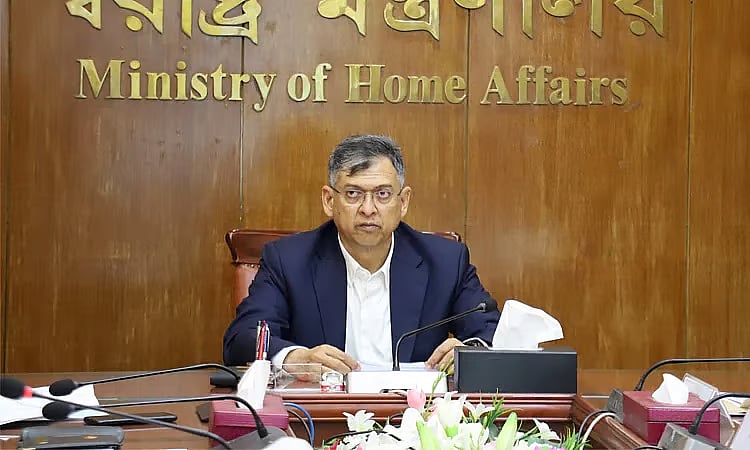
Home Minister Salahuddin Ahmed has said that he has not made any statement so far regarding an investigation into the deaths of police personnel during the July mass uprising.
He made the remarks today, Sunday, while responding to a journalist’s question at the Secretariat.
A journalist asked about comments reportedly attributed to the Home Minister by Mirza Fakhrul Islam Alamgir, secretary general of the Bangladesh Nationalist Party (BNP) and Minister for Local Government, who had said that actions regarding the police personnel killed in July would follow the stance of the Home Minister.
In response, Salahuddin Ahmed said, “Has the Home Minister said anything about this? I do not know why the secretary general gave such an explanation. I have made no statement on this matter. I do not know what our secretary general has said. I have not made any statement on this issue.”
The Home Minister added, “You are aware that toward the end of the interim government’s tenure, A protection ordinance. Its basis was a clause in the July National Charter pledge. All political parties agreed to that clause. Those who signed the July National Charter agreed to the pledge, which stated that legal protection must be provided to those who led and participated in the July mass uprising. Constitutional protection must also be ensured. We signed and committed to those pledges.”
When asked how long members of the armed forces would remain deployed in the field, the Home Minister said the decision would be made through discussions at the highest level.
He noted that the military itself does not wish to remain deployed for long because it disrupts training and other activities.
He said the government must assess how much the law-and-order situation has improved since assuming office. However, he could not specify when the army would be withdrawn, though he acknowledged that withdrawal would eventually be necessary.
The Indian High Commissioner paid a courtesy call on the Home Minister this morning. Asked about the discussion, he said such meetings are customary when a new government takes office. He added that Bangladesh maintains extensive engagements with neighbouring India and that he raised the issue of preventing further killings along the Bangladesh–India border.
During the interim government’s tenure, a decision was made to change the name and uniform of the Rapid Action Battalion (RAB). Asked about the current government’s stance, the Home Minister said there is public demand regarding reforms to the force, and the July National Charter also recommended taking certain decisions about it.
He said these matters involve political consensus and must now be evaluated based on practical realities. RAB is a specialised force.
“The question is whether such a force is needed. The answer is yes,” he said.
He added that decisions would be taken after examining the force’s structure, jurisdiction, accountability mechanisms, transparency, and ways to ensure maximum public service.
The Home Minister said that 27 upazilas in Bangladesh currently lack fire service facilities, and a separate project has been proposed to address this. Instructions have also been issued to ensure transparency in fire service recruitment.
He further said that authorities are preparing a complete list of firearm licences issued and weapons purchased between 2009 and 5 August 2024.