Consensus commission to handover July Charter to political parties today
The National Consensus Commission will send the final copy of the July national charter to political parties today, Tuesday. However, the charter contains no recommendations on how to implement the reform proposals. The commission will later provide these recommendations to the caretaker government and the parties. This will not be part of the July national charter.
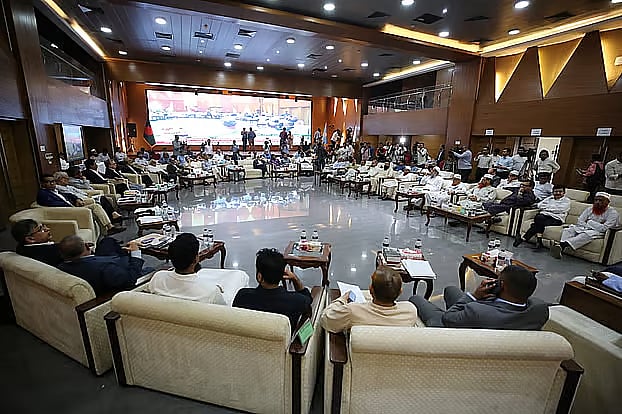
After the caretaker government assumed office, it took initiatives to implement reforms in various sectors of the state. In the first phase, the National Consensus Commission holds discussions with political parties on the reform proposals of six reform commissions—covering the constitution, election system, public administration, anti-corruption commission, police, and judiciary. In the first round, the commission meets with 33 parties, and in the second round, with 30 parties.
After the caretaker government assumed office, it initiated reforms in various sectors of the state. The National Consensus Commission discussed the reform proposals of six reform commissions—covering the constitution, election system, public administration, anti-corruption commission, police, and judiciary—with political parties. In the first round, the commission met with 33 parties, and in the second round, with 30 parties.
Between February and July, the two rounds of discussions led to consensus and decisions on 84 reform proposals. These are being incorporated into the July National Charter.
The charter signing ceremony will take place next Friday at the South Plaza of the National Parliament. Preparations for the event have already begun. The Ministry of Cultural Affairs is assisting the National Consensus Commission in organising the ceremony, and the commission plans to invite around three thousand guests.
Thirty political parties and alliances are being invited to sign the charter. Earlier, the commission had requested each party to provide the names of two signatories. The 30 parties and alliances have since submitted the names of two signatories each to the commission. However, it is still unclear whether all the parties will ultimately sign the charter.
According to commission sources, no further opinions will be sought from political parties regarding the charter. The draft previously sent (on 11 September) is now being circulated in its final form. There are no changes to the main content, only some linguistic corrections.
The commission had sought political parties’ views on repealing Article 4(A) of the constitution, which deals with displaying the portrait of Father of the Nation Bangabandhu Sheikh Mujibur Rahman in government and private institutions. Nearly all parties supported this. However, it will not be newly mentioned in the charter; the decision will be taken by the next parliament.
The July national charter has three sections. The first section outlines the background of the charter, the second contains 84 reform proposals, and the third lists the seven-point pledge for implementing the charter.
The National Consensus Commission had aimed to have the July national charter signed last month. The charter had been stalled until now because no decision was made on the methods for implementing the reform proposals.
However, the commission had earlier stated that the implementation procedures would not be part of the charter, and this recommendation has not yet been finalised.
Discussions with the parties on the reform proposals concluded on 31 July. Following demands from several political parties, the National Consensus Commission later held formal and informal discussions with the parties and experts on the methods for implementing the charter. These discussions concluded on 9 October.
Consensus was reached on implementing the charter through a referendum, but there is disagreement among the parties—especially BNP, Jamaat-e-Islami, and the National Citizen Party (NCP)—over the basis, timing, and procedures of the referendum.
On 9 October, during discussions with the parties, the commission stated that it would coordinate the opinions of experts and political parties and recommend to the government the methods for implementing the charter.
Subsequently, the commission held informal talks with BNP, Jamaat-e-Islami, and NCP to reduce disagreements over the implementation process. According to relevant sources, differences remain among the parties over the basis of the referendum, whether it will be held simultaneously with the parliamentary elections or beforehand, and what questions will be included in the referendum. Discussions are ongoing on whether the recommendations on the implementation methods can be finalised by Friday.
National consensus commission’s vice-chairman Professor Ali Riaz told Prothom Alo yesterday that copies of the July Charter will be sent to the parties on Tuesday.
The charter signing ceremony will be held on Friday. The commission hopes that by then it will be possible to submit recommendations to the government on the methods for implementing the charter.