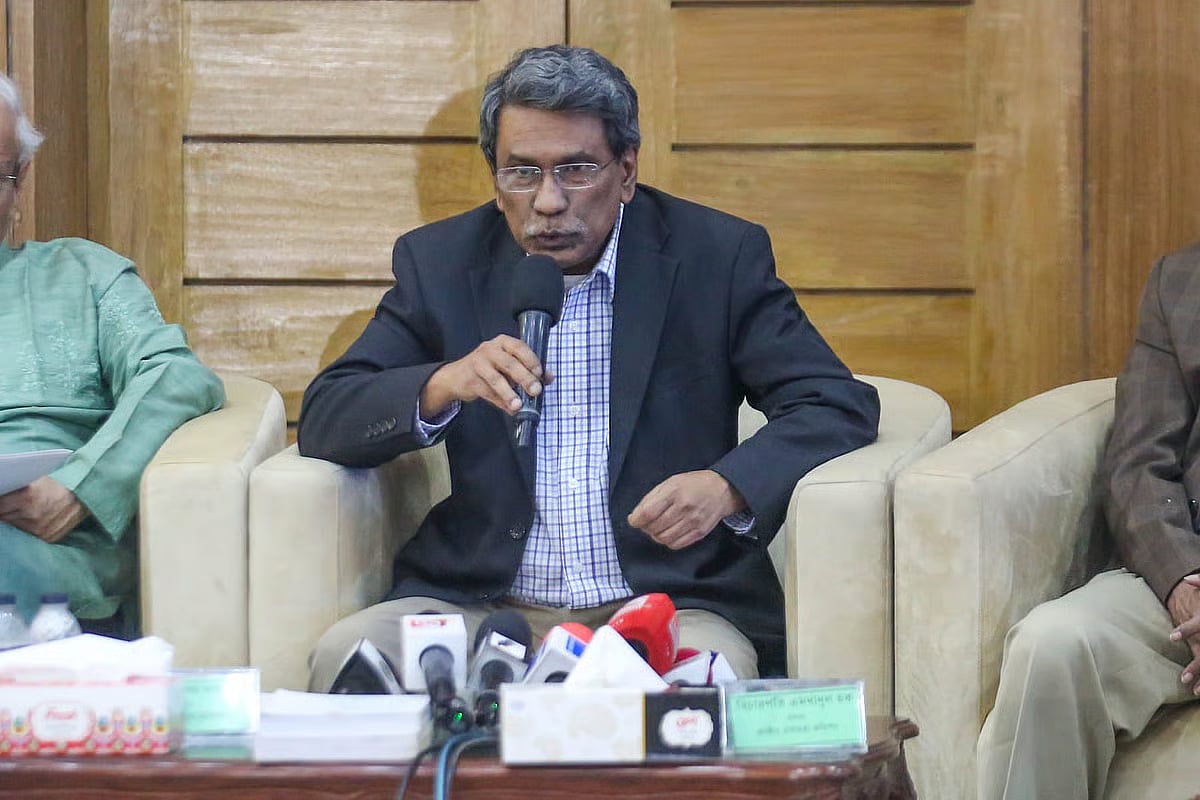
National Consensus Commission hopes
July Charter to take full form by 15 October
The National Consensus Commission will again meet with political parties on 5 October to discuss the implementation mechanism of the July National Charter.
The Commission intends to finalise recommendations on the implementation procedure by 10 October and submit them to the government.
Its aim is to present the complete Charter, endorsed by all parties, by 15 October.
However, differences remain among political parties regarding the mechanism of implementing the constitutional proposals of the July Charter.
The Bangladesh Nationalist Party (BNP) insists that the proposals should be implemented after the national election, through parliament. Jamaat-e-Islami, on the other hand, demands implementation prior to the election, with the election held on that basis.
This raises uncertainty as to whether the Commission’s target will be achieved.
The July National Charter is being prepared with 84 reform proposals. Although the draft has been finalised, the implementation procedure has not yet been agreed upon, leaving the Charter paused.
To decide on implementation, the National Consensus Commission began discussions with political parties on 11 September. Despite three days of continuous discussion, consensus was not achieved and discussions have since been adjourned.
According to Commission sources, it will again meet political parties on 5 October. The plan is to conclude discussions with the parties on that day. There will be no further discussions with them afterwards.
The Commission had received six broad recommendations from political parties on implementing the constitutional proposals. These were - referendum on the full Charter or part of it; implementation through a special constitutional order; implementation via a Constituent Assembly; implementation through the 13th Parliament; establishing Parliament as a constitutional reform assembly to incorporate the Charter into the Constitution; and, under Article 106 of the Constitution, seeking an advisory opinion from the Appellate Division of the Supreme Court on whether the interim government could implement the Charter.
Meanwhile, experts recommended that a constitutional order could be issued regarding the July Charter. This would take immediate effect, while a referendum on the order could be held on the day of the national election.
Furthermore, they stated that a referendum or a Constituent Assembly would be the most suitable option for the reforms to be sustainable.
Sources indicated that the Commission will recommend multiple alternative procedures for implementation to the government.
The current approach is to reduce the number of alternatives through discussions with political parties. If consensus is not achieved, then after hearing parties’ views on 5 October, the Commission will consult experts and finalise recommendations. The aim is to submit recommendations to the government on 8–9 October.
The extended tenure of the Consensus Commission ends on 15 October. Within this period, the Commission seeks to finalise the July National Charter.
Professor Ali Riaz, Vice-Chairman of the National Consensus Commission, told Prothom Alo that the Commission aims to finalise recommendations on implementation procedures by 10 October, by combining expert advice and political parties’ proposals.
stating that multiple alternative procedures will be recommended, he further said, “The best outcome would be if the solution came from the politicians themselves, as the Commission is only a facilitator.”
Commission sources indicated that the Commission will recommend multiple alternative procedures for implementation to the government. The current approach is to reduce the number of alternatives through discussions with political parties.
Political differences
The BNP and Jamaat-e-Islami remain in complete disagreement on the question of implementation.
The BNP believes that the only legitimate forum for implementing constitutional reform proposals is the National Parliament and that they must be implemented through the next Parliament.
The party also supports seeking an advisory opinion from the Supreme Court on whether constitutional reforms can be made in any other way.
Jamaat, however, demands full implementation of the July Charter before the upcoming national election, and for the election to be held on that basis. It argues that leaving implementation to the next Parliament would result in indefinite delays.
The National Citizen Party (NCP) calls for implementation through a Constituent Assembly. It suggests that the next Parliament, formed through the election, could function both as a Constituent Assembly and as a regular Parliament.
The best outcome would be if the solution came from the politicians themselves, as the Commission is only a facilitator.Professor Ali Riaz, Vice-Chairman of the National Consensus Commission
Sources indicate that in the midst of such political disagreements, there is doubt as to whether the July Charter can be finalised by 15 October.
There are concerns that if the method of implementation does not align with their preferences, some major parties may refuse to sign the Charter.
When asked whether the Charter would be finalised by 15 October, BNP Standing Committee member Salahuddin Ahmed told Prothom Alo, “The Consensus Commission will meet political parties again on 5 October. There can a comment be made only after seeing what happens.”
Sources revealed that one purpose of adjourning discussions for an extended period was to allow parties to consult among themselves to reach consensus.
Some parties have already held internal discussions. However, effective dialogue has not taken place among the main parties.
When asked whether finalisation of the Charter by 15 October was feasible, Jamaat-e-Islami assistant secretary general Hamidur Rahman Azad told Prothom Alo, “This could have been done much earlier. The Commission has also made efforts. But it did not happen due to opposition from certain parties. If once again obstacles are placed for partisan interests and the Commission cannot take a firm stance, it will not happen. Parties will have their opinions, but the government must decide in line with public aspirations. Political compromise has not yet shown significant progress, though the opportunity still exists.”