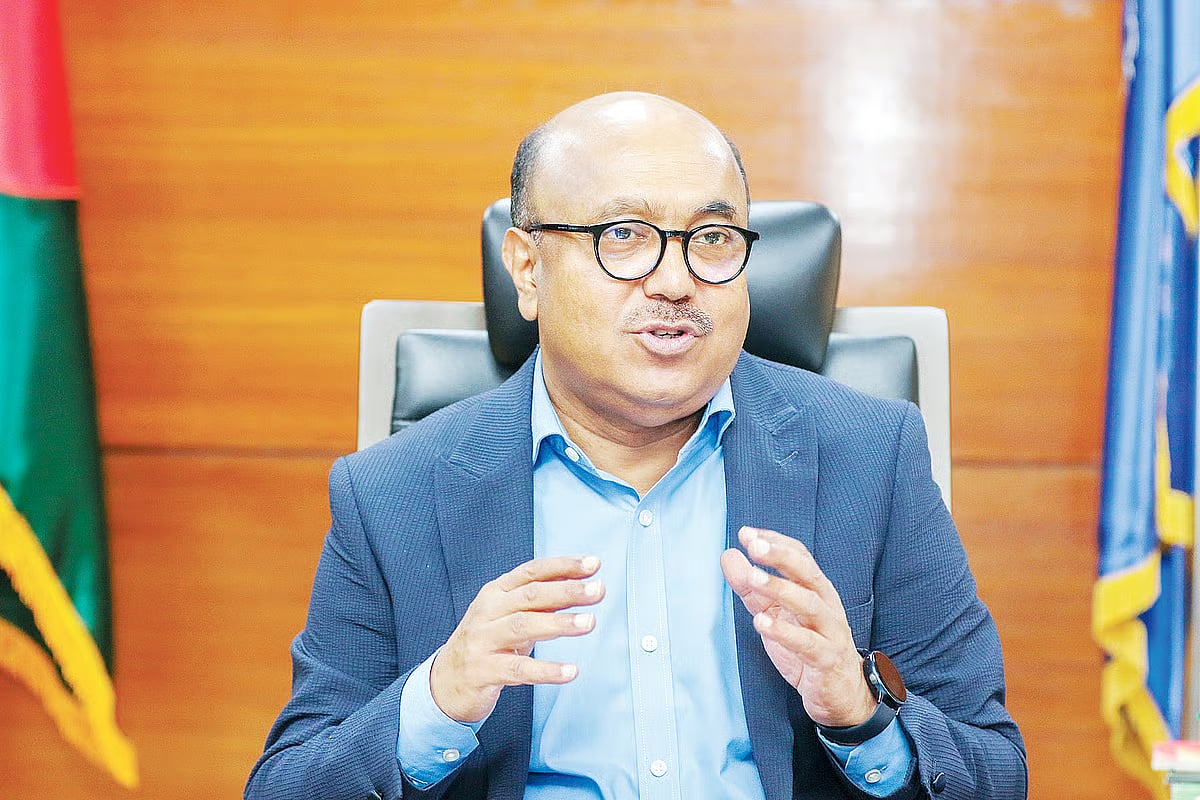
Exclusive Interview: Mobasser Monem
One BCS can be completed in a year if independence given
A new reality has emerged in state governance following the mass uprising of 5 August 2024. Transparency, accountability, and speedy recruitment in government jobs are now the top expectations of the youth. The Public Service Commission (PSC) is the central institution in this regard. In an interview with Prothom Alo, PSC Chairman Professor Mobasser Monem spoke about the current challenges facing the commission and the prospects for reform. Golam Rabbani has taken the interview.
Students have been growing increasingly frustrated due to delays in the publication of BCS recruitment circulars, examinations, and results over the years. What is the reason behind this delay?
Mobasser Monem: Previously, the biggest issue in our recruitment process was the lengthy evaluation time for written exam scripts. To reduce this time, after much trial and error, we have introduced the ‘Circular System.’ From now on, examiners will come to the PSC to evaluate the answer scripts. Each script will be assessed by multiple examiners, and each examiner will evaluate only one specific question. For example, the first examiner will assess only the answer to question one, the second examiner will look at question two, and so on. This method ensures relative judgment and promotes fairness. It will save time and improve quality. Without this system, completing an exam cycle within a year is not feasible. Our goal is to complete the entire BCS process—from circular publication to recruitment—within one year.
How many BCS exams are currently in progress?
Mobasser Monem: At the moment, six BCS exams are ongoing. Since we took office, we have published the results of the 44th BCS. The viva voce (oral exams) for the 45th General BCS and the 48th Special BCS are underway. The written exam for the 46th BCS has been completed. The preliminary exam for the 47th BCS is scheduled to start on September 19. Additionally, the application process for the 49th Special BCS has been completed, and we are currently preparing the exam questions.
You say completing one BCS in a year is possible. But with six BCS exams running simultaneously, how realistic is that goal?
Mobasser Monem: We believe that if the Public Service Commission is granted full autonomy as a constitutional body, completing one BCS in a year is achievable. We have already created a roadmap. Every year, the BCS circular will be published in November, and results will be announced by October 30 of the following year. The current backlog of BCS exams is not a problem—but for this plan to work, we must be given full independence.
What percentage of qualified candidates are typically found in a single BCS exam?
Mobasser Monem: The number isn’t fixed; it varies. Generally, we recommend about 0.45 per cent to 0.65 per cent of candidates in a BCS exam. For example, the recommendation rate was 0.54 per cent in the 37th BCS, 0.64 per cent in the 38th, 0.48 per cent in the 40th, 0.62 per cent in the 41st, 0.49 per cent in the 43rd, and 0.48 per cent in the 44th BCS.
Many engineers and physicians are now opting for administration, police, or foreign service cadres instead of the technical cadres designated for their professions. Among the last five BCS exams, out of 1,980 candidates appointed to these three cadres, 387 were engineers and physicians. What is your view on this?
Mobasser Monem: Our commission hasn’t officially started working on this issue yet. But personally, I believe that every citizen has a constitutional right to freely choose their profession. No one should be deprived of that right. However, I do think this matter deserves national-level discussion.
Job seekers are protesting, demanding an increase in non-cadre positions so more candidates can be recommended. Will the commission recommend more candidates from the non-cadre list?
Mobasser Monem: The commission believes that the more candidates we can recruit from the non-cadre list into government service, the better. It saves both time and money, ensures talented individuals enter public service, and reduces corruption in recruitment. But for this to happen, inter-ministerial coordination is crucial. If we receive proper requisitions from the government, the PSC can indeed recommend a greater number of non-cadre candidates.
In the wake of recent student movements, there have been calls for reforms in the PSC’s recruitment process. How do you view these demands?
Mobasser Monem: Even before these demands arose, the new commission had already identified the areas in need of reform and began taking action. I believe the demands are reasonable. However, it is disappointing that the Public Administration Reform Commission made recommendations without consulting us. Their report had procedural flaws. Interestingly, many of the reforms they proposed were already being implemented by us.
For instance:
We had already set a calendar to complete each BCS cycle within a year.
We reduced the application fee from 700 to 200 taka (only 50 taka for candidates with special privileges).
To prevent question leaks, we shifted printing from the government BG Press to our own secured printing system.
There hasn’t been a single question leak in the past year. These efforts show that the PSC is committed to reform. We are actively working to implement any necessary reforms in step with the times.
The Public Administration Reform Commission has proposed a fixed calendar for the BCS process—from circular publication to recruitment. How feasible is it to implement this?
Mobasser Monem: Since taking office, we have been working on preparing a roadmap. Even before the Reform Commission made its recommendations, we developed a one-year calendar and have been working accordingly. In many cases, we’ve published results ahead of schedule. However, to make this system permanent, the PSC must be granted true independence.
Although we are constitutionally an independent body, in practice, we function more like a department under the Ministry of Public Administration—which is not desirable. Due to the complexities of rule amendments, we cannot make quick decisions without their approval.
Therefore, it is now essential to amend the Rules of Business to ensure the PSC’s true autonomy.
Even when it comes to amending recruitment rules or making financial decisions, we have to depend on the ministry and the finance division.
According to the Bangladesh Bureau of Statistics, there are nearly 2.7 million unemployed people in the country. In this context, how effective do you think the government recruitment process is in addressing unemployment?
Mobasser Monem: The number of educated unemployed is indeed alarming. Opportunities in government jobs are limited, and this alone cannot solve the unemployment problem. We need to create new entrepreneurs. The government must support entrepreneurs and integrate this approach into national planning. The private sector must also be strengthened.
The PSC’s role is to bring qualified candidates into public service. However, at the national level, our focus should also be on how young people can become entrepreneurs and create new employment opportunities.
What is the primary structural reason behind the shortage of skilled human resources in the country—is it the education system, lack of training, or weaknesses in national policies and planning?
Mobasser Monem: I would say there are weaknesses in all areas. The education system needs reform. We must design a curriculum that is relevant to the times and place more emphasis on practical skills. It's essential to ensure consistency across all levels of education. Skill development through training is also crucial—refresher training is equally important. Every institution should follow its own training policy, and a national training policy must be implemented. Education is the backbone of the nation, so there is no alternative to a modern, relevant education policy. One of the biggest issues is that, although people are aware of the problems in our education system, no real effort has been made to build a national consensus on the matter.
There have long been concerns about transparency in the PSC's recruitment process. What steps have you taken to enhance transparency and accountability?
Mobasser Monem: Transparency is our top priority. Preventing question leaks, introducing a new method of script evaluation, and reducing application fees—all these steps are aimed at restoring candidates’ trust. We are working to make the process even more transparent by using digital platforms. We're also moving toward automation. The commission is fully committed to ensuring transparency in the recruitment process.
What kind of reforms do you think are necessary to prevent corruption or political influence in recruitment?
Mobasser Monem: The most urgent need is administrative and financial autonomy. As long as the PSC cannot make its own decisions independently, it will be difficult to shield the process from political influence. If we are allowed to operate independently, only honest and qualified candidates will be selected.
Following the interim government, the new generation wants to take part in state governance. How does the PSC plan to regain the trust of this generation?
Mobasser Monem: The younger generation demands fairness. They do not want to see discrimination or favouritism in government recruitment. That’s why we have introduced a fast, transparent, and technology-driven process. The PSC cannot succeed without regaining the trust of the youth.
As part of that effort, we have reduced the marks for the viva voce (oral exam) from 200 to 100, and we are actively considering reducing it further to 50 marks. In addition, keeping in mind the competencies required for civil service, we are working to establish an assessment center that includes psychometric analysis. The United Nations Development Programme (UNDP) has expressed its willingness to support us in this initiative. Once established, this assessment center will make the candidate selection process more efficient and transparent.
We are continuously working to eliminate bias at every stage of the recruitment process.
What kind of human resources do you think will be needed in Bangladesh's administrative structure over the next 10 years?
Mobasser Monem: In the coming decade, the key strength will be human resources that are technology-oriented, environmentally conscious, honest, free from corruption, and committed to good governance. However, it must also be noted that those who cannot keep pace with technological advancements will fall behind in the job market. Therefore, we must prioritise skill development and technological training starting now.
According to the constitution, the Public Service Commission is an independent constitutional body. Yet, in many instances, it has to rely on the Ministry of Public Administration. Doesn’t this undermine the constitutional status of the PSC?
Mobasser Monem: There’s no denying that, despite being an independent institution, we cannot make regulatory changes or financial decisions on our own. Even for minor amendments to rules, we need approval from the Ministry of Public Administration. For financial matters, we repeatedly need clearance from the Finance Division. This raises questions about our independence and affects our efficiency.
Has the PSC ever formally raised the demand with the government to ensure its constitutional autonomy?
Mobasser Monem: Absolutely. We have consistently said that the PSC should not function like a department under a ministry. As a constitutional body, our administrative and financial autonomy must be ensured. Only then can we recruit top meritorious candidates into government service through more thorough evaluation. One of the key demands of the July mass uprising was the end of discrimination. To fulfill that demand, there is no alternative to allowing the PSC to operate as a truly independent institution.
You say that although the PSC is constitutionally independent, it remains practically dependent on ministries. Have you personally conveyed this limitation to the Chief Adviser?
Mobasser Monem: No, I have not personally conveyed it to the Honourable Chief Adviser.
Thank you
Mobasser Monem: Thank you too