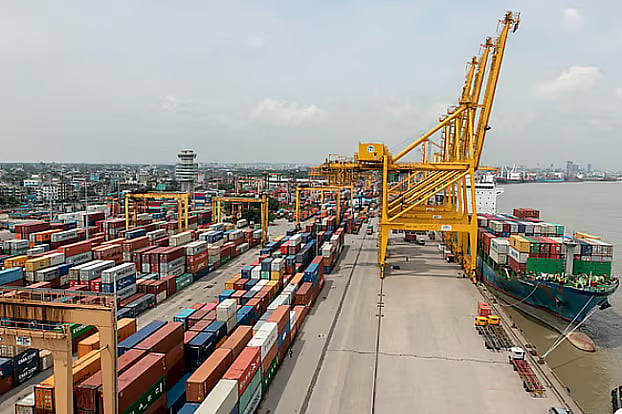
“Resource curse” refers to an economic and political situation in which a country, despite possessing abundant natural resources (such as oil, gas, gold, or diamonds), fails to achieve the desired level of economic development. Instead, it suffers from economic stagnation, instability, and corruption. This phenomenon is often referred to as the “paradox of plenty.” Is Bangladesh experiencing such a paradox in relation to Chittagong Port?
The fact that there are arguments in favour of appointing a foreign operator does not place the decision to entrust a particular company with long-term operations under specific terms beyond scrutiny
A port’s depth is measured by its navigability, but the depth of a state is reflected in the transparency of its decision-making. The question of handing over the operation of Chittagong Port’s New Mooring Container Terminal (NCT) to a foreign company for 15 years is therefore not merely a matter of efficiency, investment, or profit. It is also a question of the public’s rights over state assets and of democratic accountability in decisions concerning those assets.
Recently, an agreement was signed with DP World, a company from the United Arab Emirates, concerning the operation of the New Mooring Container Terminal. But why was such a major national economic decision not discussed in parliament? Why was there no perceived need for meaningful parliamentary debate on the terms of the agreement, the financial gains and losses for the state, the future of the hundreds of port workers, and questions of national security?
These questions do not arise from opposition to foreign investment; rather, they stem from a demand for democratic accountability in decisions as important as investment. An agreement may be legally valid, but that does not mean every decision it entails automatically passes the test of serving the public interest. Particularly when a decision will have implications extending beyond the tenure of the current government and spanning the next 15 years, parliamentary discussion is not a mere formality, it is part of the state’s responsibility.
Modernising the port, but on what terms?
Improving the efficiency of Chittagong Port is essential. Vessel waiting times, delays in container handling, lengthy customs procedures, and limitations in road and rail connectivity increase the cost of imports and exports. The technology, experience, and professional management of an international operator could help address some of these problems.
There is no reason to automatically conclude that a foreign company is necessarily acting against the national interest. However, the fact that there are arguments in favour of appointing a foreign operator does not place the decision to entrust a particular company with long-term operations under specific terms beyond scrutiny. On the contrary, the greater the need for investment, the greater the importance of contractual transparency and competition.
According to information published in the media, DP World is expected to invest $150 million in operating and modernizing the New Mooring Container Terminal (NCT). Of this amount, $50 million is to be paid to the port authority as a one-time payment. The contract term is 15 years. Under the revenue-sharing arrangement, the port authority is reportedly expected to receive between 40 and 67 per cent of the revenue per container. In addition, reports indicate that the authority will receive a fixed annual fee.
These figures are important, but they are not sufficient to assess the entire agreement. Alongside the investment amount, it is necessary to know the terminal’s current revenue and expenditure, how net income will be calculated under the new arrangement, who will bear the operating costs, who will have the authority to revise tariffs, and in what condition the assets and technology will be returned to the state when the contract expires.
The most important question is that the NCT is an already operational terminal in which the government has made substantial investments. According to published information, the total investment in the terminal, including construction and equipment installation, amounts to Tk 27.12 billion. In the last fiscal year, it handled 1.385 million containers. So, how was the financial value of this existing capacity assessed? Was the alternative of continuing operations under domestic management examined with equal seriousness? The state cannot simply look at the potential revenue under the proposed arrangement; it must also calculate how much revenue could have been generated under alternative arrangements.
Parliamentary discussion is essential
This is where the issue moves beyond the confines of a commercial agreement and becomes a question of democratic governance. Parliament is the principal institution responsible for overseeing the state budget, expenditure, policies, and the accountability of the executive branch. It would not be appropriate to insist, without a legal basis, that every commercial agreement must receive parliamentary approval. But whether Parliament should discuss the long-term operation of a strategic asset such as the country’s largest container terminal is an entirely different question. From the standpoint of democratic accountability, the answer is clearly "yes".
It is worth noting that Article 145A of the Constitution of Bangladesh provides for treaties concluded with foreign states to be laid before Parliament. In this context, it is important to recognise that the political and democratic necessity of parliamentary discussion is not the same as a legal obligation to hold such a discussion. Given the port’s strategic importance, the case for parliamentary accountability is compelling; however, that importance does not automatically create a constitutional obligation.
Nevertheless, parliamentary discussion would have required the government to answer several fundamental questions. Why was an agreement with a specific company chosen instead of an open, competitive tendering process for this terminal? Why were proposals from domestic companies not considered? Were alternative proposals comparatively assessed in terms of investment, revenue, technology, workers’ rights, and security? Which clauses of the agreement cannot be disclosed, and why? These questions are not intended to oppose the government; they are necessary to scrutinize its decisions in light of the public interest.
When decisions are made about nationally important assets, the parliament must not be treated merely as a “platform” for presenting information. Parliamentary debate provides an opportunity to scrutinise the executive branch’s decisions, enables opposition parties to present alternative arguments, and helps the public understand the reasoning for and against a decision.
Even if it is not possible to disclose every commercial clause of an agreement, Parliament could at least have discussed its basic financial structure, the state’s liabilities, the risks involved, the extent of control, and the long-term implications. Commercial confidentiality may be necessary for strategic reasons, but confidentiality must not become a means of evading accountability.
In this context, the “public trust doctrine”, which concerns the state’s fiduciary responsibility for public resources, is a relevant concept. The central principle of this doctrine is that, when managing resources that affect the public interest, the state cannot simply exercise its discretion as an owner; it must also act as a responsible trustee charged with protecting the public interest. In the case of strategic infrastructure such as Chittagong Port, this concept reminds us that even if operational responsibility is transferred to a private company, the state cannot shirk its duty to safeguard the public interest.
Is a foreign operator the only way to efficiency?
The involvement of foreign companies in port operations is an internationally recognised arrangement. World Bank publications on port reform, along with international experience in port management, demonstrate that terminals can be operated by private companies while ownership remains with the government. Under such arrangements, efficiency and productivity have increased at many ports around the world.
However, the model of port management and the method of selecting an operator are two different matters. Under the “landlord model,” the public authority retains ownership of the land and basic infrastructure, while a private company undertakes investment and operations under a contract. This model can also be implemented through an open, competitive tendering process. Therefore, appointing a foreign operator should not automatically be equated with greater efficiency.
The challenges facing Chittagong Port are not confined to the terminals themselves. Waiting times for ships to berth, river navigability, customs clearance, delays in cargo handling, and inadequate road and rail connectivity all affect overall efficiency. An operator may be able to increase the speed of container handling within a terminal, but it cannot resolve administrative complications in customs or traffic congestion outside the port.
Therefore, alongside entrusting operations to a foreign company, the government must digitise customs procedures, increase container transportation by rail and waterways, modernize the port’s information systems, and strengthen the capacity of state regulatory institutions. If the state’s own capacity remains weak while dependence on a foreign company’s expertise increases, enforcing the state’s contractual rights may eventually become difficult, even when those rights are formally stipulated in the agreement.
Lessons from Doraleh Port
The dispute between DP World and the government of Djibouti over the Doraleh Container Terminal is an important international example. Following a dispute over a long-term concession agreement, the Djiboutian government terminated the contract in 2018 and took control of the terminal. The dispute subsequently escalated to international arbitration and courts. Questions concerning breaches of contract, the recognition of arbitral decisions, and remedies arose at various stages of the legal proceedings.
There is no need to label DP World a good or bad company on the basis of this experience. Rather, the lesson is that port operation agreements can sometimes become sources of long-term financial liabilities for states and give rise to complex international legal disputes.
One point must be kept in mind: governments change and policy priorities shift, but the obligations arising from contracts entered into by the state do not disappear easily.
It is therefore essential to understand the provisions of the NCT agreement concerning dispute resolution, the seat of arbitration, applicable law, conditions for contract termination, compensation, state intervention on national security grounds, and the restoration of operational control to the state in emergencies. It is not enough for the state’s rights to be written into the contract; the state must also possess the legal and administrative capacity to enforce them effectively.
Workers’ rights and public interest
The concerns raised by workers’ organisations regarding the NCT cannot be ignored. The government has stated that existing officers and employees are not at risk of losing their jobs and that modernisation could create additional employment opportunities. How far these assurances will hold up in practice will depend on the terms of the agreement and how it is implemented. Workers’ job security, training, working conditions, and opportunities to adapt to technological changes must be ensured.
At the same time, the concerns of businesses must also be taken seriously. If tariffs rise as the operator improves efficiency, the cost of imports and exports could increase. Ultimately, consumers and producers will bear the burden of those additional costs.
Therefore, efficiency cannot be assessed solely by counting how many containers are handled per hour. It is also necessary to examine how much service quality improves, whether ship waiting times decrease, whether business costs fall, whether workers’ rights remain protected, and how much the state’s net revenue increases.
Transparency and accountability are essential
Once the agreement has been concluded, the government’s greatest responsibility is to ensure public trust. Information that cannot be disclosed for reasons of national security or commercial confidentiality may reasonably be withheld. However, the key terms concerning investment, revenue sharing, tariff-setting, performance targets, workers’ rights, contract termination, and compensation should not be concealed from the public.
The government should present the main provisions of the agreement to parliament and arrange for the relevant parliamentary committee to review its financial, legal, security-related, and labour-related aspects. The agreement’s financial benefits and risks should be assessed through an independent audit. The results of periodic evaluations of the operator’s performance should also be made public.
There can be no disagreement over the need to modernise Chittagong Port; foreign investment may also be necessary. But accountability must not be weakened in the name of modernisation, nor should the state’s own capacity be allowed to erode in exchange for promises of greater efficiency.
The failure to discuss the long-term agreement concerning the country’s most important port in Parliament is therefore not merely a procedural shortcoming; it raises fundamental questions about how the state makes decisions. If development is intended to serve the public interest, what is the difficulty in presenting the rationale for that development to the people’s elected representatives?
Responsibility for port operations can be transferred through a contract. But responsibility for decisions concerning the country’s economic future cannot be handed over to an operator. That responsibility rests with the government, Parliament, and ultimately, the state itself.
The debate over Chittagong Port, therefore, is not about foreign versus domestic companies. The real question is how transparent and accountable the state is in its pursuit of efficiency, and how capable it is of protecting its own interests. A port may be leased to a foreign company, but the state’s responsibilities, the people’s rights, and the national interest cannot be leased out.
* MM Khalequzzaman is an Advocate of the Supreme Court and can be reached at adv.mmkzaman@gmail.com
* The views expressed here are the author’s own.
* This article has been translated into English by Ayesha Kabir