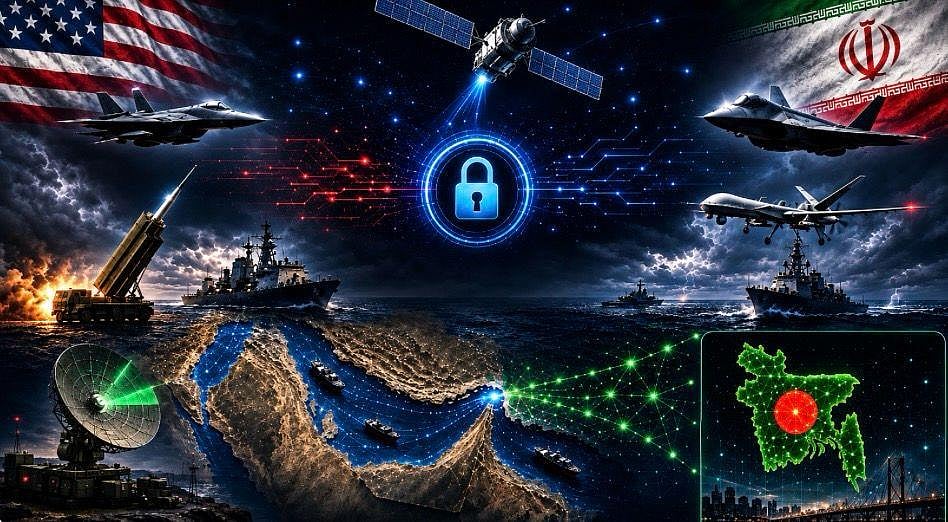
The ongoing US-Iran War introduced a new and alarming dimension modern warfare: the deep integration of cyber warfare with conventional kinetic strikes. The war erupted on 28 February 2026 when Israel and the United States launched coordinated airstrikes (codenamed Operation Roaring Lion and Operation Epic Fury) targeting Iranian leadership, nuclear facilities, and military sites, including the assassination of Supreme Leader Ali Khamenei. Cyber and electronic-warfare capabilities were integrated to disrupt Iranian critical infrastructure, communications systems, state media, and digital networks.
According to US Chairman of the Joint Chiefs of Staff Gen Dan Caine, joint space and cyber operations disrupted Iranian communications and sensor networks before the kinetic strikes, aiming to leave Iranian forces “disrupted, disoriented and confused.” Israeli cyber operators reportedly compromised the widely used Iranian prayer application BadeSaba Calendar, which had over five million downloads. Users received Persian-language notifications encouraging civilians and military personnel to defect, surrender, or support opposition movements.
Simultaneously, several Iranian government and media websites, including the state-run IRNA news agency, were defaced with anti-regime messages, while cyber intrusions targeted military and government systems to weaken coordinated responses.
Electronic warfare operations also disrupted GPS and Automatic Identification System (AIS) signals, affecting more than 1,100 ships in the Gulf region. Israeli intelligence allegedly exploited long-term access to Tehran’s traffic cameras and mobile-phone infrastructure to assist in targeting senior Iranian officials.
Following damage to Iran’s state broadcaster IRIB, hackers hijacked television channels and aired speeches from Donald Trump and Benjamin Netanyahu through Artificial intelligence (AI) urging Iranians to oppose the regime. These operations coincided with a nationwide internet blackout, reducing connectivity to only 1–4 per cent of normal levels for over 60 hours. US also used satellite images, MQ-9 drones, F-35and B-2 spirit drone to precisely destroy Iranian nuclear facilities, oil, water and electricity infrastructures.
On the other hand,Iranian state-sponsored actors and pro-Iran hacktivist collectives threatened retaliatory cyber attacks on U.S., Israeli, and allied critical infrastructure, including distributed-denial-of-service (DDoS) attacks, data wipers, and information operations. However, the domestic internet blackout and degradation of Iranian leadership structures severely limited state actors' ability to coordinate sophisticated operations in the first days of the conflict.
A surge in hacktivist activity was observed, with more than 60 groups claiming actions by 2 March 2026. Notable claims included: Handala Hack (linked to Iran's Ministry of Intelligence) compromising Israeli energy firms, Jordanian fuel systems, and healthcare healthcare targets. Cyber Islamic Resistance, Dark Storm Team, FAD Team, conducted low-level DDoS attacks, website misinformation & defacements, and phishing campaigns, primarily targeting entities in the Middle East, Israel, and the United States.
Analysts noted that Iran's own blackout limited large-scale state-directed operations from within the country, shifting activity toward external proxies. On 15 March, Iran likely executed the biggest wartime cyber attack against the US in history, and experts warned that more such attacks are likely.In addition to these attacks,Iran combined AI, satellite imagery, and electronic warfare to destroy patriot and THAAD air defense system of U.S. forces in the Gulf countries by launching Shahed-131&136 drones and missile attack. Iranian commanders reportedly used AI & Chinese commercial satellites to monitor
American airbases in Saudi Arabia, the UAE, Bahrain, and Qatar as well as to shoot down US drones and aircrafts like F-15, F-16 and F-35 through air defense system. Iran also used GPS jamming and spoofing in the Strait of Hormuz, disrupting navigation systems of ships and military assets which ended in the complete blocked of the Strait of Hormuz. Swarms of drones, fast attack on air craft carrier USS Abraham Lincoln, and missile systems increased pressure on U.S. air and naval operations, while cyber and electronic warfare attempted to disrupt aircraft communications and regional surveillance network.
This 2026 US–Iran war provides clear and compelling case study about how cyber operations have become a central element of modern hybrid warfare. Cyber tools were used alongside air and kinetic strikes to disrupt financial systems, navigation networks, and military coordination. The conflict showed that cyber power is now a force multiplier rather than a support tool.
Key lessons for Bangladesh include the need to integrate cyber strategy with military planning, improve attribution mechanisms, protect critical infrastructure and strengthen regional cooperation. Bangladesh must have strong air defense and satellite system to prevent air and naval strikes in case of war. The military must be provided with drones as it has become a productive and cost effective weapon.
AI technology and powerful cyber security must be ensured in all sectors to prevent hacking and internet blackouts. Taken together, these lessons provide a roadmap for adapting defense, diplomacy, and deterrence to a new era of hybrid conflict.
Now, the challenge for Bangladesh is to institutionalize these lessons, turning insights from this consequential war into durable frameworks for security and stability in the cyber age.
Sakib Imam Refat is a law student at the Bangladesh University of Professionals (BUP) in Dhaka.