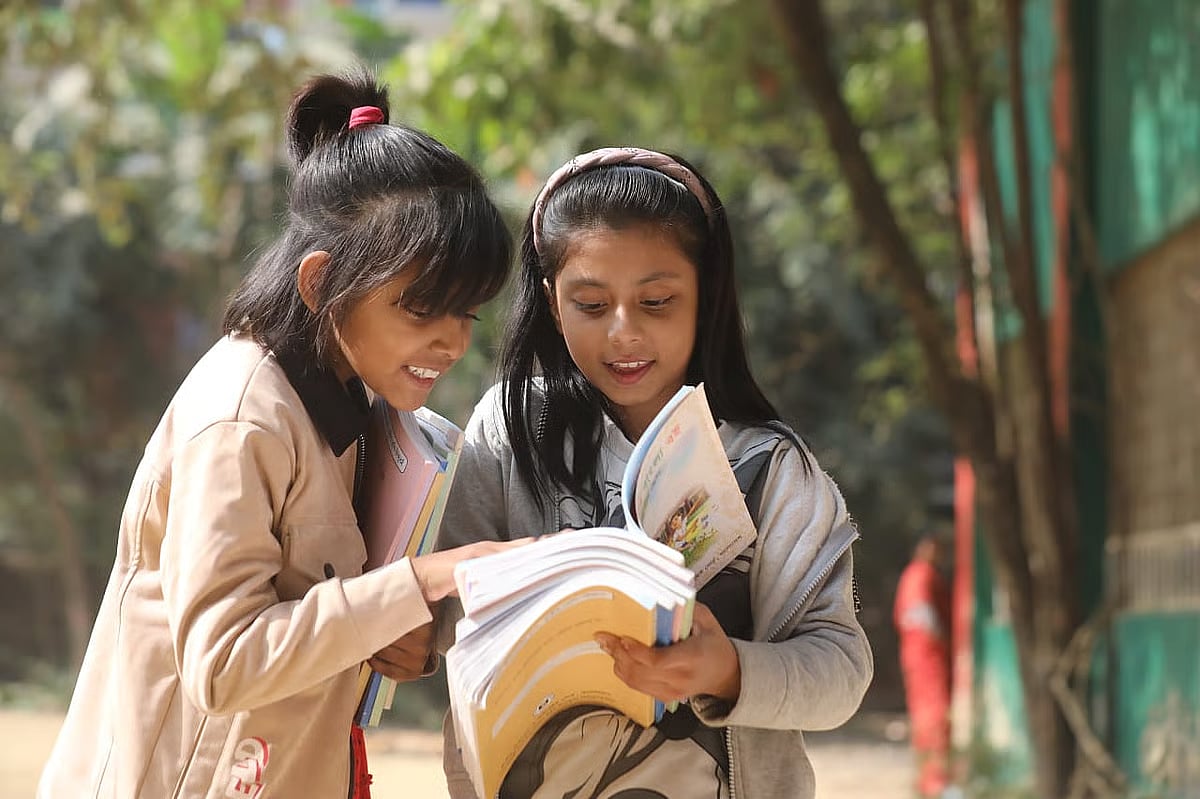
Class 1-2 exams reintroduced, how it will be evaluated
The Ministry of Primary and Mass Education has once again decided to revise the assessment system in primary education.
Under the new decision, cumulative assessment (examinations) will be reintroduced this year in classes one and two of primary schools.
Following the implementation of the new curriculum in 2023, the authorities had abolished examinations in these two grades and introduced a fully continuous assessment system.
Less than two years later, the government has reversed that decision. However, the move has raised questions about whether it is appropriate to impose examination pressure on very young children.
To implement the new assessment policy, the Ministry of Primary and Mass Education issued a letter on 1 February to the director general of the Directorate of Primary Education and the chairman of the National Curriculum and Textbook Board.
The letter stated that the decision was taken at a meeting held on 26 January to finalise the revised assessment guidelines for implementation at the primary level in the 2026 academic year.
When contacted, Shahana Sarmin, additional Secretary (Schools) of the Ministry of Primary and Mass Education, confirmed the new assessment decision.
Cumulative assessment refers to evaluation conducted through question papers, essentially the conventional examination system.
Continuous assessment, on the other hand, evaluates students throughout the academic year based on various classroom activities.
Under the new policy, subjects in classes one and two that are taught using both textbooks and teachers guides will carry 50 per cent continuous assessment and 50 per cent cumulative assessment.
However, subjects taught solely through teachers guides will continue to be assessed entirely through continuous assessment. As a result, classes one and two will now follow a combined system of continuous assessment and examinations.
Less than two years later, the government has reversed that decision. However, the move has raised questions about whether it is appropriate to impose examination pressure on very young children.
Under the new curriculum introduced in 2023, class three to five had followed an assessment structure of 50 per cent cumulative assessment and 50 per cent continuous assessment for textbook-based subjects.
This development raises questions about the distinction between subjects taught through textbooks and those taught through teachers guides.
A head teacher of a government primary school in Dhaka told Prothom Alo that classes one and two have three textbooks—Bangla, English and Mathematics—alongside four co-curricular subjects, such as Fine Arts.
He added that class three to five have six textbooks, along with several co-curricular subjects, including arts and crafts (which vary by grade).
In reality, classrooms are not delivering effective teaching, nor is continuous assessment being conducted properly. The system shifts that failure onto children in the name of term assessment. Instead, authorities should ensure learning according to each child’s ability and place greater emphasis on continuous assessment.Muhammad Mahboob Morshed, a member of the government-formed advisory committee on improving the quality of primary and non-formal education
Under the new decision, subjects with textbooks will follow both cumulative and continuous assessment methods, while co-curricular subjects will be assessed entirely through continuous evaluation.
Government primary schools conduct cumulative assessments three times a year. The first term assessment takes place in April, the second in August, and the final term assessment in early December.
Under the new decision, subjects with textbooks will follow both cumulative and continuous assessment methods, while co-curricular subjects will be assessed entirely through continuous evaluation.
The Ministry of Primary and Mass Education has stated that each government primary school will prepare its own question papers for term examinations.
If a school cannot do so independently, several neighbouring schools will jointly prepare the question papers. For each term-based cumulative assessment, at least 30 per cent of the questions must be drawn from textbook exercises.
Emphasis needed on learning and continuous assessment
According to the directorate of Primary Education’s 2024 Annual Primary School Census, Bangladesh has more than 118,000 primary schools, with a total student population exceeding 20 million (2 crore).
Muhammad Mahboob Morshed, a member of the government-formed advisory committee on improving the quality of primary and non-formal education and an associate professor at the Institute of Education and Research, University of Dhaka, does not support the introduction of term-based or cumulative assessments in classes one and two.
He questioned why children aged six or seven should be burdened with term examinations.
Speaking to Prothom Alo, he said, “In reality, classrooms are not delivering effective teaching, nor is continuous assessment being conducted properly. The system shifts that failure onto children in the name of term assessment. Instead, authorities should ensure learning according to each child’s ability and place greater emphasis on continuous assessment.”