Further changes to come in the integrated draft of the July Charter
The National Consensus Commission is reviewing political parties’ opinions on the integrated draft of the July Charter. The Commission is working to incorporate objections and suggestions raised by the parties regarding the Charter’s implementation commitments.
Based on this feedback, the Commission plans to bring fresh changes to the consolidated draft so that the views of the parties are broadly reflected.
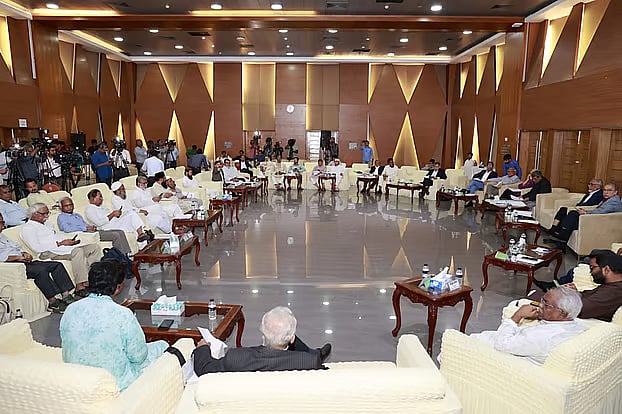
The Commission held a meeting yesterday, Wednesday, at its office in the Jatiya Sangsad Bhaban, where it reviewed the parties’ feedback, according to a press release.
Another meeting is scheduled for today, Thursday, to finalise the draft. Once complete, the Commission aims to begin discussions with political parties next week on the process of implementing the Charter.
After the interim government assumed responsibility, it initiated reform efforts in various sectors. In the first phase, the Consensus Commission held discussions with parties on reform proposals from six reform commissions—Constitution, Electoral System, Public Administration, Anti-Corruption Commission, Police, and Judiciary. Between February and July, two rounds of talks produced consensus on 84 reform proposals, which now form the basis of the July National Charter.
While there is consensus on the areas of reform, disagreements remain over the Charter’s commitments and methods of implementation. These differences have stalled progress.
On 29 July, the Commission circulated a preliminary draft of the Charter to 30 political parties. Following their feedback, a “integrated draft” was prepared and distributed to the parties on 16 August. So far, 29 parties have submitted opinions on the draft.
The integrated draft has three sections: the background of the Charter, the 84 reform proposals, and an eight-point commitment framework for implementation. Several parties, including the BNP, have objected to aspects of the commitment framework.
In particular, they oppose proposals to place the Charter above the Constitution and to prohibit legal challenges to the Charter in court. BNP deems these provisions unreasonable, while Jamaat-e-Islami argues they are necessary.
Parties are also divided on the method of implementation. BNP maintains that legal reforms can be enacted through ordinances of the interim government, while constitutional amendments should be carried out by the next parliament.
Jamaat-e-Islami, however, prefers implementation through a national referendum or presidential proclamation, while the National Citizen Party (NCP) has proposed forming a Constituent Assembly to implement the reforms, to be elected simultaneously with the next parliamentary polls.
Discussions between the Consensus Commission and experts have so far considered several options: holding a referendum on reform on the same day as parliamentary elections, adopting a legal framework, or using a presidential proclamation.
At yesterday’s Commission meeting, parties’ objections and suggestions—particularly on the commitment framework—were extensively discussed, with consideration of possible language changes.
Professor Ali Riaz, Vice-Chairman of the National Consensus Commission, told Prothom Alo, The Commission is giving serious consideration to the political parties’ opinions. He said, we are planning to introduce certain amendments to the draft in order to reflect the views collectively, while also taking into account the Charter’s legal and constitutional foundations.
Following the meeting, a Commission press release stated, the meeting discussed in detail the opinions received from political parties on the consolidated draft of the July National Charter. It analysed how these views could be reflected in the Charter, the process of finalising the Charter with due importance to the feedback, and the formation of necessary legal and policy frameworks. The meeting also reviewed possible options the government may consider for implementing the Charter.
Besides Vice-Chairman Professor Ali Riaz, the meeting was attended by Commission members Justice Emdadul Haque, Iftekharuzzaman, Badiul Alam Majumdar, Safar Raj Hossain, Aiyub Mia, and the Chief Adviser’s Special Assistant Monir Haider, who is involved in the consensus-building process.