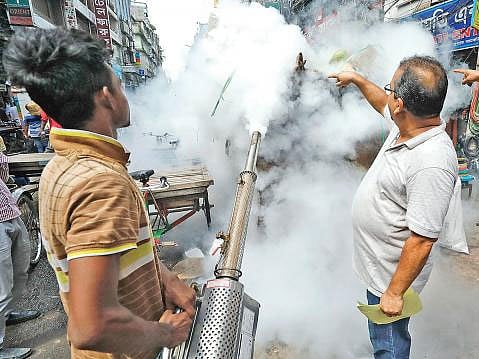
DSCC: Mosquitoes not dying despite drives, committee formed to find solutions
Mosquito control is one of the primary responsibilities of the city corporation. The abnormal surge in mosquito infestation in the capital suggests that the work is not being carried out effectively.
Although Dhaka South City Corporation (DSCC) claims that operations are ongoing regularly, officials themselves are concerned about why mosquitoes are not dying.
To assess whether the insecticides are effective, DSCC has formed a committee. The committee will conduct field-level investigations to determine whether mosquitoes are dying after insecticide application. It will also verify whether mosquito control workers are properly attending their assigned duties.
According to sources in DSCC’s health department, 1,030 workers are currently engaged in mosquito control activities. As per official guidelines, each ward is supposed to have seven workers spraying larvicide in the morning and six workers conducting fogging in the afternoon. However, field observations and citizens’ experiences suggest otherwise.
This correspondent toured the National Press Club, Segunbagicha, Bijoynagar, Naya Paltan and Kakrail areas under Ward No. 20 of DSCC on a motorcycle between 3:00 pm and 5:00 pm on Thursday. No mosquito control workers were found in any main roads or alleyways.
When informed that no workers had been seen in Ward No. 20 despite a two-hour search, assistant health officer Faria Fayez of DSCC Zone-1 said that mosquito control efforts have recently been prioritised in the secretariat area.
According to the official schedule, during Ramadan, six workers per ward are supposed to conduct mosquito control from 3:00 pm until just before iftar.
When informed that no workers had been seen in Ward No. 20 despite a two-hour search, assistant health officer Faria Fayez of DSCC Zone-1 said that mosquito control efforts have recently been prioritised in the secretariat area.
Workers assigned to Ward No. 20 were reportedly spraying insecticide inside the secretariat compound on Thursday, resulting in relatively less coverage in other areas.
She, however, maintained that mosquito control operations are being conducted regularly through area-based scheduling.
Another DSCC health official, speaking on condition of anonymity, said that although the city has seen several changes of administrators, the absence of elected mayors and councillors has weakened oversight. Some workers allegedly use political affiliations to avoid proper accountability.
Another official, however, admitted that mosquito control efforts were somewhat relaxed for 10 to 15 days before and after the national electio, though this may not be publicly acknowledged. This could be one reason for the sudden increase in mosquito infestation, the official added.
Urban experts say mosquito control cannot rely solely on fogging. While fogging may reduce adult mosquito populations, integrated efforts are required to eliminate larvae.
Over the past two days, this correspondent visited Khilgaon, Dhanmondi, Jatrabari, Jurain, Lalbagh and Chawkbazar, six areas under DSCC jurisdiction, and spoke to 32 residents and shopkeepers. All said mosquito infestation has suddenly worsened compared to previous years.
A footpath vendor, Md Rokon, said mosquito makes it difficult to conduct business after the afternoon. Ahmed Rony, a resident near Dhanmondi Lake, told Prothom Alo that standing on the balcony after sunset has become nearly impossible.
Effective in lab, questionable in field
According to DSCC health department sources, a larvicide called Temephos, imported from India, is sprayed in the morning to destroy mosquito larvae. In the afternoon, fogging with Malathion, imported from China, is conducted to kill adult mosquitoes.
A health department official said laboratory tests show the insecticides are effective. However, desired results are not being achieved in field applications. While larvae control measures are being conducted in drains and stagnant water bodies, the issue with fogging is that only mosquitoes directly hit by the smoke die; those not directly exposed survive.
DSCC chief health officer Jahan-e-Ferdous Binte Rahman said she herself is concerned about mosquito infestation around her residence in the Bailey Road area, despite regular spraying. This concern prompted the formation of the committee to evaluate insecticide effectiveness. The committee is expected to submit its report soon.
To ensure neutrality, no health department officials have been included in the committee. Instead, the chief waste management officer of DSCC has been appointed as its head.
Rising costs, growing questions
According to DSCC sources, Tk 465 million has been allocated for mosquito control activities in the current fiscal year. In the previous fiscal year, Tk 467.5 million was spent.
Accounting department sources say nearly Tk 1.88 billion has been spent on mosquito control over the past five years.
Despite this significant expenditure of public funds, questions are being raised as to why mosquito infestation remains uncontrolled.
Stakeholders say that without effective monitoring, quality verification of insecticides, and stronger field-level accountability, simply increasing allocations will not improve the situation.
Urban experts say mosquito control cannot rely solely on fogging. While fogging may reduce adult mosquito populations, integrated efforts are required to eliminate larvae. Without regular monitoring of construction sites, rooftop water accumulation, open drains and waterlogged areas, it will be difficult to bring the situation under control.
With dengue outbreaks intensifying in recent years, scrutiny of mosquito control programmes has grown stronger.
Experts stress that instead of seasonal or symbolic drives, year-round integrated planning is essential, particularly ward-based data collection, regular supervision and strengthened field-level accountability.