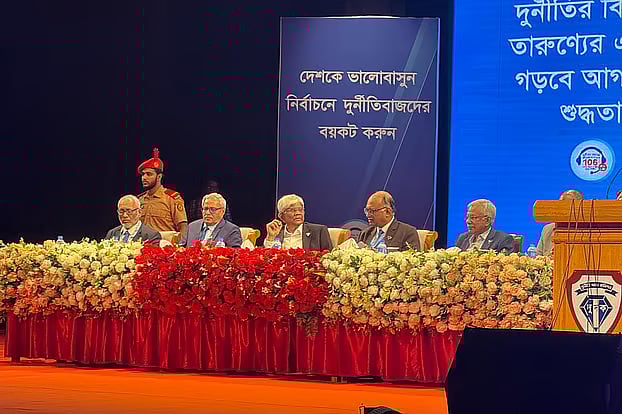
People rush to marry off children to corrupt individuals: Finance adviser
Finance adviser Salehuddin Ahmed has emphasised the need for social awareness to prevent corruption.
“When we were young, we rarely heard about corruption. We and even our fathers would avoid people involved in corruption. If someone was corrupt, we kept our distance. Even marrying our children into such families was considered inappropriate. But now, people rush to marry their children to those involved in corruption. Corruption doesn’t matter anymore; as long as they have money, that’s enough," he added.
Economic Adviser Salehuddin Ahmed made these remarks while delivering the keynote speech at a discussion meeting organized on the occasion of International Anti-Corruption Day 2025. The meeting was held today, Tuesday, at the National Theatre Hall of the Bangladesh Shilpakala Academy in Segunbagicha, Dhaka. The event, titled “Youth Unity Against Corruption: Building a Pure Future,” was organized by the Anti-Corruption Commission (ACC).
The finance adviser commented that corrupt people have no sense of responsibility and are rarely punished.
He said, “Their children live in luxury. Some of them reportedly spend Tk 5,000 to 10,000 on breakfast alone.”
He emphasised that without social awareness and a collective sense of disgust for corruption, it will never end.
He further stated that preventing corruption requires not only advice but also effective punishment, transparency, and accountability. Society must socially stigmatise corrupt individuals and promote greater information sharing.
In this context, the ACC Chairman pointed out inconsistencies in the asset declaration of former Prime Minister Sheikh Hasina during the 2008 election. He said that while the declaration listed 5.2 acres of agricultural land, the actual land was 29 acres. In addition to the declared vehicles, two more cars were found whose taxes had not been paid.
Salehuddin Ahmed believes that while lawmaking is essential, the bigger challenge lies in law enforcement.
He added that if strong checks and balances, credit rating systems, and technology-driven monitoring—similar to those in developed countries—are implemented, corruption would be significantly reduced.
In his speech as a special guest, AK Enamul Haque, Director General of the Bangladesh Institute of Development Studies, said that corruption cannot be eliminated through punishment alone; it requires social awareness, ethical values, and sustained vigilance. He noted that there are 14 to 15 different types of corruption in the country.
Mohammad Abdul Momen, Chairman of the Anti-Corruption Commission (ACC), commented that if a public referendum were held on corruption, 100 per cent of people would oppose it. Yet, corruption continues in the country, and the Anti-Corruption Commission (ACC) has to take action.
He said, “Before the previous government’s Prime Minister fled, the finance minister escaped. The Governor of Bangladesh Bank also fled. Almost none of those involved in the financial system remained in the country. Even the Chief Justice of our Supreme Court fled. More astonishingly, the Khatib of Baitul Mukarram Mosque also fled. From this, one can imagine how deeply corruption has penetrated.”
He added that if corruption had been stopped at its onset, the country could have avoided 15 to 16 years of suffering.
In this context, the ACC Chairman pointed out inconsistencies in the asset declaration of former Prime Minister Sheikh Hasina during the 2008 election.
He said that while the declaration listed 5.2 acres of agricultural land, the actual land was 29 acres. In addition to the declared vehicles, two more cars were found whose taxes had not been paid.
Had these discrepancies been detected, her nomination would have been canceled. However, the ACC overlooked these issues at the time. If these had not been suppressed, her nomination would have been rejected, she could not have contested the election, and she could not have become Prime Minister.
He stressed that choosing honest and capable leadership is crucial ahead of elections, and re-electing corrupt individuals makes good governance impossible.
Other speakers at the discussion included ACC Commissioner (Investigation) Mian Muhammad Ali Akbari Azizi, Commissioner (Inquiry) Brigadier General (Retd.) Hafiz Ahsan Farid, and Secretary Mohammad Khaled Rahim.