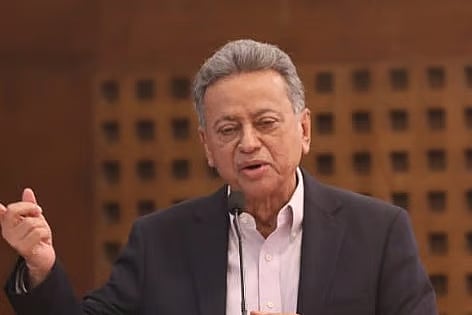
BNP Standing Committee member Amir Khasru Mahmud Chowdhury has urged all parties and groups to work towards restoring democracy through a national election in the first half of February, without creating debate or division.
He said history shows that countries returning to democratic processes quickly after an uprising have fared well, while those that delayed elections by dragging disputes and issues ended up facing civil wars, social divisions, and economic disaster.
Speaking at a seminar titled “Reform and Election: The Context of National Unity” organised by Democracy Dias Bangladesh, Amir Khasru discussed the ongoing reform process and the upcoming elections. The seminar was held yesterday, Saturday afternoon, at the BIISS auditorium in Ramna, Dhaka. Democracy Dias Bangladesh, a research-based organisation, launched its activities two years ago.
Questioning why consensus talks are still needed 14 months after the July mass uprising, the BNP leader said, “To the extent we have reached consensus, let’s close the chapter. Why again so much discussion beyond that? Why do I have to discuss PR (proportional representation)? If there is no consensus on PR, close the chapter. … Who gave us the mandate that a few parties sitting around a table will decide the future of Bangladesh?”
He also stressed that even if political parties reach consensus, it must still go to the people. “If we all agree today on many issues, but tomorrow the people reject it and deny the mandate, then what happens? We have made it clear that we will go to the people with our 31 points. But beyond that, the exercises going on will cause more harm than benefit.”
Senior journalist and poet Sohrab Hasan said there is no scope for proportional representation (PR) if elections are to be held in February. If the election is delayed, he warned, it will threaten national security, democracy, the economy, and society
Rebuilding or falling into crisis?
At the seminar, Nagorik Oikya president Mahmudur Rahman Manna said, “The economic crisis has not ended, administration is not fixed, police don’t listen. In such a situation, how good will the election be, that’s everyone’s question. Four and a half months are left. People still ask—will the election even happen? If people still doubt the election, how can it take place?”
Calling mistrust the “main problem”, Manna said, “By resolving the debate, we can go to the election on the basis of a joint decision.”
Senior journalist and poet Sohrab Hasan said there is no scope for proportional representation (PR) if elections are to be held in February. If the election is delayed, he warned, it will threaten national security, democracy, the economy, and society.
Dhaka University professor Rashed Al Mahmud Titumir said the important question now is whether Bangladesh will witness a period of rise, or fall into a political crisis. “The fundamental question is—will we rebuild the state, or create instability that will push the country into a shadow war?”
Dhaka University professor Asif Mohammad Sahan observed that PR elections could cause problems of governmental instability, though he personally supports PR in the upper house.
Another Dhaka University professor, SM Shameem Reza, said PR must indeed be discussed, but questioned: “For the people who have been excluded from the electoral process for many years, how can they be suddenly told about a new system? Imposing such a condition in a complex time could create uncertainty about the election. Elements of instability must be reduced.”
At the start of the seminar, Democracy Dias Bangladesh chairman Abdullah-Al-Mamun presented a “concept paper” highlighting the negative aspects of PR elections and the political motives behind suddenly raising the demand for PR.
Minimum national consensus needed
Gano Sanghati Andolan chief coordinator Zonayed Saki said that 54 years after independence, as Bangladesh once again stands at the point of deciding the “rules of the game”, a minimum level of national consensus is required. He said PR has no practicality in the lower house, but discussions can be held about it in the upper house.
Rashed Khan, general secretary of Gono Odhikar Porishad, also said PR could be discussed in the upper house, but not in the lower house.
Jamiat Ulema-e-Islam secretary general Golam Mahyuddin Ikram said those suddenly calling for PR elections are not aiming for elections but for creating instability and fishing in murky waters. He warned that delaying elections will increase unrest and allow fascist forces to rise.
Rezaul Karim Rony, editor of Jaban magazine, said it is not democratic behaviour to frame national elections with preconditions. “PR may be important, but that’s like thinking the Titanic can be sailed on the Buriganga River.”
Among others, BNP media cell convener Professor Moudud Hossain Alamgir, journalist Kazi Jesin, and actor Shahed Sharif Khan spoke at the seminar.