Election campaign
Shafiqur seeks to bring Jamaat back to centre of discussion
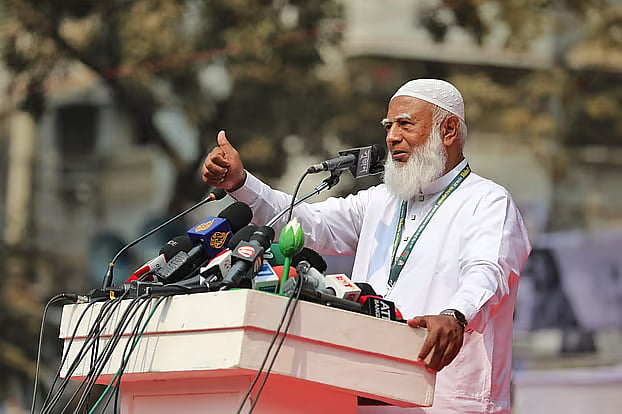
In the campaign for the 13th national parliamentary election, Jamaat-e-Islami ameer Shafiqur Rahman has spoken in a forthright and assertive tone.
The substance, diction and presentation of his speech differ markedly from the party’s long-standing conventional rhetoric. He has clearly sought to bring the party back to the centre of political debate.
Rather than relying on routine promises of development or the customary narrative of a change in power, Shafiqur Rahman has repeatedly called on voters at nearly every rally to secure a ‘Yes’ vote in the referendum to achieve structural state reform and to prevent what he describes as the return of ‘fascism’.
He has consistently invoked the themes of haq (truth or rightful entitlement), insaf (justice), and governance based on the ‘Madina model’.
This approach appears to present Jamaat-e-Islami as an ‘untested’ alternative, positioning itself in contrast to the Bangladesh Nationalist Party (BNP) and maintaining a vocal competitive stance.
Observers have also noted his careful and strategic tone on sensitive issues such as the Liberation War, women and minority communities.
Responsible party sources state that since launching the campaign on 22 January, the Jamaat ameer has addressed at least 62 public rallies. He has travelled by car to some venues and by helicopter to others.
On 30 January alone, he addressed four large rallies in Feni, Noakhali, Laksam and Cumilla.
At these events, he did not confine himself to seeking votes; he clearly attempted to construct a political narrative against his principal rival, the BNP.
In particular, he has repeatedly criticised the BNP over allegations of ‘extortion’ and ‘corruption’. He has also pledged to prevent vote rigging and to guard voting centres.
At one campaign rally, the Jamaat ameer remarked that certain leaders who had signed the July Charter now oppose the referendum. On the issue of reforms, he said they had adopted a ‘No’ stance, claiming they had signed the July Charter reluctantly.
Mohiuddin Ahmed, author of ‘Jamaat-e-Islami: Utthan Biporjoy Punorutthan’, told Prothom Alo that Shafiqur Rahman had spoken clearly and candidly at public meetings.
He added that some of the ameer’s remarks had generated controversy and may have offended sections of society, although they could attract support from other segments.
In Ahmed’s assessment, Jamaat had long remained a peripheral actor in Bangladeshi politics but has now moved to the forefront.
Tarique Rahman questioned why, if the BNP were so corrupt, Jamaat leaders Motiur Rahman Nizami and Ali Ahsan Mohammad Mojaheed did not resign from the cabinet during the BNP-led four-party alliance government between 2001 and 2006.
Terrorism and corruption debate
During the campaign, Jamaat has pledged zero tolerance for corruption and terrorism. These two issues significantly affect young people, particularly business owners and ordinary citizens.
By repeatedly foregrounding these themes, the Jamaat ameer has intensified electoral debate.
At a rally in Sirajganj on 25 January, he described the BNP as ‘champions of corruption’. On 28 January in Mymensingh, BNP chairman Tarique Rahman responded.
Tarique Rahman questioned why, if the BNP were so corrupt, Jamaat leaders Motiur Rahman Nizami and Ali Ahsan Mohammad Mojaheed did not resign from the cabinet during the BNP-led four-party alliance government between 2001 and 2006.
Jamaat’s increased visibility in national politics, Islami Chhatra Shibir’s victories in university student union elections, media prominence, anti-corruption and anti-terrorism speeches, sustained grassroots engagement, outreach to women voters, and its branding as a ‘new opportunity’ together constitute its strategic advantages in this election.
Tarique Rahman stated, ‘My question is, from 2001 to 2006, two of their members served in the BNP government. If the BNP was so bad, why did those two individuals not resign? They remained in government because they knew very well that Khaleda Zia was firmly combating corruption.’
On 29 January, at a campaign street meeting in Karwan Bazar, Dhaka, Shafiqur Rahman replied, ‘We did not withdraw because we wanted at least three ministries to survive and remain protected from corruption.’
‘Haq’, ‘Madina model’ and ‘give us a chance’
The terms "haq" and "insaf" have featured prominently in Jamaat’s campaign and have also entered voters’ discussions. According to standard dictionaries, haq denotes truth or rightful entitlement, while insaf means justice.
Although leaders of other parties have spoken about citizens’ rights and social justice, the use of these Arabic-derived terms has struck many voters as distinctive.
Shafiqur Rahman has pledged that, if elected, his party will establish "haq" and "insaf", govern the country according to the ‘Madina model’ and build a united Bangladesh.
He has also promised to publish annual asset declarations of party leaders and to repatriate funds that have been illicitly transferred abroad. Shafiqur Rahman and other party leaders have made a specific appeal to voters.
They have argued that the electorate has already seen the Awami League and the Bangladesh Nationalist Party (BNP) govern the country and should now consider Jamaat-e-Islami as a new opportunity.
BNP leaders, however, have countered that there is nothing new about Jamaat, asserting that the public witnessed its role as far back as 1971.
Various election-focused political analyses have highlighted one major point – voters have never seen Jamaat govern the country independently and therefore its success or failure in office remains untested.
By contrast, some recent actions of the BNP have generated public dissatisfaction. As a result, a segment of voters may view Jamaat’s promises as a potential alternative.
BNP chairman Tarique Rahman has pledged that, if elected, he will issue ‘Family Cards’ to 40 million (4 crore) families.
In response, the Jamaat ameer has stated that his party will not ‘insult’ unemployed citizens by offering allowances or cards; instead, it will provide employment.
At campaign rallies, Shafiqur Rahman has declared, ‘You, our brothers and sisters, are our cards. With your support, prayers and goodwill, we wish to build a Bangladesh free from unemployment and burdens.’
He has also promised that, if elected, Jamaat will train young people and develop a skilled workforce. He has pledged comprehensive reforms of the Qawmi education system.
Furthermore, the Jamaat ameer has stated that he will work to end border killings and build global relationships on the basis of equality, prioritising national interests.
The liberation war, women and minorities
In the campaign exchanges between the two principal rival parties, two sensitive issues have emerged prominently: corruption and the Liberation War.
Whenever the BNP raises Jamaat’s role during the Liberation War, Jamaat leaders have reacted with marked anger.
Conversely, when Jamaat highlights recent allegations of extortion or past corruption involving the BNP, BNP leaders have responded sharply.
Jamaat’s historical position regarding the Liberation War, women and minority communities has long generated controversy. During this campaign, however, the party has spoken cautiously on these matters.
Leaders have offered various explanations concerning their role during the Liberation War. Observers have also noted Shafiqur Rahman’s efforts to win the confidence of minority communities and women voters.
In his speeches, he has placed particular emphasis on women’s dignity and honour, as well as their safety in the workplace and in public spaces.
He has also expressed strong condemnation of attacks and harassment targeting female party activists in different locations.
However, on 31 January, a post from the Jamaat ameer’s official X account containing derogatory remarks about women sparked criticism. Jamaat subsequently claimed that hackers had compromised the account and published the post without authorisation.
According to information available on Jamaat’s official website, Shafiqur Rahman is 67 years old.
After obtaining his MBBS degree from Sylhet Medical College (now MAG Osmani Medical College) in 1983, he pursued medical practice alongside political activities.
He joined Jatiya Samajtantrik Dal (JASAD) Chhatra League in 1977 and later joined Islami Chhatra Shibir in the same year. In 1984, he joined Jamaat-e-Islami and became its ameer in 2019.
He contested the 2001 parliamentary election from the Moulvibazar-2 constituency as a Jamaat candidate and lost, securing 12,415 votes.
In the 2018 general election, widely referred to as the ‘nighttime vote’, he contested the Dhaka-15 constituency (covering Kafrul and part of Mirpur) as a candidate of the Jatiya Oikko Front, at a time when Jamaat’s registration had been cancelled.
Despite widespread allegations of electoral irregularities against the Awami League, he received 39,071 votes. He is contesting the same constituency again in the current election.
Whenever the BNP raises Jamaat’s role during the Liberation War, Jamaat leaders have reacted with marked anger. Conversely, when Jamaat highlights recent allegations of extortion or past corruption involving the BNP, BNP leaders have responded sharply.
Pillars of confidence
Political observers note that Jamaat is currently attracting considerable media attention, a trend that has been visible since the mass uprising of 2024.
Both domestic and international media outlets have, at times, given the party space and prominence comparable to that of other major political parties.
Observers also point to the sustained online campaigning by Jamaat supporters. For many years, they have worked to shape the party’s image and promote its agenda on social media platforms.
In addition, the party has long maintained an organised grassroots outreach and mobilisation structure.
Jamaat’s increased visibility in national politics, Islami Chhatra Shibir’s victories in university student union elections, media prominence, anti-corruption and anti-terrorism speeches, sustained grassroots engagement, outreach to women voters, and its branding as a ‘new opportunity’ together constitute its strategic advantages in this election.
Shafiqur Rahman has incorporated these elements into his campaign strategy. However, the true measure of a tree lies in its fruit.
What that fruit will be remains uncertain, as voters will determine the outcome on voting day, 12 February.