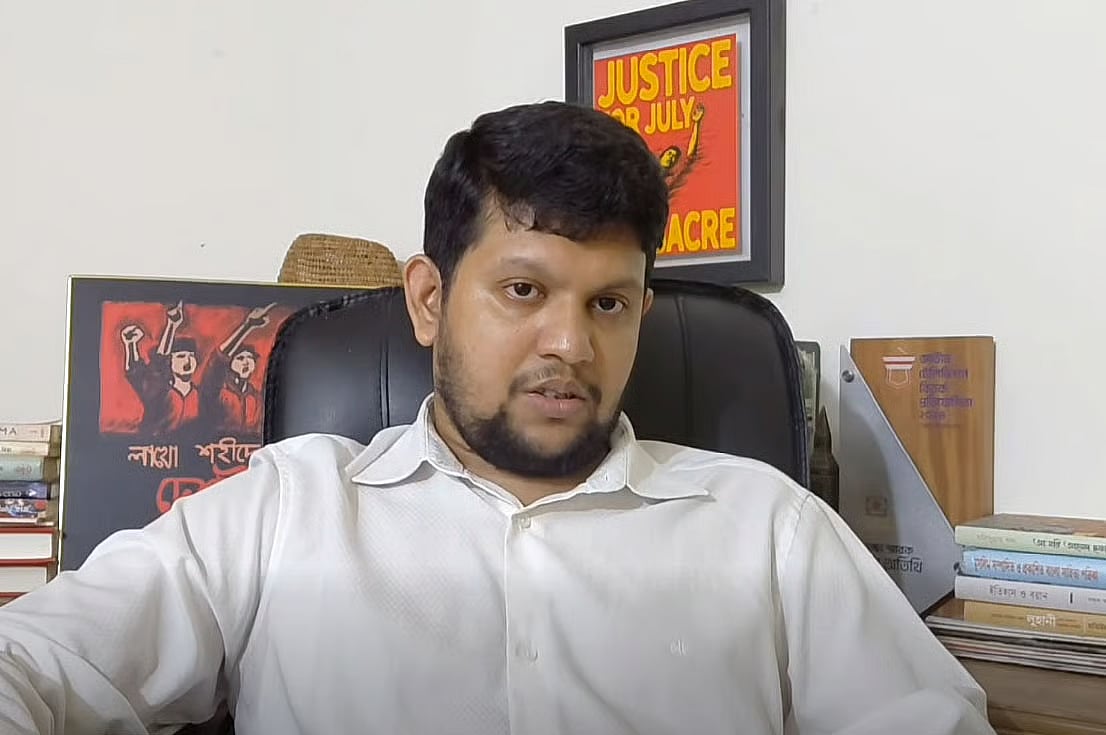
Former adviser to the interim government, Mahfuj Alam, believes that the Awami League — whose activities were banned following the July mass uprising — has effectively returned to Bangladesh’s political arena. He expressed this view in a Facebook post on Tuesday.
In the post, Mahfuj Alam wrote, “The League is a theology before it is a political party, and faith in that theology has returned once again. Today I will explain how it returned.”
He then presented a long list explaining how, in his view, the Awami League made its comeback. Mahfuj Alam, who played an important role in the July mass uprising, wrote: “The League returned the very day anti-independence forces positioned 2024 against 1971. The League returned the very day people within the interim government began working for the rise of the right wing. The League returned the day the oppressed masses found joy in mob rule instead of the rule of law after the past 17 years.”
Mahfuj Alam also believes that silence over attacks on shrines and persecution of Hindus paved the way for the Awami League’s return. He wrote, “The League returned the day extremists attacked shrines and drove dissenters out of mosques. The League returned the day the oppressed remained silent over persecution against Hindus.”
He further argued that fears among secular-minded people about the rise of right-wing politics, along with creating safe spaces for extremists, also contributed to the Awami League’s return.
In his words: “The League returned the day people who believed in secular values became fearful of the state-sponsored rise of the right wing in this country. The League returned the day mobsters were turned into heroes. Safe spaces were created for extremists.”
Mahfuj Alam also believes that several actions of the interim government played a role in this process. He wrote: “The League returned the day people were alienated and disillusioned through minimal reforms and so-called consensus commissions instead of dismantling the system altogether. The League returned the day BNP and * turned against the interim government, and the interim administration embraced Jamaat in order to contain BNP and *.”
He continued: “The League returned the day students failed to transform into a revolutionary organisation and instead turned into lumpen clubs and mobs. The League returned the day attacks on media and cultural institutions were orchestrated. The League returned the day the interim government shifted from being political to bureaucratic, and decisions began coming from a bureaucracy-dependent kitchen cabinet. Most members of that kitchen cabinet were covert loyalists of Jamaat, BNP, or the League itself. To them, July was merely about protecting the interests of their own families, future generations, and institutions.”
Listing further reasons that, in his opinion, facilitated the Awami League’s return, Mahfuj Alam wrote: “The League returned the day authoritarian group politics triumphed over democracy on campuses. The League returned the day the kitchen cabinet united to obstruct approval for new media outlets. The League returned the day the process of drafting the July declaration or charter was handed over to bureaucrats and vested interest groups. The League returned the day the oppressed masses celebrated when leftists and Shahbagh activists were beaten.”
Mahfuj Alam added: “The League returned the day regressive cultural systems such as qawwali and Inqilab Islamic culture were promoted as a grand alternative to Bengali nationalism. The League returned the day reforms and justice were compromised through electoral bargaining and turned into bargaining tools for BNP and Jamaat. The League returned the day commissions, tribunals, universities, and other institutions were transformed into bargaining tools for the rise to power of people from a particular ideological camp. The League returned the day those who had stood with us culturally and intellectually during July were sidelined, while people with zero contribution but hidden affiliations were empowered.”
At the end of the post, Mahfuj Alam noted that the list of reasons behind the Awami League’s return would continue to grow.