World Bank report
Rise in poverty rate: 36m poor in Bangladesh
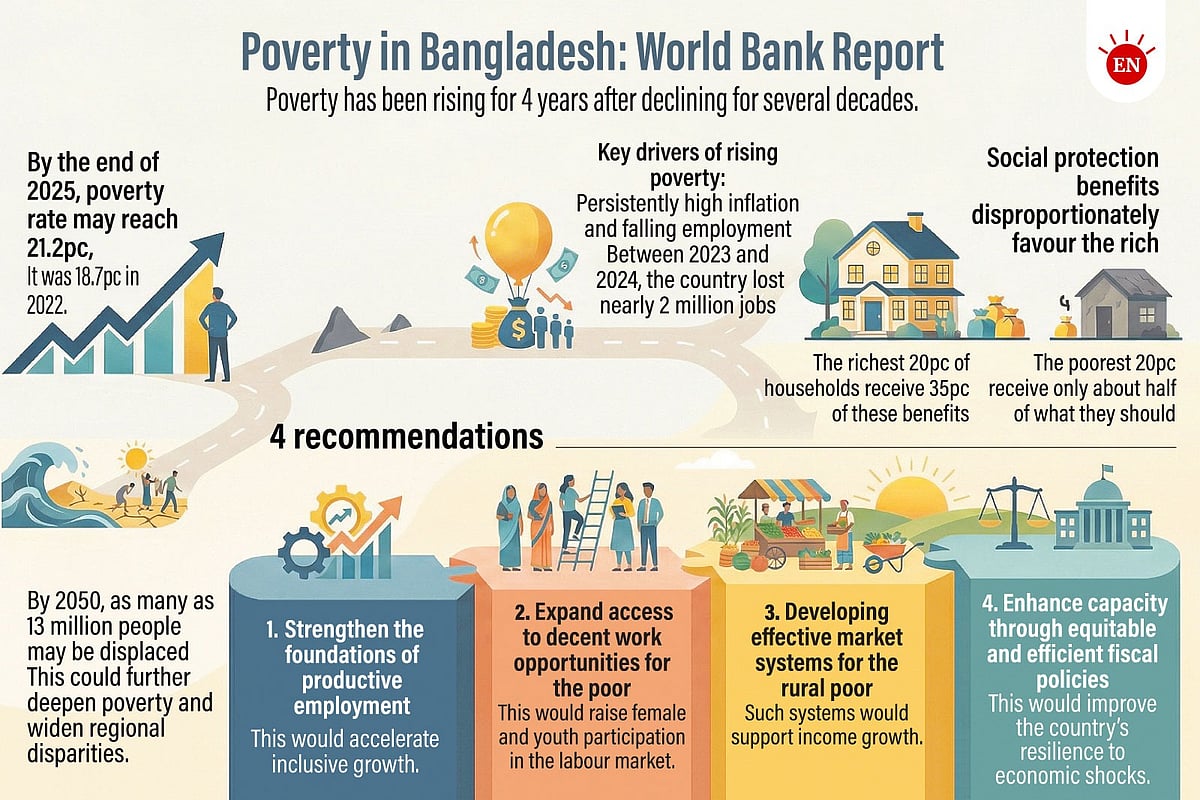
Bangladesh is moving backward in terms of poverty reduction. The World Bank says the poverty rate has been rising for the past four years. According to the organisation’s projected estimate, the poverty rate may exceed 21 per cent in 2025. The number of poor people in the country now stands at 36 million.
A large share of the population lives just above the poverty line. Because of shocks such as high inflation, they face the risk of falling below the poverty line. According to World Bank estimates, in 2022 this number was 62 million.
Poverty in Bangladesh is calculated by the Bangladesh Bureau of Statistics (BBS), based on the Household Income and Expenditure Survey. The most recent survey was conducted in 2022. At that time, the overall poverty rate was 18.7 per cent.
The World Bank’s estimate is essentially a projection, conducted using a method called the “micro-simulation model.” The World Bank says the poverty rate was assessed in this model based on labour market dynamics, remittance inflow, and government subsidy spending.
In Bangladesh, the poverty rate began to decline significantly from the 1990s (it was 56.7 per cent in 1991–92). After 2000, the pace accelerated further. Bangladesh had earned global recognition for successfully reducing poverty. But now, recent data shows that Bangladesh is moving backward.
The World Bank has provided new poverty estimates in a report titled “Bangladesh: Poverty and Inequality Analysis, Progress Toward Shared Prosperity.” The report was released yesterday, Tuesday, at a hotel in Dhaka along with a discussion session. The event was organised jointly by the World Bank and the private research organisation Policy Research Institute (PRI).
The chief guest at the event was Hossain Zillur Rahman, executive chairman of the private research organisation PPRC. Reflecting on the past record of poverty reduction, he said the period from 2022 to 2025 has unfortunately become a time of “reversal.” World Bank data shows this is not a sudden fall—this is reality, poverty has increased.
The second phase, 2016 to 2022, saw a deceleration in poverty reduction. A new political economy emerged, where debt-driven infrastructure development overshadowed other priorities. Corruption-based incentives replaced rule-based governance. The erosion of political democracy further weakened economic democracy.PPRC executive chairman Hossain Zillur Rahman
PPRC also released a poverty survey report last August. It stated that in 2025 the country’s overall poverty rate had increased to 27.93 per cent.
According to the World Bank report, a monthly per capita income of Tk 2,750 is considered the lower poverty line, and Tk 3,832 represents the upper (total) poverty line.
Why poverty is increasing
World Bank senior economist Sergio Olivieri presented various aspects of the report at the event. It identifies several major reasons behind rising poverty: insufficient job creation, job losses, high inflation, and stagnant wages. The organisation says some 2 million jobs were lost between 2023 and 2024. Another 800,000 jobs may disappear in 2025. The biggest shock from the shrinking job market has hit women and young people.
The World Bank believes that after 2016, the nature of Bangladesh’s economic growth began to change. It says that during this period, an average of around 1.5 million new jobs were created each year. But 63 per cent of those were in the agriculture sector, where income is low. Urban employment growth remained largely stagnant.
Rich receive more social safety
The government’s social safety programmes benefit the rich more than the poor. According to the World Bank report, in 2022 only half of the poorest 20 per cent of households received social assistance, while 35 per cent of the richest 20 per cent also received such benefits.
The World Bank says Bangladesh has indeed increased social spending, but weaknesses in beneficiary selection undermine its expected impact. Due to systemic flaws in the subsidy mechanism, comparatively wealthier households receive greater benefits. As a result, progress in poverty reduction and inequality alleviation remains limited.
Although the coverage of social protection programmes has expanded, the World Bank notes inefficiency in management and beneficiary selection. It says that between 2010 and 2022, the coverage of social assistance in urban areas increased rapidly—from 16 per cent to 34.5 per cent. This is positive in terms of numbers. However, the flow of benefits to affluent households could not be stopped.
13m people could be displaced by 2050
The World Bank states that climate change risks may threaten Bangladesh’s hard-earned achievements in reducing poverty and regional inequality. By 2050, climate change may displace 13 million people. It could reduce GDP from the agriculture sector by up to one-third.
Bangladesh has made notable progress in reducing regional disparities, particularly the east–west divide. Between 2010 and 2022, poverty fell more rapidly in western and high-poverty regions. But various climate-related risks could increase regional inequality in the future, the World Bank warns.
According to the organisation, floods and drought disproportionately affect rural households. Their ability to recover depends heavily on local infrastructure and institutional capacity.
4 recommendations
To accelerate poverty reduction, the World Bank has made four recommendations: strengthen employment generation in productive sectors; expand decent job opportunities for the poor and vulnerable; build effective market systems for rural poor communities; and, enhance resilience through equitable and efficient fiscal policies.
At the event, PPRC executive chairman Hossain Zillur Rahman analysed the poverty situation through three time periods.
According to him, the period from 2010 to 2016 represented a continuation of past momentum. During this time, although the link between poverty reduction and growth had not reversed, signs of slowdown were visible. The second phase, 2016 to 2022, saw a deceleration in poverty reduction. A new political economy emerged, where debt-driven infrastructure development overshadowed other priorities. Corruption-based incentives replaced rule-based governance. The erosion of political democracy further weakened economic democracy.
According to Hossain Zillur Rahman, the period from 2022 to 2025 is the phase of “reversal.” He said, “We now stand at many crossroads—LDC graduation, middle-income transition, return of an elected government. But how prepared are we?”
After the report presentation, economists discussed its findings. This session was moderated by Selim Raihan, executive director of the private research organization South Asian Network on Economic Modeling (SANEM). He said several research institutions have shown that poverty has increased in recent years, but BBS remained silent on the matter.
In this session, Mustafizur Rahman, distinguished fellow at the private research organisation Centre for Policy Dialogue (CPD), said sustainable poverty eradication measures must be taken. The government-appointed White Paper Drafting Committee has made several recommendations for sustainable growth, which also align with the World Bank report.
Bangladesh Institute of Development Studies (BIDS) director general Enamul Haque said government investment plays a crucial role in poverty reduction. The agriculture sector should be developed, as 42 per cent of the population depends on it.
Dhaka University pro–vice-chancellor Saima Haque Bidisha said income growth requires access to quality or decent jobs. This would also reduce poverty.
Uzma Chowdhury, director of PRAN-RFL Group, emphasised increasing access to finance for entrepreneurs to expand employment opportunities. She said poverty reduction also depends on the law-and-order situation.
World Bank country director Jean-Pascal Nguessa Nganou said traditional approaches will not accelerate poverty reduction. Jobs must be created for youth, women, and vulnerable populations.
The event was chaired by PRI chairman Zaidi Sattar. He said that over the past few decades a large number of people have risen above the poverty line and improved their living standards. But now, instead of decreasing, poverty has increased.
Also speaking at the discussion was World Bank regional practice director Sebastian Eckardt.