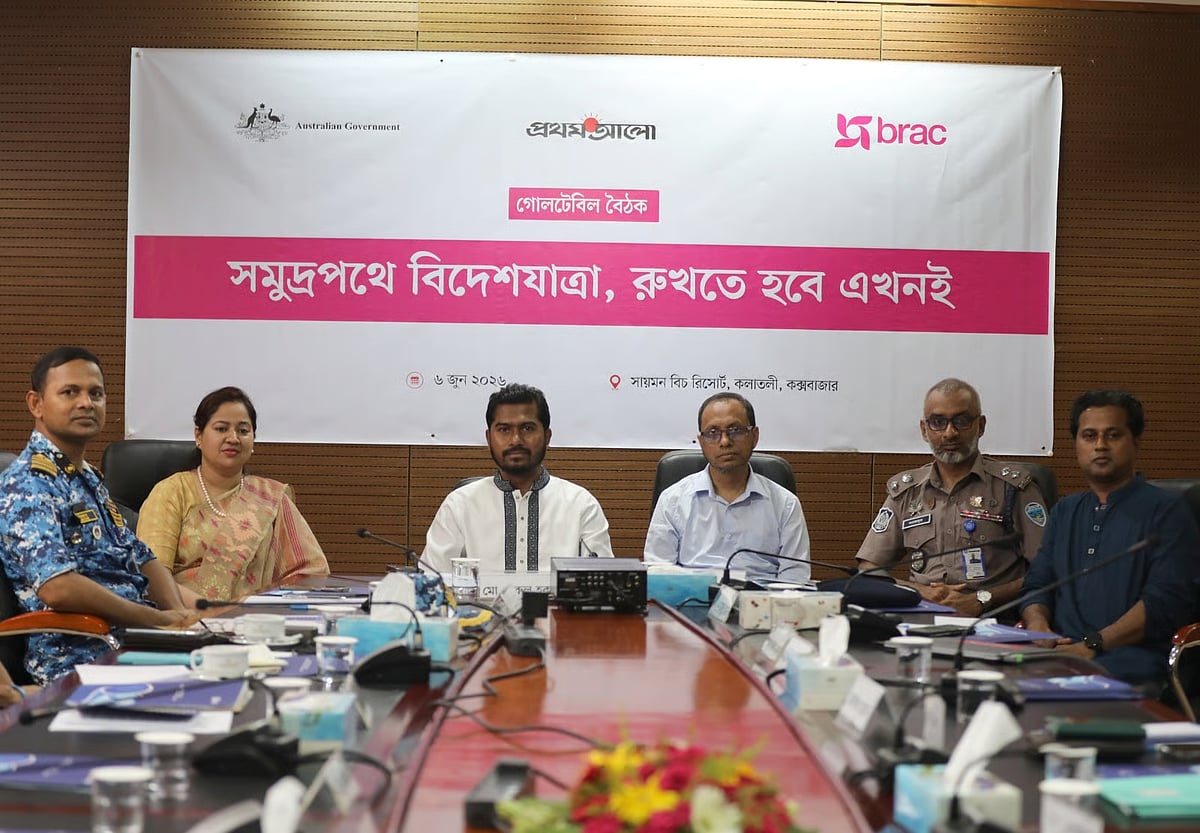
Speakers at BRAC–Prothom Alo Roundtable
Say ‘no’ to irregular migration by sea
Irregular migration by sea must be stopped to prevent human trafficking, loss of life, and the tarnishing of Bangladesh’s international reputation, speakers said at a roundtable discussion in Cox’s Bazar on Saturday.
Organised jointly by BRAC and Prothom Alo with support from the Australian Government, the discussion, titled “Irregular Migration by Sea Must Be Stopped now,” was held at Sayeman Beach Resort in the tourist town.
Government officials, law enforcement representatives, migration experts, journalists, development practitioners, and survivors of trafficking attended the event.
Addressing the programme as chief guest, State Minister for Expatriates’ Welfare and Overseas Employment Md Nurul Haque said, “We must stop journeys by sea to Europe, Australia, and other countries. These movements have already created numerous problems.”
He said many people are lured by promises of a better life abroad and fall victim to traffickers who exploit their hopes and vulnerabilities.
“People sell land and properties or take loans in order to finance these dangerous journeys. Along the way, traffickers hold them hostage and extort money from their families. Many die before reaching their destination, while those who survive often face arrest,” he said.
The state minister described such incidents as humanitarian tragedies that affect not only the victims but also their families and communities.
Highlighting efforts to promote safe migration, he noted that Bangladesh currently has 104 Technical Training Centres (TTCs) serving prospective migrant workers and said the government is working to improve the quality of training provided at these institutions.
He also stressed the importance of grassroots awareness campaigns involving government agencies, NGOs, elected representatives, political leaders, and the media.
Deputy Commissioner of Cox’s Bazar district Md A Mannan said the district administration remains vigilant in preventing irregular migration through coastal routes and called on civil society and development organisations to support these efforts.
Suraya Akter Swety, camp-in-charge and deputy secretary at the Refugee Relief and Repatriation Commission, said irregular migration by sea remains a concern among both Bangladeshis and Rohingya refugees. She noted that traffickers often target adolescent Rohingya girls by promising them a better future or prospects of marriage abroad.
Highlighting efforts to promote safe migration, he noted that Bangladesh currently has 104 Technical Training Centres (TTCs) serving prospective migrant workers and said the government is working to improve the quality of training provided at these institutions.
He also stressed the importance of grassroots awareness campaigns involving government agencies, NGOs, elected representatives, political leaders, and the media.
Deputy Commissioner of Cox’s Bazar district Md A Mannan said the district administration remains vigilant in preventing irregular migration through coastal routes and called on civil society and development organisations to support these efforts.
Suraya Akter Swety, camp-in-charge and deputy secretary at the Refugee Relief and Repatriation Commission, said irregular migration by sea remains a concern among both Bangladeshis and Rohingya refugees. She noted that traffickers often target adolescent Rohingya girls by promising them a better future or prospects of marriage abroad.
Captain Mohammad Mizanur Rahman, zonal commander of the Bangladesh Coast Guard’s Eastern Zone (Chattogram), said traffickers use Cox’s Bazar as a transit route, bringing people from different parts of the country and hiding them in remote locations before transporting them to larger vessels.
“Before departure, traffickers fill them with dreams of a better future. But the abuse and exploitation begin as soon as they board the vessel,” he said, adding that stronger action against traffickers could significantly reduce such incidents.
District Superintendent of Police ANM Sazedur Rahman said law enforcement measures alone are insufficient to stop irregular migration and called for greater public awareness and community engagement.
Presenting the keynote paper, Shariful Hasan, associate director of BRAC’s Migration Programme, highlighted trends and challenges in migration from Bangladesh.
Recalling his experience as a journalist, he said hundreds of Bangladeshis and Rohingya have lost their lives over the past decade while attempting irregular migration by risky sea routes. He referred to the discovery of mass graves in Thailand and Malaysia in 2015, where many trafficking victims remained unidentified and were buried under numbered markers.
“Eleven years later, the situation has still not changed,” he said.
Shariful Hasan noted that Bangladesh remains one of the leading countries of origin for people attempting to reach Europe through irregular sea routes.
“Being number one in this respect is deeply embarrassing for the country,” he said.
Drawing a comparison with Bangladesh’s success in reducing acid violence, he added that a similar collective effort could help end irregular migration by sea.
Two trafficking survivors also shared their experiences during the discussion.
Aung Aung Yu Jewel said traffickers promised to take him to Australia via Malaysia for Tk 12 lac. During the journey, he was taken through Myanmar before being arrested. With assistance from a police officer and the Bangladesh embassy, he eventually returned home.
“When I returned, I found my entire life had been thrown into disarray,” he said.
Another survivor, Tarequr Rahman of Maheshkhali, said a trafficker promised him a job in Malaysia but instead took him through Myanmar and Thailand, repeatedly demanding money from his family. He was eventually arrested while attempting to cross into Malaysia and later returned to Bangladesh after serving a prison sentence.
Abdul Quddus, Prothom Alo’s staff correspondent in Cox’s Bazar, delivered the welcome address, while Firoz Choudhury, assistant editor of Prothom Alo, moderated the discussion.
Among others, those attending the event included Astrid Castelein, assistant representative of UNHCR; Mobarak Hossain, assistant director of the Cox’s Bazar Regional Passport Office; Liton Kanti Chowdhury, assistant director of the District Employment and Manpower Office; Md Shah Jalal, principal of Ramu TTC; trafficking survivor Hamida Yasmin; Mahbubur Rahman, president of the Cox’s Bazar Press Club; Mumtaz Uddin Bahari, general secretary of the Press Club; Biswajit Bhowmik of the Bangladesh National Women Lawyers’ Association; Rezaul Karim, associate director and officer-in-charge of BRAC’s Humanitarian Crisis Management Programme; and Mohammad Shahidul Islam, regional head and deputy director of EPSA in Cox’s Bazar.