Analysis
Defence deal with Japan will enhance capabilities, questions remain about timing
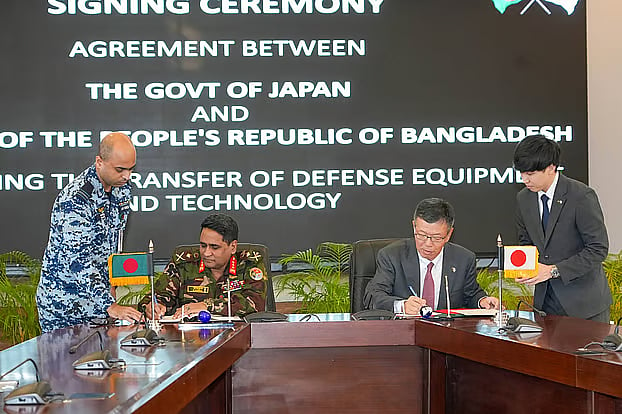
An agreement on the "Transfer of Defense Equipment and Technology" was signed between Bangladesh and Japan last Tuesday.
This initiative was taken about four years ago.
Experts believe that this specialised defence agreement will enhance the capabilities of Bangladesh's armed forces through equipment supply, technology transfer, and opportunities for joint research.
The defence agreement with Japan was signed at a time when Bangladesh's strategic decisions are receiving more international attention than ever before. Recently, understanding with China to establish a drone manufacturing facility indicates an increase in military-industrial capability.
Additionally, the new US ambassador's warning in Dhaka regarding ties with China has clarified Washington's concerns. Meanwhile, plans to sign a tariff agreement with the United States next Monday (9 February) suggest that security, defence, and trade are no longer isolated issues but part of the same strategic reality.
However, while defence and diplomatic analysts support the initiative for defence cooperation with Japan, they question the timing of the agreement signing. Global geopolitical competition centered around the region, especially in Indian and Pacific oceans, has reached a complex and sensitive stage. Additionally, an election is set to take place in Bangladesh in less than two weeks.
Some believe that the final decision on a sensitive issue like a defence agreement should have been left for the elected government rather than an interim government. They argue that defense agreements or memorandums of understanding can have a broad impact on geopolitics and geoeconomics in the future and should be carefully analysed at each step to make decisions in the country's best interest.
ISPR on the agreement
In a post on the Facebook page of the Inter-Services Public Relations (ISPR) last Tuesday, it was stated that an agreement related to the transfer of defence equipment and technology has been signed between the governments of Bangladesh and Japan. The agreement on behalf of Bangladesh was signed by the Principal Staff Officer of the Armed Forces Division, Lieutenant General SM Kamrul Hasan, and on behalf of Japan by Japan's Ambassador to Bangladesh, Saida Shinichi.
The post stated that the agreement was made possible as a result of the close and continuous efforts of both parties since 2023. This defence agreement is a reflection of deep mutual trust, a coordinated vision, and cooperation between the two countries, achieved through the visionary and effective diplomacy of Bangladesh's interim government.
The agreement is expected to further accelerate Bangladesh's defence modernisation process. It was completed in full compliance with the principles of the United Nations Charter, creating an institutional framework for acquiring advanced technology and defence equipment, joint research and development, contributing to international peace and security while safeguarding Bangladesh's independence and sovereignty. Additionally, the strategic partnership between Bangladesh and Japan in South Asia will deepen, making a significant contribution to regional stability and global security.
The Facebook post further stated that this agreement will enhance military expert exchange between the two countries, playing an important role in Bangladesh's defence capability development and the implementation of future action plans.
Implementation of step-by-step initiatives
Discussions on purchasing defence equipment from Japan began in 2022. In September of that year, Japan’s Ambassador to Dhaka, Ito Naoki, disclosed Japan's recent easing of laws related to military equipment export. Since then, Japanese arms manufacturing companies have started exporting military equipment to several countries in Asia.
The then Japanese Ambassador also mentioned that a delegation from Mitsubishi Electronics visited Dhaka to discuss military equipment supply with relevant representatives of the Bangladesh Air Force. The company is primarily interested in selling radar systems as part of the Air Force's air defence.
Diplomatic sources said that the defence-related agreement emerged in preparation for former Prime Minister Sheikh Hasina's projected visit to Tokyo in November 2022, although the visit was eventually postponed. However, when Japan raised the issue of arms sales, Bangladesh cited financial constraints. Japan then suggested that if needed, arms sales could be considered with special financial assistance.
Diplomatic sources said that the defence-related agreement emerged in preparation for former Prime Minister Sheikh Hasina's projected visit to Tokyo in November 2022, although the visit was eventually postponed. However, when Japan raised the issue of arms sales, Bangladesh cited financial constraints. Japan then suggested that if needed, arms sales could be considered with special financial assistance.
Subsequently, in April 2023, Bangladesh, and Japan signed a memorandum of agreement on defence cooperation, serving as a prerequisite for a detailed agreement on the transfer of defence equipment and technology.
In May 2025, Professor Muhammad Yunus, Chief Adviser of the interim government, made a bilateral visit to Japan. During this visit, he had an official meeting with Japan's Prime Minister Shigeru Ishiba. Senior officials of the Ministry of Foreign Affairs informed that in this meeting, Bangladesh and Japan agreed in principle to sign an agreement related to the transfer of defence equipment and technology.
Components of the defence agreement
Security and defence analysts say that the agreement on exchanging military equipment and technology with Japan will enhance Bangladesh's capabilities. However, it is still unclear how China will react to the signing of this agreement consisting of seven articles, as Bangladesh has long maintained close cooperation with China in military collaboration and arms acquisition. If Bangladesh's defence-related cooperation with Japan progresses towards strategic partnership, it may create some discomfort for China.
Following Japan’s defence policy, the "Arms and Defense Technology Exchange" agreement comprises three main components:
1. Transfer of Defence Equipment: Supply of non-lethal military technology, such as naval patrol vessels, surveillance systems, and communication equipment.
2. Joint Research on Cyber Security, Coastal Surveillance, Satellite Technology, etc.
3. Strict regulatory measures must be followed in the area of arms; arms cannot be transferred to a third country and must be used within specific limits.
Diplomatic sources suggest that the agreement with Japan will allow Bangladesh to gain special capabilities in advanced technology, especially in maritime and cyber security. This will elevate overall security standards, including the defence sector. However, at the same time, Dhaka will have to proceed by maintaining a balance among major powers.
When asked, Major General (Rtd) ANM Muniruzzaman, President of Bangladesh Institute of Peace and Security Studies (BIPSS), told Prothom Alo, “The initiative for a defence agreement with Japan is positive. Along with arms acquisition, there are also issues of diverse aid, including training. Although the detailed support for technology is not mentioned, overall it will pave the way for continuity in defence cooperation, and it will enhance the capability of our armed forces. Since the agreement doesn't contain binding provisions, it is beneficial for us.”
On the other hand, Japan has been discussing the defence agreement for a long time. Hence, the defence agreement between Bangladesh and Japan may have been anticipated by China. The country may now want to understand how Bangladesh and Japan's defence cooperation will advance through the signed agreement.
Agreements with 12 countries
Japan has already signed similar arms and defence technology exchange agreements with several other countries. According to defence-related websites of various countries, Japan first signed such a defence-related agreement with the United Kingdom in 2013. Mongolia was added as the 12th country to this list in January of the current year. Among the twelve countries, those in Asia include India, Singapore, Vietnam, the Philippines, and Mongolia.
Since independence, Bangladesh has signed 20 Memorandums of Understanding (MoUs) related to defence with 11 countries. Among these, under the interim government, an MoU was signed with Malaysia on 12 August of the current year.
Previously, on 18 April 2024, it was announced at a seminar of the Bangladesh Institute of International and Strategic Studies (BIISS) that Bangladesh has signed 19 defence-related MoUs with 10 countries, including China, Russia, Saudi Arabia, Kuwait, Qatar, Turkey, India, France, and the United Kingdom. The Chief of the Bangladesh Army, General SM Shafiuddin Ahmed, was the chief guest at the seminar titled "Defence Diplomacy."
For instance, while Bangladesh signed a memorandum of understanding (MoU) with China to produce drones recently, there has not yet been any reaction from the United States. It doesn’t mean it has escaped US attention.
Defence analysts believe the agreement is beneficial and positive for Bangladesh initially, without any doubt. However, there may be long-term strategic elements in signing this agreement with Japan, a member of the Quad.
For instance, while Bangladesh signed a memorandum of understanding (MoU) with China to produce drones recently, there has not yet been any reaction from the United States. It doesn’t mean it has escaped US attention.
It has been understood that the US is reviewing the MoU regarding the drone manufacturing factory between the two countries. On the other hand, Japan has been discussing the defence agreement for a long time. Hence, the defence agreement between Bangladesh and Japan may have been anticipated by China. The country may now want to understand how Bangladesh and Japan's defence cooperation will advance through the signed agreement.