Rural load shedding is from 'technical' issues, not 'electricity shortage': Power Minister
Power, Energy and Mineral Resources Minister Iqbal Hassan Mahmood has said that although rural areas continue to experience load-shedding, the situation has improved compared with the past.
He stated, “Most of the load-shedding occurring in rural areas results from technical issues rather than a shortage of electricity. We are working to resolve these problems.”
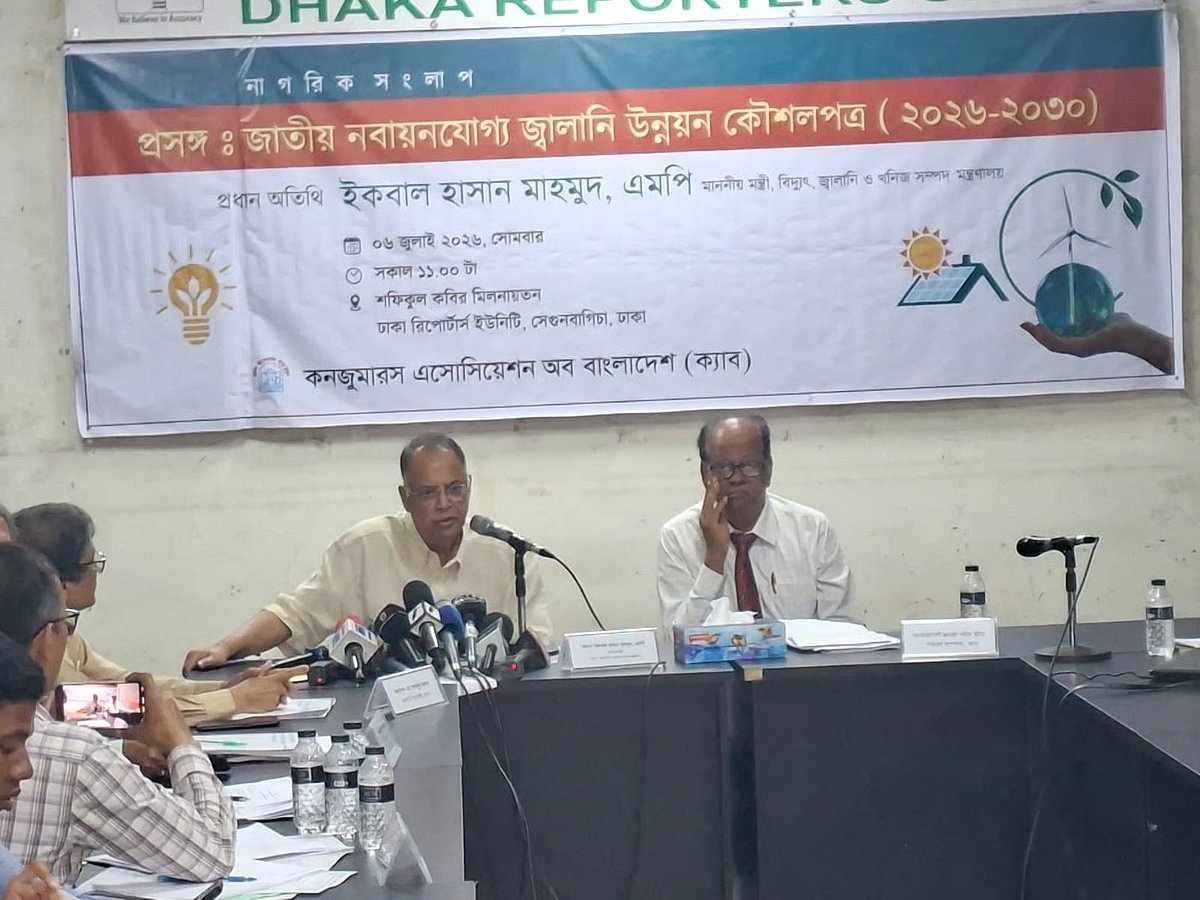
The minister made the remarks today, Monday, while responding to a question during a citizens' dialogue titled "National Renewable Energy Development Strategy (2026–2030)", held at the Dhaka Reporters' Unity (DRU) auditorium in the capital.
The Consumers Association of Bangladesh (CAB) organised the event, where the minister attended as the chief guest.
Iqbal Hassan Mahmood explained that the authorities had extended electricity coverage to achieve universal electrification, but they had installed some distribution lines without adequate planning.
He said, “When we place a heavier load on those lines, they develop faults, and the affected areas experience power outages.”
The minister said that the government had instructed the Rural Electrification Board to address the problem. He added, “It will take time to eliminate these issues.”
During the dialogue, Iqbal Hassan Mahmood identified renewable energy as the principal means of helping the Ministry of Power, Energy and Mineral Resources overcome its financial difficulties.
He said, “If we can reduce energy imports, the government will save a substantial amount of money. We will then be able to use those savings to settle the outstanding liabilities in the power sector.”
He also announced that the government had adopted a plan to generate 10,000 megawatts of electricity from solar power over the next five years.
He said, “Once we implement this plan, it will bring about a significant transformation in the country's energy sector.”
The minister also said that the government was taking a cautious approach to the use of agricultural land for renewable energy projects. He explained, “For this reason, we are giving priority to using fallow or uncultivated land for such projects.”
Humayun Kabir Bhuiya, general secretary of the Consumers Association of Bangladesh (CAB), chaired the dialogue.
Other speakers included Professor M Shamsul Alam, energy adviser to CAB; Mostafa Al Mahmood, president of the Bangladesh Sustainable and Renewable Energy Association; and Alamgir Kabir, general secretary of the Bangladesh Poribesh Andolon (BAPA), among others.