World Sight Day
Eyeglasses, cataract surgery can unlock the ability to learn, earn, and prosper
Increased investment in eye care from governments, philanthropists and organisations will unlock the potential for more people in Bangladesh to learn, earn and prosper.
New research from IAPB, Seva Foundation and Fred Hollows Foundation estimates that addressing preventable vision impairment by 2030 would return USD 2.31 billion to the country’s economy each year.
It is also estimated that the impact of prioritising vision and eye care could generate the equivalent of 45,212 school years.
This World Sight Day, 9 October, international development organisation Sightsavers is calling for further action to reduce the global burden of avoidable vision impairment, including uncorrected refractive errors and cataracts, reports a press release sent by them.
Vision and eye care are often a ‘missing’ topic in health and development priorities, but at least one billion people worldwide, that’s one in eight of us, have an untreated or preventable vision impairment. It is a crucial element of achieving the United Nations Sustainable Development Goals.
Eye health interventions, including cataract surgery and glasses, are cost-effective, with an estimated return on investment in low to middle-income countries of USD 28 for every dollar invested.
Yet, the right to sight is not universal. More than 85 per cent of people with vision impairment live in low and middle-income countries. Shockingly, nearly half of the people with refractive error in Southeast Asia do not have the glasses they need. Women also account for more than half of blindness and visual impairment across the world.
Amrita Rejina Rozario, country director of Sightsavers in Bangladesh, says, “Making eye care a priority will be transformational for people, communities, and nations. Good eye health can reduce inequities, increase the number of children in school, and enable more adults to work. Access to glasses and cataract surgery could boost learning and economic productivity.”
The impact of access to cataract surgery is evident in stories like that of Alom Hawlader from Khulna, whose life was transformed following cataract surgery. He supports his family of four by riding an auto rickshaw.
Years of blurred vision threatened his livelihood, prompting Alom to seek support from his neighbour, Giash Uddin, who works at Khulna BNSB Eye Hospital, a Sightsavers partner. At his advice, Alom attended an eye screening camp and had a surgery. Now, with restored vision he can drive his auto rickshaw without difficulty and is grateful to Sightsavers and Khulna BNSB Eye Hospital.
In Bangladesh, Sightsavers is enhancing vision and eye health services in partnership with the National Eye Care, as well as government and private hospitals, providing technical support in 17 districts. Annually, Sightsavers achieved more than one million eye screenings and performed over 70,000 cataract surgeries in Bangladesh.
Amrita Rejina Rozario adds, “We commend existing efforts from governments, donors, decision-makers, NGOs, and other partners, but big changes are still needed to make vision impairment truly avoidable, by acknowledging NGOs’ contribution and systematic GO-NGO coordination. The time has come to consider eye healthcare more seriously, in light of its significant impact on human and social development.”
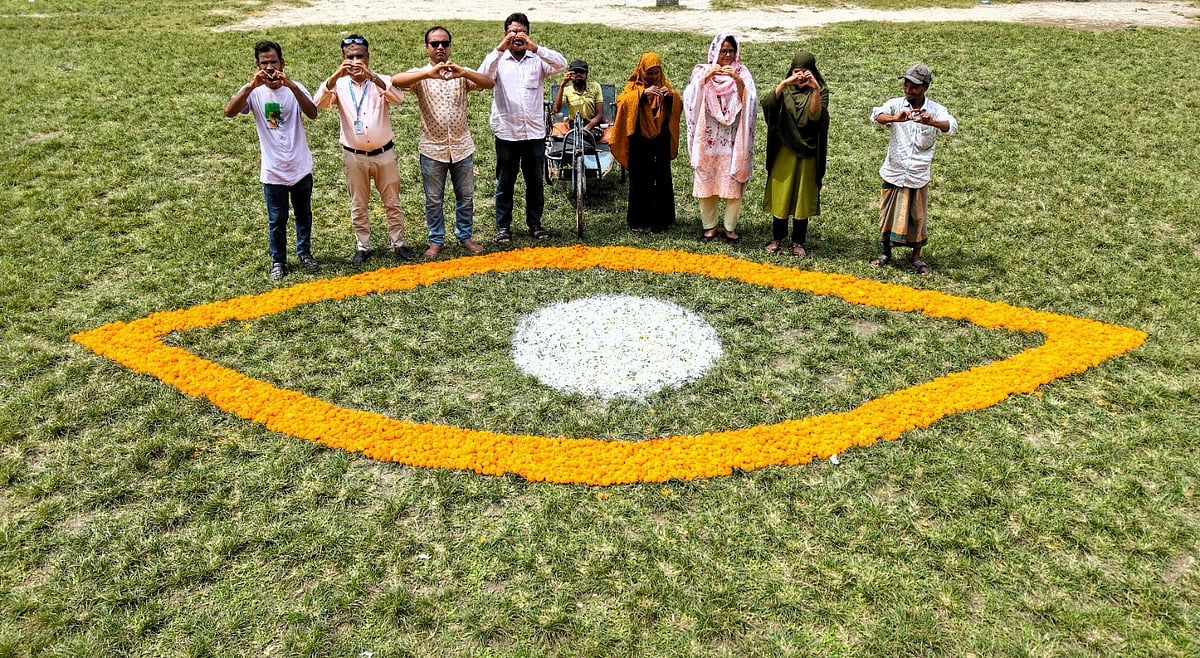
Sightsavers and its 13 partners are also observing World Sight Day with various activities, including mini-marathons, eye creation, rallies, eye camps, and the free distribution of spectacles, among others. These activities engage youth, persons with disabilities, community members, and service providers.
Sightsavers' message aligns with the wider call from the IAPB to prioritise eye health and put people at the heart of efforts. It also complements the World Health Organization’s efforts to raise awareness of eye health and advocate for universal access to eye care services.