In a country like Bangladesh with a deficit budget, the government has to rely on borrowing to run its operations. Such borrowing can come from both domestic and foreign sources. The government spends first and then arranges the funds. The new government is now also having to bear the costs of previous governments’ poorly planned projects.
The only source of income for the government of Bangladesh is the revenue sector, but the revenue situation is very poor. In the first nine months of the current fiscal year, there has been a revenue shortfall of about Tk 1 trillion in customs and tax collection, which is the highest ever. The country’s business and trade situation is also not very strong. Therefore, it is difficult to expect an increase in revenue.
In such a situation, the government is continuously taking loans to pay salaries and allowances of government employees, interest payments, subsidies, and ongoing project costs.
Meanwhile, the government’s debt management has reached such a level that, in addition to the banking sector, the central bank is also occasionally printing money to provide loans.
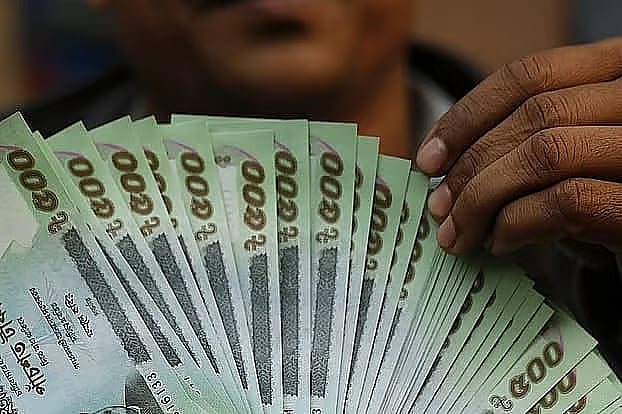
Printing money to finance loans means an increase in reserve money, known as high-powered money. Printing one taka can create up to five taka in the market, which increases inflation. People are already under pressure due to rising oil and gas prices. Now an additional burden is being added.
Government borrowing beyond limits
In the budget for the current 2025–26 fiscal year, the government set a target of borrowing Tk 1.04 trillion from the banking sector. From July of last year to 9 April, the government has borrowed about 1.13 trillion (112,761 crore), which is 108 per cent of the target.
Of this, the interim government (until 16 February) had borrowed Tk 682.29 billion. In the first 52 days of assuming responsibility, the new government borrowed Tk 445 billion from the banking system, which is more than the entire fiscal year’s budget target. This information was found in the latest report of Bangladesh Bank.
There are still two and a half months left in the current fiscal year. So it remains to be seen where government borrowing from the banking system will end up. If the government borrows more, efforts to revive the private sector will be hindered, as private sector credit growth has already fallen to its lowest level.
According to Bangladesh Bank data up to 9 April, in the previous fiscal year, the government’s outstanding borrowing from commercial banks was over Tk 4.52 trillion (452,481 crore), which has increased to about Tk 5.42 trillion (541,659 crore).
In the same period, government borrowing from Bangladesh Bank has increased to over Tk 1.22 trillion (122,007 crore). Overall, by 9 April of the current fiscal year, the total outstanding government borrowing from the banking sector stands at about Tk 6.64 trillion (663,666 crore).
How much money was printed by the government
Bangladesh Bank maintains the government’s accounts. When revenue or loans are received, they are deposited into the government’s account. From this account, payments are made for salaries, debt servicing, subsidies, project expenses, and contractor bills. Sometimes the government’s account runs empty. For this purpose, Bangladesh Bank has set a borrowing limit of Tk 120 billion each for two accounts—Ways and Means and Overdraft.
Ways and Means Advance is a short-term loan taken from the central bank to cover temporary cash shortages in government finances. When the government faces a short-term cash gap—such as before tax revenue arrives—it borrows from the central bank for a very short period.
For example, at the beginning of a month, the government may have large expenses such as salaries, development project payments, and electricity and energy bills. To meet such expenses, this short-term loan is taken. The same applies to overdraft borrowing.
If the government cannot borrow from commercial banks, it directly borrows from Bangladesh Bank, which leads to money creation.
Bangladesh Bank’s report shows that although Tk 120 billion was borrowed under Ways and Means, overdraft borrowing has reached Tk 224.74 billion. In addition, during the tenure of the ousted Awami League government, Bangladesh Bank purchased treasury bills and bonds and lent money to the government. This now stands at Tk 681.32 billion. In total, government borrowing from Bangladesh Bank stands at over Tk 1.22 trillion (122,007 crore), of which Tk 235.83 billion was taken in the current fiscal year.
What happens when money is printed
A country’s central bank usually prints money in line with GDP and foreign exchange reserves. When money supply increases in proportion to production of goods and services, the economy remains stable. If excess money is printed without a rise in production, people have more money in hand while supply remains limited. This increases demand, but supply remains constrained, causing prices to rise rapidly. As a result, purchasing power of ordinary people declines.
In addition, excessive money supply reduces the value of the local currency against foreign currencies, making imported goods more expensive. Newly printed money circulating in the market creates a multiplier effect, often up to five times, which destabilises the market. Excessive money printing is like adding water to milk—it increases volume but reduces quality and nutritional value.
Therefore, Bangladesh Bank should exercise maximum caution in directly lending to the government, as controlling money supply is its primary responsibility. While printing money may provide short-term relief to the government, in the long run it pushes ordinary people into hardship and weakens the macroeconomy. It is time to pay serious attention to this issue.