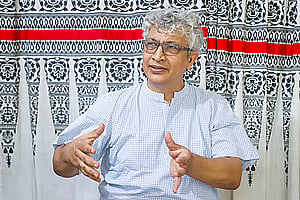
Exclusive interview: Mohammad Tanzimuddin Khan
Strong relations with China will sharpen Bangladesh's negotiation skills
Mohammad Tanzimuddin Khan is a professor at the Department of International Relations of the University of Dhaka. In an interview with Prothom Alo's Rafsan Galib and Sohul Ahmed, he spoke about Prime Minister Tarique Rahman's recent visits to Malaysia and China, Bangladesh's geopolitical relations with India and Myanmar, and the country's overall diplomatic situation.
Prime Minister Tarique Rahman has made his first overseas trip since taking office. After visiting Malaysia, he traveled to China. How do you assess the decision to choose Malaysia as the first destination?
Mohammad Tanzimuddin Khan: In Bangladesh's political history, we have seen that a prime minister's first foreign visit after an election carries symbolic importance. Whether a new government's leader chooses India or China as the first destination often shapes public perceptions about whether the government's foreign policy will lean toward a particular geopolitical bloc. From that perspective, I believe choosing Malaysia as the first country for an official state visit was a relatively smart diplomatic move for Bangladesh.
Malaysia has cultivated a distinct global image by maintaining a non-aligned posture over a long period. Moreover, it is an influential member of ASEAN and an important member of the Organization of Islamic Cooperation (OIC). Bangladesh's foreign policy has to navigate a triangular strategic dynamic involving the United States, China, and India. Malaysia has managed to maintain a balanced relationship with all three powers while keeping a safe degree of distance from each. Economically, Malaysia is also highly significant for Bangladesh. Between 6 and 9 per cent of Bangladesh's total remittance inflows come from Malaysia. Through this visit, the new government appears to have conveyed the message that Bangladesh intends to pursue its own independent path.
Malaysia is also important on the Rohingya issue. It is one of the principal destinations for Rohingya refugees who leave by sea. In international forums, Malaysia has consistently taken a strong position in support of the Rohingya. Therefore, making Malaysia the destination of the first official visit also reflects the importance being placed on engaging Malaysia more closely as a diplomatic partner on the Rohingya issue.
Prime Minister Tarique Rahman also received a red-carpet welcome during his visit to China, where numerous memorandums of understanding (MoUs) were signed. How do you assess the China visit?
Mohammad Tanzimuddin Khan: The first point is that, just as Awami League historically enjoyed close relations with India, Bangladesh Nationalist Party (BNP) once had a similarly strong relationship with China. Whenever BNP came to power, it was able to build a high degree of trust and cordial relations with Beijing.
However, that relationship suffered a setback after 2001, particularly in 2004 when the Taipei Economic and Cultural Office was opened in Dhaka. China's sensitivity regarding Taiwan is greater than almost any other issue, and naturally Beijing did not view this development favourably. As a result, the traditional relationship of trust between BNP and China was significantly weakened.
Later, when a new government came to power after the 2008 election, China no longer felt the same obligation to demonstrate confidence in its relationship with the BNP. This made it much easier for Beijing to shift decisively toward the Awami League.
Even before the official results of the controversial 2018 election were announced, the then Chinese ambassador visited Ganabhaban to congratulate Sheikh Hasina. The same scene was repeated the day after the 2024 election. For China, who holds power or what ideology they represent matters less than ensuring that it maintains good relations with whichever government can best safeguard China's economic interests.
China now appears to believe that the distance that had developed with the BNP can be repaired and that the changed political circumstances present a new opportunity to rebuild its image and relationship with the party. Likewise, for the BNP, this is a major opportunity to overcome past estrangement and establish renewed engagement with China.
The greatest challenge facing a BNP government is economic. A substantial portion of Bangladesh's Annual Development Programme (ADP) is allocated to transportation and infrastructure development. At present, there is no larger global source of infrastructure financing than China. Through its Belt and Road Initiative (BRI), China has supported infrastructure projects around the world while building an extensive network of land and maritime trade routes. Through this network, it is also institutionalising its diplomatic friendships.
If you look at global politics, you can also see major changes underway. The tensions surrounding the Iran conflict and the Strait of Hormuz, followed by efforts at understanding between Iran and the United States, indicate that the United States no longer occupies the same dominant position it once did. America's economic capacity has also declined considerably.
Ultimately, politics is driven to a large extent by economic interests. The United States' ability to provide economic assistance is now much more limited than before. For example, USAID has significantly scaled back its operations worldwide. As a result, under today's global political and economic realities, many countries have become more willing to pursue policies without giving as much weight to US preferences.
Bangladesh finds itself in a similar position. If it can secure its economic interests through cooperation with China while placing somewhat less emphasis on the United States, that is the course it is likely to pursue. The same logic applies from China's perspective. Moreover, China has regarded Bangladesh as a strategic partner since 2016. Consequently, the interests of both sides have converged in a particularly favorable way at this point in time.
Although many memorandums of understanding (MoUs) were signed with China, no concrete agreements were finalised, nor were any direct commitments announced. How do you interpret this?
Mohammad Tanzimuddin Khan: When Xi Jinping visited Dhaka in 2016, China made a major commitment of US$20 billion in financial assistance, and Bangladesh joined the Belt and Road Initiative (BRI). Following that, major infrastructure projects such as the Payra Power Plant, the Padma Rail Bridge, and the Karnaphuli Tunnel were implemented with Chinese financing.
In the current geopolitical environment—particularly in the Indo-Pacific, where China is competing strategically with the United States—the Bay of Bengal, accessed through the Mongla and Chittagong ports, is extremely important to China as a potential alternative to the Strait of Malacca. China wants to connect its Yunnan Province with these Bangladeshi ports.
While memorandums of understanding may not be legally binding, they are nonetheless a strong expression of mutual trust and future commitment between the two countries.
Bangladesh recently signed a trade agreement with the United States that has generated widespread criticism and controversy. Soon afterward, however, there have been signs of closer relations with China. How do you view these two developments from Bangladesh's perspective?
Mohammad Tanzimuddin Khan: Today, many people talk about "multi-vector diplomacy," that is, pursuing multidimensional relations with competing major powers rather than becoming confined to any one geopolitical bloc. The objective is to maintain balanced relations with all sides. However, there are deeper strategic calculations involved. The risk of this approach is that, if it is not managed successfully, a country can become a "theater of power competition" among rival states.
If we look at the current foreign policy of the United States, it has shifted strongly toward economic nationalism, summarised by the slogan "America First." The United States is no longer in the economic position to provide the level of financial incentives or public goods that are necessary to keep other countries within its sphere of influence as a global leader.
This emphasis on economic nationalism has encouraged Washington to pursue and protect its own economic interests quite openly, without much diplomatic softening. In that context, it negotiated what many see as an unequal and controversial agreement with Bangladesh. It chose to conclude that agreement during the final period of a government that, in his view, did not have to concern itself with maintaining a public mandate. If the current government is also committed to a "Bangladesh First" policy, then there is little justification for remaining bound by an unequal agreement that undermines the country's interests. It should prepare to review and reconsider that agreement.
The question then becomes: How can Bangladesh strengthen its bargaining position with the United States? In this regard, China's role is Bangladesh's most important bargaining tool.
Malaysia provides a useful example. It maintains strong security ties with the United States while also sustaining excellent economic relations with China. Under today's global realities, if Bangladesh wants to resist unilateral pressure or economic asymmetries from the United States, it has few alternatives other than using its relationship with China as a strategic counterbalance.
You mentioned Bangladesh's strategy of balancing between China and the United States. Could this also give Bangladesh additional leverage in its negotiations with India?
Mohammad Tanzimuddin Khan: The equation is quite interesting when it comes to India. In South Asia, India is China's principal regional rival. For that reason, the United States has built a significant strategic partnership with India as part of its broader regional and global effort to counter China's influence.
However, more recently, a degree of friction has also emerged in U.S.-India relations. At one time, the United States largely relied on India in matters relating to Bangladesh. It now appears that this dynamic has changed considerably. That change creates an opportunity for Bangladesh.
How effectively Bangladesh can capitalize on this opportunity depends on the professionalism of its Ministry of Foreign Affairs. Previously, almost all major foreign policy decisions were made directly from the Prime Minister's Office. It is now important to see whether the Foreign Ministry is able to operate more independently and demonstrate greater professional competence in shaping and conducting the country's foreign policy.
During this visit, Bangladesh sought China's assistance for the Teesta Mega Project. At the same time, the political landscape in India has changed significantly with the Bharatiya Janata Party (BJP) coming to power in West Bengal, while reports of continued pushbacks across the border persist. How do you think India might respond to these changing circumstances?
Mohammad Tanzimuddin Khan: The BNP has always had a somewhat strained relationship with India. It has never developed the same level of mutual trust with New Delhi that some other political actors have enjoyed. However, the new development is the major political shift taking place in West Bengal. In particular, the BJP's identity politics is fundamentally built around the Hindu-Muslim divide. From that perspective, Bangladesh is often viewed as representing a predominantly Muslim population. This identity-based politics is important for the BJP's efforts to maintain its domestic political support.
When a political force with this kind of ideological orientation is in power, its supporters generally believe that it will not compromise or "sell out" the country's interests. As a result, the government has little reason to fear a strong backlash from its own voter base. Whether it is actually willing to make concessions depends on whether it can move beyond Hindu-Muslim identity politics and instead prioritise economic or strategic interests differently.
However, it is very difficult for such a political movement to move beyond identity politics. Therefore, the likelihood that the current tensions in bilateral diplomacy will ease in the near future is quite low.
The treatment reportedly received by an adviser to the Prime Minister during a recent visit to India, which he describes as bitter and undiplomatic, does not point toward a positive direction.
On a related note, India's newly appointed High Commissioner to Bangladesh is not a career diplomat but a politician. Appointing a politician to such a post is not very common. Do you see any particular signal in this?
Mohammad Tanzimuddin Khan: Absolutely. My impression is that the BJP has appointed a politician primarily to strengthen its political support base and reinforce its identity-based politics. Consider even the way he entered Bangladesh. He arrived by land rather than by air. I see that as a form of populist political messaging. I expect that both populism and identity politics will be clearly reflected in his activities.
There is another reality we need to understand. The more popular identity politics becomes in Bangladesh, the more the BJP stands to benefit politically in India. Likewise, the stronger the BJP's identity politics becomes in India, the stronger identity-based politics is likely to become in Bangladesh as well.
Since the mass uprising, both during the interim government's tenure and under the current government, political leaders and student leaders have been visiting China. During the Prime Minister's visit, the BNP also signed a memorandum of understanding with the Communist Party of China. Is Chinese influence beginning to grow in Bangladesh's domestic politics?
Mohammad Tanzimuddin Khan: In order to protect its economic interests, China is now placing much greater emphasis on public diplomacy. Its main objective is to expand people-to-people exchanges across Asia, Africa, and Latin America and to build broader public acceptance of China.
Following the mass uprising of 2024, anti-India sentiment in Bangladesh has become much stronger. Like India, China had also become overly dependent on the Awami League, which created an image problem for Beijing, as I mentioned earlier. China is now trying to overcome that image problem by emphasising public diplomacy in Bangladesh. It also sees the current anti-India mood as an opportunity to strengthen its own position through greater engagement with the Bangladeshi public.
China is also promoting a new way of thinking about the international order. For decades, the world has largely operated under a model of U.S.-led hegemony. China is now advancing the idea of "interdependent hegemony."
Through this concept of interdependence, China seeks to argue that the current international system should not be dominated by a single superpower but should instead be multipolar, with several major powers coexisting. Under this model, major powers would continue to compete in strategic and military affairs while simultaneously cooperating in trade and economic development.
China has revived the proposal for the China–Myanmar–Bangladesh Economic Corridor. How do you view this initiative?
Mohammad Tanzimuddin Khan: This is a highly strategic project for China and forms part of its Belt and Road Initiative. Its primary objective is to connect China's southwest—particularly Yunnan Province, to Bangladesh's Mongla and Chittagong ports through Myanmar.
There were lengthy discussions about this corridor in the past, but India ultimately did not agree to participate.
Under Bangladesh's current political circumstances, however, China sees a new opportunity. It now hopes to reach Bangladesh's ports through Myanmar under a trilateral initiative.
The underlying reason remains the same: China believes that India is seeking to monitor and constrain Chinese activities in the Indian Ocean, including around the Strait of Malacca. As an alternative, China wants to use this corridor to give Yunnan Province direct access to the Bay of Bengal, thereby reducing its dependence on the Malacca route.
Do you see any possibility that the visits to China and Malaysia could help resolve the Rohingya crisis?
Mohammad Tanzimuddin Khan: The prospects for any fundamental breakthrough in the Rohingya crisis are actually quite limited. This is because the foundation of China's foreign policy is its economic interests; it is unlikely to compromise those interests for political considerations.
China has made massive investments in Myanmar's Rakhine State. To protect those investments, Beijing maintains good relations not only with Myanmar's military junta but also with various armed ethnic and rebel groups operating there.
For China, economic interests take precedence over political or humanitarian concerns. At the United Nations Security Council, China has generally taken positions that are more favorable to Myanmar on the Rohingya issue. Therefore, it is difficult to expect any dramatic or extraordinary initiative from China that would bring about a resolution of the Rohingya crisis in the near future.
Thank you very much.
Mohammad Tanzimuddin Khan: Thank you as well.
* This interview appeared in Prothom Alo online and has been translated here by Ayesha Kabir for Prothom Alo English online