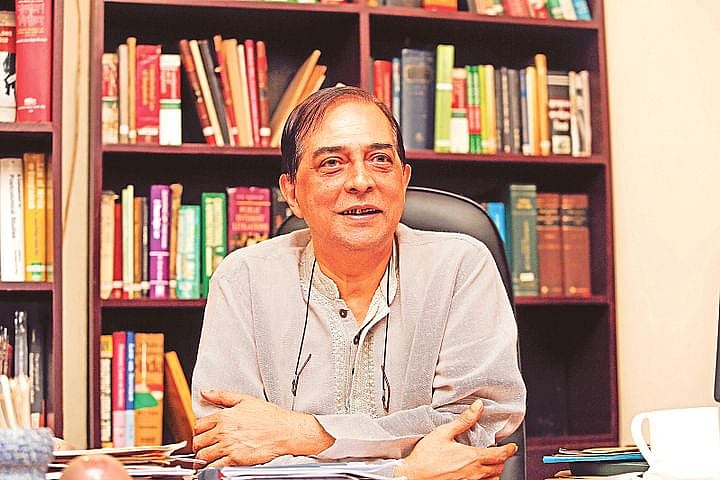
Interview: Shahdeen Malik
It's wrong for the government to campaign for one side in the referendum
Shahdeen Malik is a senior lawyer of the Supreme Court and a constitutional expert. Over the years he has been regularly writing and speaking on politics, law and the courts, the Constitution, and human rights. In an interview with Prothom Alo's Mohiuddin Faruk and Monzurul Islam, he talks about elections, the referendum, the judiciary, reforms and related issues.
Prothom Alo: After over 18 months since the interim government took office, a national election is scheduled to be held in the country next February. How enthusiastic are the people about the election and the overall electoral environment?
Shahdeen Malik: People’s enthusiasm for the election and the overall electoral environment seem positive. None of us were able to vote in the last three elections. This time, a large number of young people have at least heard about voting. So there is a great deal of enthusiasm. I believe a large number of people, especially young voters, will cast their votes this time. In developing countries like ours, there are invariably some places where scuffling or clashes take place ahead of the election. There have been some such incidents here as well. However, this is nothing to be overly alarmed about.
Prothom Alo: What kind of election do you expect it to be?
Shahdeen Malik: It will be a good one. At this stage, there are a few things the interim government needs to take into consideration. When elections were previously held under caretaker governments, we saw those interim administrations playing the role of a caretaker government, showing no bias toward any side on any electoral issue and maintaining a level playing field for all. I think there may have been one or two lapses this time, but despite that, the election will be good in all respects.
Prothom Alo: The interim government will step down through the election. How do you assess the performance of this government?
Shahdeen Malik: The assessment is not good. If I use the grading system of our time -- first division, second division, third division -- I would place this government somewhere between second and third division. I would certainly not give it a first division. I am not inclined to give it a second division either, but I would not fail it. In other words, my assessment falls midway between second and third division.
Prothom Alo: Now a specific question related to your field of work. How did the interim government perform in ensuring justice and human rights?
Shahdeen Malik: If we look at it from a very narrow, court-centric perspective, then it has to be said that two major things have been done in the courts. First, work has begun on establishing a separate secretariat as part of the separation of the judiciary. Second, the judges appointed three months ago were appointed in accordance with the law. These are two positive developments. Beyond that, this government has promulgated more than a hundred ordinances, many of which are seriously flawed.
When we talk about the justice system, everyone concerned needs to be included in that understanding. We lawyers tend to think in terms of how much our own interests have been protected, or how much benefit judges have received. For lawyers, the number of cases has increased; arrangements have been made for appointing judges; initiatives have been taken to establish a separate secretariat, although this cannot be done in a single day and is a time-consuming process. These are positive steps.
But the justice system exists to deliver justice to litigants, and yet we do not think about the suffering and hardship of those seeking justice. Most litigants are poor or from lower-income backgrounds. Very little has been done to support them. Some initiatives have been taken to expand legal aid programmes, but the suffering of litigants has not been alleviated.
Prothom Alo: During the tenure of the interim government, has the judiciary done anything markedly different from the previous period?
Shahdeen Malik: It has not done anything very different. The main reason is that within three days of the new government taking office, everyone in the Appellate Division except one judge was sent home. This set a terribly negative precedent. For the sake of argument, if the next government comes in and again removes all the judges of the Appellate Division in the same way as the previous government did, then we would have nothing left to say; in the past, changes of government have been accompanied by changes in the Appellate Division. This was not done with any serious thought.
Those who are now on the bench have this example before them, that if the government does not like us, it can remove us, whether through mobs or by exerting pressure. We have heard many times about the High Court being besieged. These things have dealt a major blow to the judiciary. The idea of an independent judiciary that we talk about, where a judge, without thinking about anything else, adjudicates solely on the basis of law and justice, has been seriously undermined.
There is always a reaction after a mass uprising, and there is no disagreement that those associated with the previous government had to be removed. But in doing so, the judiciary should have been kept outside this process. Judges who showed bias and condoned arbitrariness during the previous government’s tenure could have been removed gradually, by placing them on leave for one, two, or three months and taking administrative action against them. That is not what happened. As a result, I think a degree of fear has also taken hold within the judiciary.
Prothom Alo: In the cases filed over the casualties during the mass uprising of July-August last year, hundreds of people have been named as accused and many have been arrested. During the Awami League period, so-called “ghost cases” were filed. This time, we are seeing a tendency toward sweeping cases or indiscriminate naming of accused. Investigations in these cases are not progressing, and many people are not getting bail for months. What is your view on this?
Shahdeen Malik: There has been no real change in this regard. By “no change” I mean that under the previous authoritarian government, if there was an incident, say, an allegation of exploding firecrackers or crude bombs, 200 to 400 BNP leaders and activists from the surrounding area would be named as accused and arrested. The same thing has happened during this period as well, only instead of BNP, people from other parties have been arrested.
Under due legal process, to file a case against someone or to arrest them, the police must have reasonable grounds to be satisfied that the person was involved. Now, if one person has been killed and 250 people are named as accused, the police should have considered whether it is actually plausible that 250 people together committed that murder. But the “arrest trade” that the police engaged in during the previous regime still continues, and there are allegations that the government has taken no steps to stop it. Although a provision has been added to the Code of Criminal Procedure, questions remain about how effective it has been.
From time to time, the government has said, “What can we do if people come and file FIRs?” But whenever someone brings a complaint to the police, the police always have the authority to verify whether there is prima facie truth to the allegation. However, when 150 to 200 people are arrested in a single case, the police can profit from this arrest trade, and we lawyers also benefit from it. If this continues, we will have plenty of bail cases; it has now become a business. The government had ways to curb this situation, but why it chose not to do so is beyond my understanding.
Prothom Alo: Another widely discussed issue during the interim government’s tenure is mob violence. Even after so long in office, it has not stopped. Now we are seeing elected student leaders harassing teachers. What is your reaction to this?
Shahdeen Malik: This is absolutely unwarranted. Teachers are human and can make mistakes, but if they are treated in this way, respect for teachers will disappear. If that happens, the education system will collapse. A teacher may make a mistake, and students may feel justified anger and be upset, but the solution is not to humiliate the teacher. Driven by impulse, we are doing these things as an immature society without thinking about the consequences in the future. The price for this will be paid for a long time.
Prothom Alo: Let’s return to the election. This time, along with the national parliamentary election, a referendum will also be held. Such simultaneous elections have never happened before. People more or less understand parliamentary elections. Do you think people will be able to vote knowledgeably in the referendum?
Shahdeen Malik: The questions in the referendum are complex -- four main questions, each with several subsidiary questions. The referendum deals with the most intricate matters of the Constitution. Even a lawyer at a district court may not fully understand these constitutional complexities. Yet, public opinion is being sought on these highly intricate constitutional questions. It is practically impossible for ordinary people to understand them.
Prothom Alo: A total of 48 reform proposals are included in the referendum. A person may agree with some proposals and disagree with others. But how reasonable is it to force a voter to say ‘yes’ or ‘no’ to everything at once?
Shahdeen Malik: Generally, the worldwide practice in referendums is a two-step process: first, the parliament decides on the matter and determines what changes it wants. For example, if a country decides to increase the number of provinces from five to eight, that decision is first passed in parliament. If it is of great importance to the nation, it then goes to a referendum. In that case, the referendum question would be, “We propose to increase the number of provinces from five to eight; do you agree?”
Skipping this two-step process, first parliamentary approval, then referendum, and directly putting such complex questions to a referendum is legally unrealistic. Secondly, how obliged is the parliament to follow the result of the referendum? Parliamentary sovereignty means that no one can impose a decision on a parliament. So the provision giving parliament 180 working days to implement reforms based on the referendum raises serious constitutional and legal questions.
Prothom Alo: The interim government is campaigning in favor of a ‘yes’ vote. Can this government act as a partisan player in promoting a particular outcome in the referendum?
Shahdeen Malik: The interim government cannot campaign for a vote in favor of any particular side in a referendum. By doing so, the government is making another mistake. After the election schedule was announced, our expectation was that the interim government would act like a caretaker government, creating a level playing field and ensuring equal opportunity for all parties.
Perhaps, for the sake of argument, one could say that the government has not directly violated any law. But many government officials, employees, and even school and college teachers will be involved in the election process. It is through them that this campaigning is taking place; the government has already taken sides regarding the vote. This could face legal challenges in the future.
Prothom Alo: What will happen if ‘yes’ wins in the referendum, and what if ‘no’ wins?
Shahdeen Malik: If ‘no’ wins, all reform plans will be nullified. On the other hand, how much ‘yes’ wins by will determine a lot. For example, if 60 per cent of people vote in the parliamentary election but only 20 per cent participate in the referendum, the moral legitimacy of the referendum itself would come into question.
Prothom Alo: The interim government claims that it is campaigning for ‘yes’ to ensure reforms. On the other hand, there are allegations that the government has not carried out many reforms despite having the opportunity. Recently, TIB said that reforms have lost focus. What is your view?
Shahdeen Malik: I agree with TIB’s assessment. Some reforms have been made in the banking sector; a couple of reforms have occurred in the judiciary; but there has been little reform in the bureaucracy or administration. As a result, the long-standing lack of accountability and good governance in the country has not changed.
Public expectations from the government have risen significantly. I think the main political parties, more or less, understand this. Therefore, I do not think they will run the country solely in their own interest without paying attention to the people’s demands.
Prothom Alo: Do you think that after the election, a new government will be able to improve the overall situation, including law and order?
Shahdeen Malik: Public expectations from the government have risen significantly. I think the main political parties, more or less, understand this. Therefore, I do not think they will run the country solely in their own interest without paying attention to the people’s demands. Broadly speaking, they will have to act close to the public’s expectations.
Prothom Alo: Thank you for your time.
Shahdeen Malik: Thank you as well.