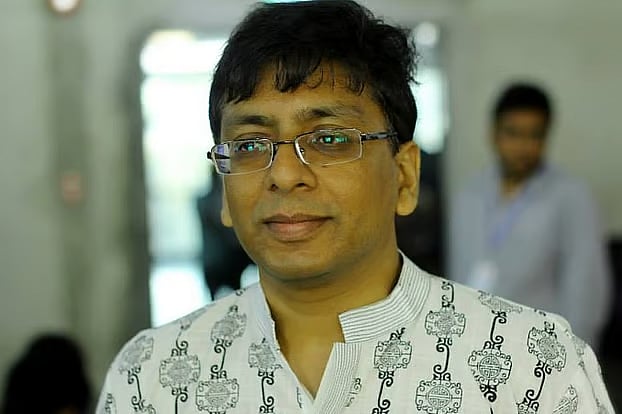
It was winter, 2010. I was sitting in a corner of a mathematics camp, a 13-year-old boy at the time. To us back then, Professor Mahbubul Alam Majumdar was a towering, mysterious figure, someone we'd secretly refer to as “a man beyond the myth.” Just hearing his name sent a shiver down our spines.
He had degrees from the world’s finest institutions like MIT, Stanford and Cambridge, a PhD in theoretical physics and applied mathematics, postdoctoral research at Imperial College. This profile was far beyond the reach of our imagination. At that time, we did not know of any other Bangladeshi who had undertaken such an academic journey.
We had heard that while still a high-school student he had written an essay on the US Constitution and received first prize at the White House from President Reagan himself. Later, he was honoured by President Bush as one of forty young scientists in the United States. Speaking in front of such a person was unthinkable; we were afraid even to stand next to him.
That winter, I had my first meaningful conversation with him. He told us the story of Nazia apu, a former math camper and Olympiad medalist who was then studying at MIT. Mahbub Sir said that when Nazia failed to solve a problem in biology, she worked at it stubbornly for three straight days. She simply would not let go until the problem was solved.
He knew that not every talented Bangladeshi would have the chance to go to MIT. That is why he set out to build a world-class education system at home. It is along this path that he is now a professor at BRAC University
Sir looked at us and said something that changed the course of my life: “Just because someone is better at mathematics than you, doesn’t mean they are more intelligent than you. It means they can cling to a problem with dogged determination.” Those words lodged themselves deep in my mind. The realisation that perseverance, the ability to stay stubbornly at it, matters more than sheer talent washed away all my fear. I kept that mantra in my heart and moved ahead. The very next year, in 2011, I earned a place on the national mathematics team as its youngest member at the time.
Time passed. Three or four years later, I was no longer that timid adolescent; I was an Olympian who had won two bronze medals and one silver for Bangladesh. During this period, working closely with Mahbub Sir, I rediscovered the human being Mahbubul Alam Majumdar. He entrusted me with training the next generation of mathematics camp students. It was then that I realised he never confined problem-solving to the blackboard alone. He had a much larger canvas in our minds. By removing our fear of mathematics, he instilled confidence in us.
He returned home with a dream. He left behind a secure academic career at prestigious universities in the United States and the United Kingdom to work with the youth of Bangladesh. His goal was not merely to send talented students abroad, though he did so for many, including me. His recommendation letters and personal encouragement played a crucial role in my admission to MIT, for which I remain eternally grateful. Yet he knew that not every talented Bangladeshi would have the chance to go to MIT. That is why he set out to build a world-class education system at home. It is along this path that he is now a professor at BRAC University.
He serves as a pro bono coach of the national Mathematics Olympiad team run under the initiative of Prothom Alo. It is due to his relentless efforts that Bangladesh is the only country outside India in South Asia to have won a gold medal at the International Mathematical Olympiad. The quiet mathematics movement he has been leading since 2006 has today spread to all 64 districts of the country with the support of Prothom Alo. Thanks to the pipeline he built, children in even the most remote regions now dare to dream of victory in mathematics.
Before his involvement with the International Mathematical Olympiad, Bangladesh’s total score in 2005 was just 3 out of 252. Under his leadership, that score rose to 112 by 2016. Not only that, Bangladesh has defeated India twice in this competition, an extraordinary achievement by any standard.
At the International Mathematical Olympiad held in Japan in 2023, I was no longer a competitor; I was the team’s deputy leader, working alongside Mahbub Sir. There, for the first time, I witnessed firsthand his singular role as a team leader on the international stage. He handled with great skill the arduous task of reasoned negotiation with judges during script evaluations. He knows that a single point can turn a bronze into a silver, or a silver into a gold, and he has been fighting that battle since 2006.
During those days in Japan, he was not just a coach to me; he became a friend. He encouraged me in research and guided me in defining my goals in life. Together, we would think about how today’s ten-year-olds might have even better opportunities than we did. It is thanks to his encouragement that girls’ participation in Olympiads has increased, bringing international medals in its wake. He has also instituted a special medal for girls, named after his mother.
Professor Mahbubul Alam Majumdar is not merely a craftsman of mathematics. He is a dreamer, a guardian, and a lifelong scholar, someone who for two decades has selflessly worked to rid Bangladesh’s youth of their fear of mathematics and nurture a scientific mindset. Saudi Arabia once offered him a substantial sum to coach their mathematics Olympiad team, but he declined. Bangladesh, and its young generation, will remain forever indebted to him for his extraordinary contributions.
* Dr Nur Mohammad Safiullah is one of MIT Technology Review’s 35 Innovators Under 35
* The views expressed are the author’s own.