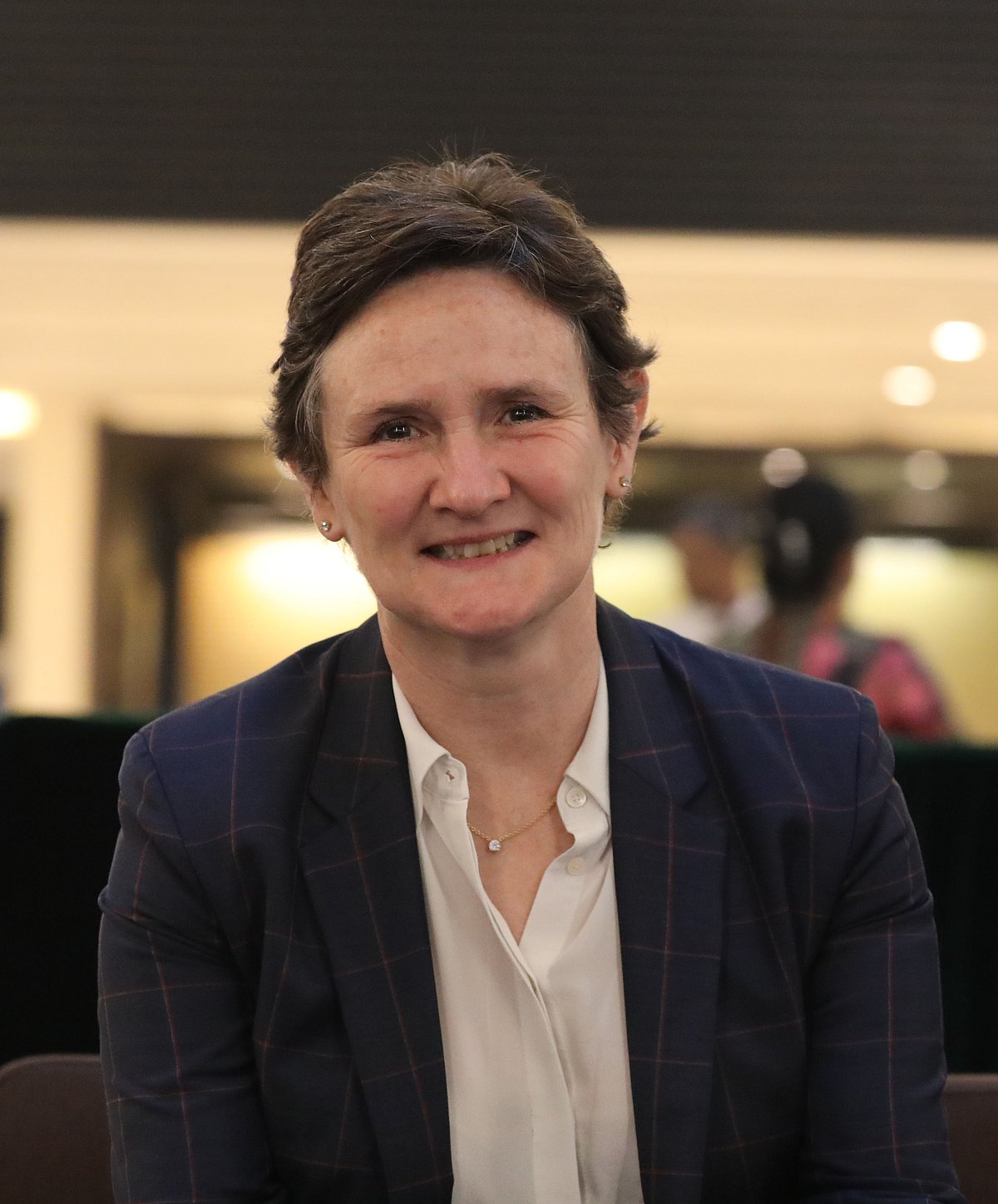
Professor Irene Tracey is a neuroscientist and second woman Vice-Chancellor of the University of Oxford in the nearly thousand-year history of this prestigious institution.Professor Tracey was in Chattogram, Bangladesh recently, attending the 12th commencement ceremony of the Asian University for Women.
Advertisement
"I have been truly overwhelmed by my first visit to Bangladesh and how friendly and kind the people are. I have been very inspired coming to the country," says Professor Irene Tracey
Advertisement
"Oxford has been around for a thousand years and has seen a lot of life and history. As an institution that is still standing, we are still teaching largely in the same way that we taught a thousand years ago, still trying to discover truth and disseminate it and look after it for the next generation, discover research and understanding about ourselves as humans, about the planet and the universe."Drawing a parallel between Oxford and AUW, Irene Tracey says, "It is wonderful for us to observe the template and model by which AUW has set itself up to target women and girls from displaced backgrounds.
Oxford is one of the few universities in UK that has now been awarded sanctuary status because of our historic looking after refugees that started during both the world wars and continued during the Greek famine. We have a long history of also looking after refugees, giving them an education, caring for them and then seeing what impact that little bit of kindness has, the hope it gives."She discussed the disparities women still face even in the West: "Some people think that the woman problem is fixed, but it is far from fixed. We still have gender pay gap. We still have glass ceilings. We still don't have the full representation of women in the private sector, in leading companies at the percentage that we populate the world, which is 50 per cent."When it comes to women, family and employment, Prof Tracey sees flexibility is key: "We can't avoid the fact that, at a time when one's career is being established, it often coincides with the time if you want to have a family, have children. That is still a challenge for society to grapple with. These are still issues that have to be resolved. It can only be resolved if we are more equitable in our thinking around jobs, being more flexible to allow women to have that time and still come back rather than saying, 'if you've gone, you've gone.'"Women invariably face challenges in leadership. Prof Tracey says, "I have observed slightly different rules apply to women leadership. They are judged a little bit more harshly. A woman doesn't have to change and become like a man in leadership. You have to be authentic and you have to help shape the world to accept your style. They have to be flexible, as opposed to you having to bend to be something to suit them."A brilliant neuroscientist, Oxford's Vice-Chancellor Irene Tracey is a firm advocate of the humanities: I really champion and speak up for the humanities, actually even more so now with AI. I think AI is going to destroy all the STEM subjects more than humanities. There has to be even bigger emphasis on the need to have people trained in the humanities and social sciences because these are going to be critical when we are living along with AI, to remind us of the importance of being human and the value of human society."