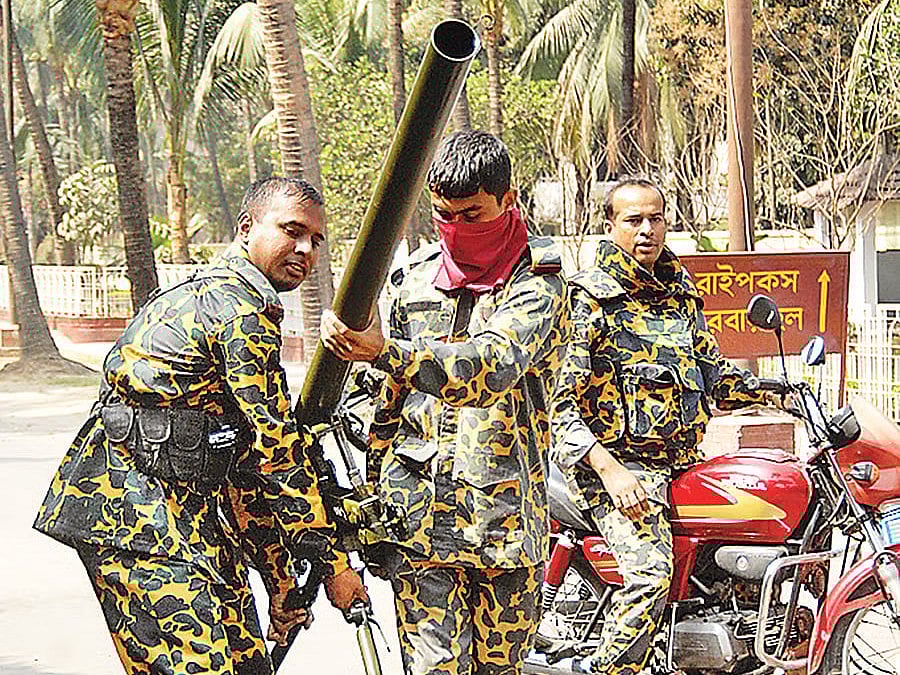
17 years of BDR mutiny
Pilkhana tragedy: Murder case awaits final disposal
Seventeen years ago, a brutal and gruesome massacre took place at the then Bangladesh Rifles (BDR) headquarters in Pilkhana, Dhaka. Two separate lawsuits were filed in connection with the incident.
In the murder case, both the trial court and the High Court have delivered their verdicts. The case is now awaiting hearing in the Appellate Division for final disposal.
Meanwhile, in the case filed under the explosives act, the trial court is still recording statements of the witnessess.
In the horrific incidents, which took place at the then BDR (now Border Guard Bangladesh – BGB) headquarters at Pilkhana in Dhaka on 25 February 2009, as many as 57 army officers, including the then BDR director general Major General Shakil Ahmed, were killed.
In total, 74 people lost their lives that day. Family members of the military personnel present at Pilkhana also suffered extreme violence.
Two separate cases were filed on 28 February 2009 under the murder and explosives acts. In the murder case, 850 people were accused, making it the largest case in the history of Bangladesh’s judiciary in terms of the number of defendants.
The trial court delivered its verdict on 5 November 2013, sentencing 152 people to death, 160 to life imprisonment, and 256 to various jail terms. Some 278 were acquitted, and four accused had died before the verdict.
Murder case moves to appeal stage
In criminal cases, if a trial court hands down a death sentence, it requires the High Court’s approval, known as the death reference case.
After hearings on the death reference and appeals in the Pilkhana murder case, a special High Court bench of three judges delivered its verdict on 26 and 27 November 2017.
The full High Court judgment was published in January 2020, upholding the death sentences for 139 accused, sentencing 185 to life imprisonment, and handing various terms to 228 others. Some 283 were acquitted. A total of 61 accused died so far, including the 15 accused, who passed away before the pronouncement of the High Court verdict.
Court sources say 73 separate appeals and leave-to-appeal petitions have been filed on behalf of 226 accused against the High Court’s sentences. Meanwhile, the prosecution has filed 20 leave-to-appeal petitions concerning 83 accused whose sentences were reduced or acquitted. These appeals are pending hearing in the Appellate Division.
After the High Court verdict, the prosecution filed separate leave-to-appeal petitions in 2020, while the defence filed appeals and leave-to-appeals in 2021 and 2022.
The defence’s appeals were placed before the Appellate Division’s chamber court on 12 November 2023, which then referred the matter to the regular bench. The case was placed on the Appellate Division’s schedule on 24 January 2024. The appeal was at number 669 on the Appellate Division's cause list yesterday, Tuesday.
Mohammad Aminul Islam, one of the defence lawyers in the case (recently appointed chief prosecutor of the International Crimes Tribunal), told Prothom Alo that both the defence and prosecution have submitted synopses of their appeals.
He further said that the case is ready for hearing and is already on the Appellate Division’s schedule. The hearing will proceed in due course.
Explosives case unresolved even after 17 years
The explosives case involves 1,344 witnesses. Of them, testimony from 302 has been completed so far. The trial continues at a special court near Dhaka Central Jail in Keraniganj. There are 834 accused in this case, of whom 59 have died and 20 are absconding.
Mohammad Aminul Islam told Prothom Alo that nearly 300 individuals who were acquitted or handed down various sentences in the murder case have obtained bail in the case filed under explosives act.
Borhan Uddin, the lead government counsel (PP), told Prothom Alo that the next hearing in this case is scheduled for Thursday. He said 302 witnesses have been produced so far, and their testimony has been recorded.
Summary trial
The gruesome Pilkhana incident was also tried under the BDR’s own law, known as a summary trial. In that proceeding, 10,973 people received various sentences.