The global crisis is making it increasingly difficult to maintain energy supply in the country. To keep gas supply stable, liquefied natural gas (LNG) is being imported at nearly double the price.
Even then, demand for gas cannot be fully met. More than half of the generation capacity of gas-fired power plants is lying idle. At the same time, reduced electricity generation from coal is increasing load-shedding.
Bangladesh’s major long-term LNG import sources are Qatar and Oman. After the outbreak of war in the Middle East, LNG supply from these two countries has been suspended.
According to sources at the Energy and Mineral Resources Division, Bangladesh has four long-term agreements with these countries. Due to the ongoing conflict, they have informed that LNG supply will remain suspended until mid-May. If the war persists, the suspension period may be extended further.
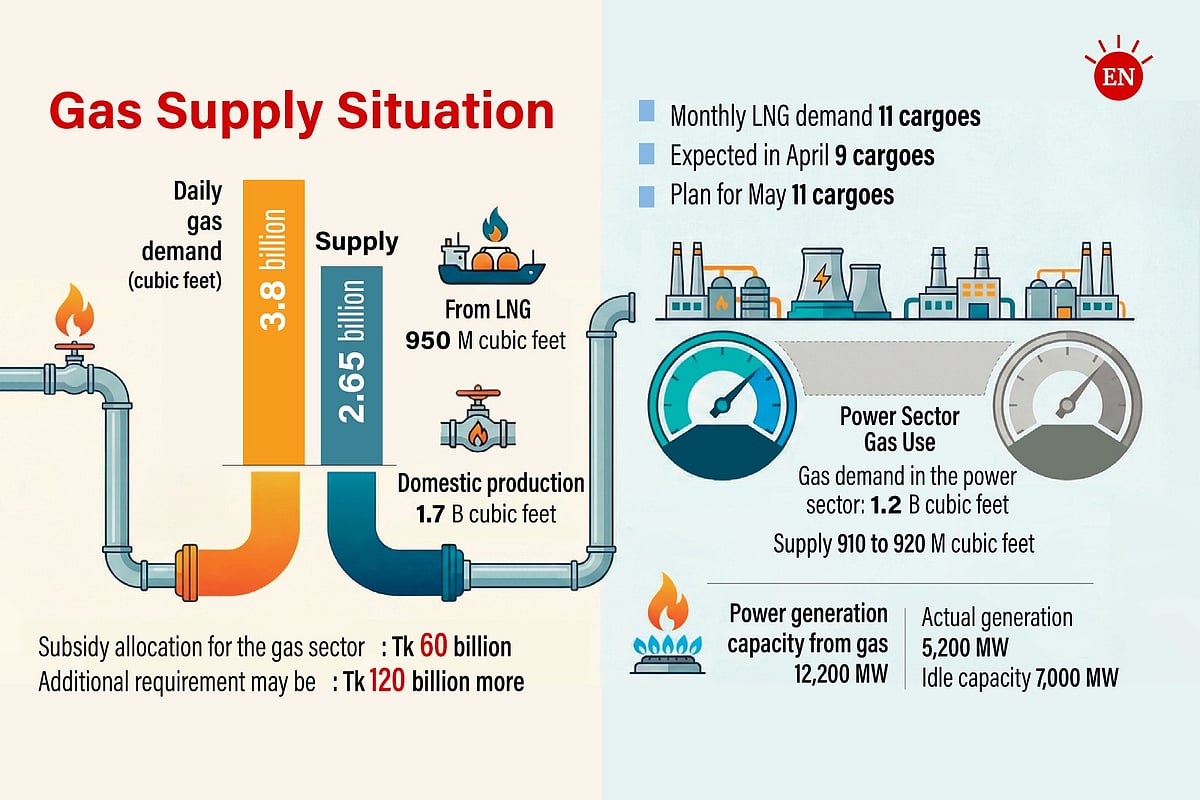
The country has been facing a gas supply crisis for several years. Domestic gas fields are currently producing 1.7 billion cubic feet per day, while LNG contributes 950 million cubic feet. Altogether, supply stands at 2.65 billion cubic feet, against a daily demand of 3.8 billion cubic feet. To manage the shortfall, gas is being diverted from one sector to another. At present, gas supply to fertiliser factories has been halted.
According to sources at Petrobangla, the country has the infrastructure to supply a maximum of 1.1 billion cubic feet of gas per day from LNG, which requires importing 11 LNG cargoes per month. This month, nine cargoes are being brought in.
Of these, eight have been purchased from the spot market, while one cargo is expected from Angola under a second contract with Qatar. This will allow an average daily LNG supply of 950 million cubic feet.
According to the Bangladesh Power Development Board (BPDB), ensuring load-shedding-free electricity during the summer (April–May) would require 1.2 billion cubic feet of gas per day. However, only about 910 million cubic feet was supplied yesterday, preventing power plants from operating at full capacity.
State Minister for Power, Energy and Mineral Resources Aninda Islam Amit told Prothom Alo that ensuring uninterrupted industrial and agricultural production remains a government priority.
Gas supply to industries cannot be reduced to increase supply to the power sector. LNG imports are being increased to maintain supply, and if coal-based plants can operate at full capacity alongside proper energy-saving measures, load-shedding can be avoided.
Incoming cargoes, rising subsidy pressure
According to Petrobangla, two LNG vessels have already arrived and begun unloading—one on 4 April and another on 5 April. Seven more cargoes are scheduled to arrive on 10, 11, 15, 18, 21, 24, and 27 April.
To maintain supply next month, the government plans to import 11 LNG cargoes. The Cabinet Committee on Government Purchase has already approved proposals to procure two cargoes, while tenders have been floated for three more, to be opened on 8 April.
Petrobangla officials say that before the war, LNG cost around $10 per unit. In April, purchases have been made at an average price exceeding $20 per unit, with one cargo bought at as high as $28.28. This is increasing Petrobangla’s losses.
In the current fiscal year, Tk 60 billion has been allocated as subsidy for the gas sector. In the first nine months, Petrobangla has already taken Tk 45 billion, and it is seeking an additional Tk 45 billion for April alone—meaning expenditures have already exceeded the allocation by Tk 30 billion.
Another Tk 90 billion may be required over the next two months. At the same time, LNG imports are increasing pressure on foreign currency reserves, particularly US dollars. From March to June, Petrobangla initially estimated a requirement of $1.4 billion for LNG imports, which is now rising further.
Petrobangla chairman Arfanul Hoque said last Saturday that despite higher prices, there is government instruction to procure LNG. Therefore, efforts are being made to maintain supply even at increased cost, with plans to import more LNG next month.
Idle plants, rising load-shedding
According to the Bangladesh Power Development Board (BPDB), ensuring load-shedding-free electricity during the summer (April–May) would require 1.2 billion cubic feet of gas per day. However, only about 910 million cubic feet was supplied yesterday, preventing power plants from operating at full capacity.
Gas-based power plants currently have a generation capacity of 12,200 megawatts, but production has reached only a maximum of 5,200 megawatts—leaving 7,000 megawatts of capacity idle. Despite this, the government must continue paying capacity charges for these plants. These plants were built during the previous Awami League government without ensuring adequate gas supply sources.
BPDB officials say two coal-fired plants are underperforming due to coal shortages, while the Adani Power plant is operating at half capacity due to technical issues.
Increasing generation from oil-based plants would further raise subsidies, while these plants are also pressing for payment of overdue electricity bills. As a result, load-shedding has become unavoidable.
Peak electricity demand has already reached 15,000 megawatts, leading to around 1,000 megawatts of load-shedding. This may increase further, with peak demand expected to reach 18,500 megawatts this season. Efforts are being made to manage demand alongside increasing generation. Reducing electricity use in the evening—such as closing shops and shopping malls—could help lower demand.
Geologist Badrul Imam told Prothom Alo that the country cannot function without energy. While LNG imports may be necessary in the short term, conservation could be an effective measure.
However, continued dependence on imports will repeatedly expose the country to such risks. He stressed the need to utilise domestic potential by increasing gas exploration and production.