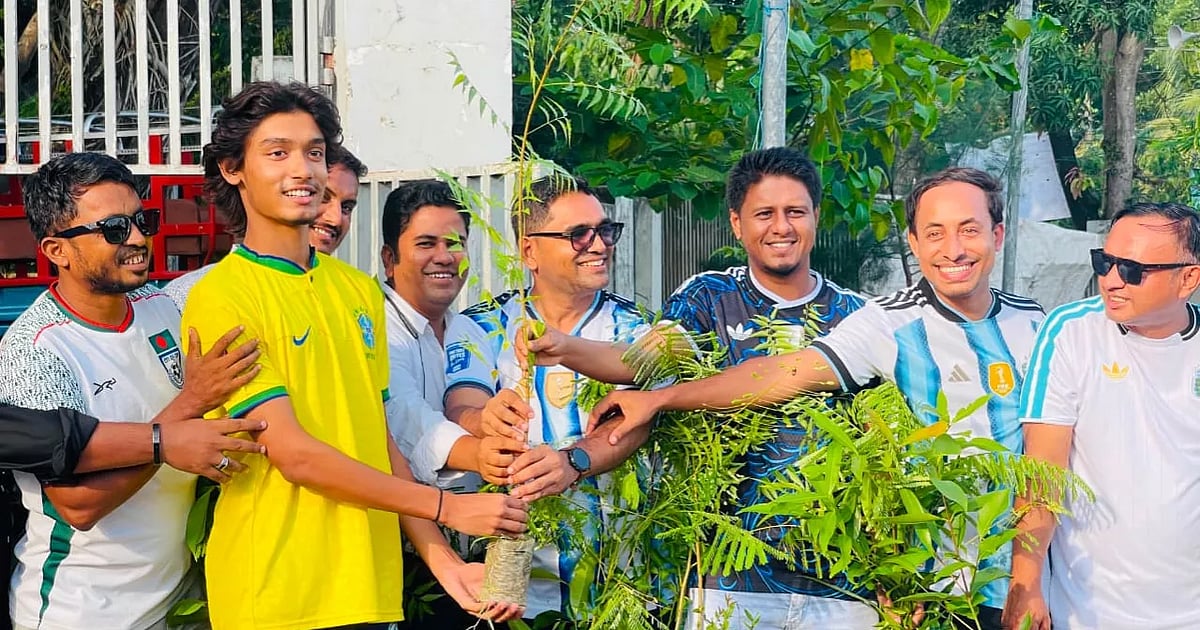
In Bangladesh, the FIFA World Cup is more than a sporting event. From village tea stalls to city rooftops, the tournament brings an outpouring of passion as fans proudly display their favourite teams' flags and jerseys.
Among young people in particular, football often inspires a level of enthusiasm that few other social movements can match. However, when that passion extends beyond the thrill of the game, it can create a lasting impact.
That is the idea behind Argentina Fans for Nature, a youth-led initiative that has transformed support for the Argentine national football team into a nationwide environmental campaign.
As one of the countries most vulnerable to climate change, Bangladesh continues to face increasingly frequent heatwaves, erratic rainfall, river erosion, cyclones, salinity intrusion and biodiversity loss.
Rapid urbanisation has also reduced green spaces as concrete development continues to expand. In this context, planting trees is no longer just an environmental gesture; it is now an important part of building climate resilience.
Environmental experts have repeatedly stressed that addressing climate change requires coordinated efforts by the government, the private sector and the public.
Many consider meaningful participation by young people a key element in building a sustainable environmental movement.
Against this backdrop, the campaign launched a nationwide programme on June 7 to distribute and plant 4,000 saplings across Bangladesh.
Hundreds of volunteers participated in the initiative in Dhaka, Mymensingh, Gazipur, Rajshahi, Bogura, Kushtia, Faridpur, Madaripur, Jashore, Narayanganj, Noakhali and Cox's Bazar.
Unlike conventional tree distribution programmes, the initiative places equal emphasis on long-term care.
Each participant is encouraged not only to plant a sapling but also to take responsibility for nurturing it for at least two years, recognising that ensuring a tree's survival is far more important than planting it.
The campaign has distributed nearly 70 species of native fruit, forest and medicinal trees, including mango, black plum, jackfruit, coconut, dewa, mahua, drumstick, Indian gooseberry, arjun, neem, wood apple, jarul, royal poinciana and golden shower.
Beyond providing fruit and shade, these trees are expected to contribute to carbon sequestration, biodiversity conservation, soil fertility and ecological balance.
Critics often target young people for their immersion in social media or sporting rivalries.
Yet initiatives such as Argentina Fans for Nature demonstrate that, with positive leadership and a meaningful objective, they can become powerful agents of social change. When support for a football team inspires someone to plant a tree, sport evolves from entertainment into a catalyst for environmental action.
The campaign concluded with a gathering at Shaibal Beach in Cox's Bazar, where more than a hundred supporters received saplings.
Organisers also announced that if Argentina wins the World Cup, they will launch a nationwide campaign to plant an additional 40,000 trees.
The pledge reflects an ambition to turn football enthusiasm into a long-term environmental movement.
The initiative is organised by the Chandrakoli Foundation, which has also been promoting the practice of planting trees to mark personal milestones such as weddings, birthdays, childbirth, anniversaries and memorials.
Over the past five years, the foundation has distributed nearly 2,000 saplings to families of newborns at the Mohammadpur Union Health Complex in Subarnachar, Noakhali.
The World Cup will come to an end. Flags will come down, and the celebrations will fade. But the saplings planted today will continue to grow for decades, providing shade, fruit, oxygen and habitat for wildlife.
In the years ahead, they may stand as a lasting reminder that a nationwide football celebration also gave birth to thousands of new green dreams.
Football brings joy to millions. When that joy grows into a tree—and eventually into a forest that helps protect future generations—it becomes far more than a celebration of sport. It becomes an investment in the country's future.