Govts change, buses don’t
Dhaka’s public transport trapped in politics and disorder
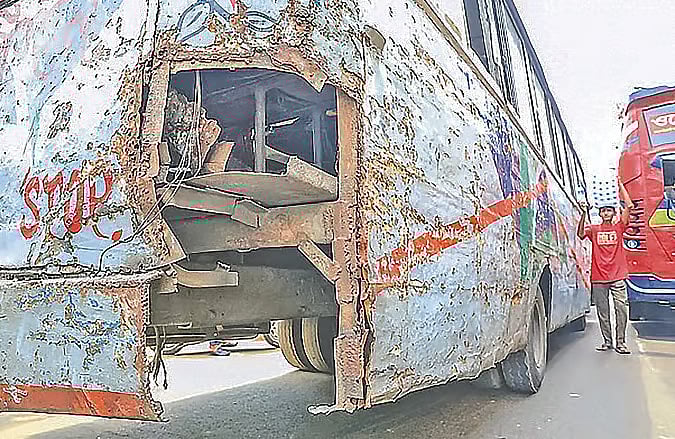
A bus was moving through Karwan Bazar in Dhaka. Even from a distance, its age was obvious — dented, rusted, and paint long faded. It looked as if it had survived far beyond its time.
I boarded the bus on 15 March 2026. Inside, the seats were sticky with oil and grime. Instead of 30 seats, there were 36 crammed into the space, yet all were occupied. I had no choice but to stand.
Saddam Hossain, an assistant of the bus driver, said they hire the vehicle paying Tk 4,500 to the owner daily. After covering fuel and road expenses, the remaining income is shared between the driver, conductor and the person who realises fare. It quickly became clear that no matter how old the bus is, the owner’s income does not seem to decline.
The bus, registered as Dhaka Metro-Ba-11-3335, belongs to the Shikhor Paribahan route between Mirpur and Jatrabari. Officials at the Bangladesh Road Transport Authority (BRTA) confirmed that the vehicle’s route permit had expired and its fitness certificate had lapsed. Manufactured in 2006, the bus is now 20 years old, long past its legal operating life and destined, in principle, for scrap. Yet it continues to operate on Dhaka’s roads without interruption, thanks to political patronage.
According to BRTA data, around 30 per cent of registered buses in Dhaka are past their operational life. Although BRTA and traffic police are responsible for removing such vehicles, old buses continue to run freely. Allegations have it that informal monthly payments allow them to remain on the road without enforcement.
A 2024 study by Transparency International Bangladesh (TIB) found that around Tk 10.59 billion is collected annually in extortion from privately operated buses. The proceeds are shared among politically affiliated individuals, police, BRTA officials and others.
The TIB study also noted that around 92 per cent of large bus companies are linked to politicians, with 80 per cent associated with the then ruling Bangladesh Awami League.
After the fall of the Awami League, Pankaj Debnath went into hiding, and control of the company reportedly passed to Mesbah Uddin, president of Ward No. 13 of BNP’s Dhaka North city unit, who now serves as secretary of the Bihanga Bus Owners Association.
Efforts to remove old buses from Dhaka roads began around 15 years ago but failed to succeed. During the Awami League’s long tenure, many party leaders were themselves bus owners or controllers, often obstructing reforms. As a result, passengers continued to travel in ageing, unsafe buses while paying higher fares.
Following the political change brought about by the July uprising and the fall of the Awami League government on 5 August 2024, expectations rose that reform would follow. However, the interim government did not take strong measures, while control of the transport sector has reportedly shifted to the leaders linked with the Bangladesh Nationalist Party (BNP).
New controllers, same system
BRTA estimates that around 7,000 buses operate in Dhaka under approximately 300 companies, owned by at least 4,000 individuals. The system remains largely informal.
Owners often lease buses on daily contracts to companies or workers, receiving a fixed amount regardless of earnings. In other cases, drivers themselves hire buses, pay a set fee to the company, and keep the remaining income.
Since many buses lack valid fitness certificates and route permits, owners often place them under influential operators to avoid enforcement action.
One example is Bihanga Paribahan, which operates on the Mirpur–Sadarghat route. During the previous government of the Bangladesh Awami League, its managing director was Pankaj Debnath, then president of the Swechhasebok League and a former MP.
After the fall of the Awami League, Pankaj Debnath went into hiding, and control of the company reportedly passed to Mesbah Uddin, president of Ward no. 13 of BNP’s Dhaka North city unit, who now serves as secretary of the Bihanga Bus Owners Association.
Mesbah Uddin told Prothom Alo that the committee is currently run by nine members and claimed he was previously only a general owner with a single bus during the Awami League period.
Boarding buses in Dhaka itself is difficult. The drivers’ assistants often touch passengers inappropriately while boarding. After evening, it is unsafe for women.A female private-sector employee
Similarly, control of the Basumati Paribahan, operating from Gabtoli to Abdullahpur, has also changed hands following the departure of its former controller Khondaker Enayet Ullah. Saiful Alam now leads the company.
Changes have also taken place in transport labour organisations. Shahjahan Khan, a former Awami League presidium member, once led the Bangladesh Road Transport Workers Federation but is now in prison. BNP-affiliated leaders Shamshur Rahman Shimul Biswas, MP, who is also an adviser to the party chairman, and Humayun Kabir Khan now hold the positions of president and general secretary respectively.
In the owners’ association, leadership has also shifted from Awami League’s Enayet Ullah to BNP-backed Saiful Alam.
Speaking about this, Saiful Alam told Prothom Alo that after the fall of the Awami League, disorder increased in the transport sector as former Awami League-linked leaders fled.
“We are trying to restore discipline,” he said. However, he added that removing all old buses at once would create a transport shortage, and suggested replacing them gradually with new vehicles through loans and restructuring the system into a franchise model with uniform buses on each route.
Repeated decisions, repeated retreats
According to the BRTA data, as many as 16,198 buses and minibuses currently operating in Dhaka are past their legal lifespan. Out of roughly 54,000 registered buses and minibuses in the capital, around 30 per cent are more than 20 years old.
BRTA sources say a large portion of these ageing vehicles operate on long-distance routes and registrations have been taken from outside Dhaka in surrounding districts. As a result, the proportion of expired buses actually running within the capital is even higher.
BRTA officials note that the number of expired vehicles increases every day as more vehicles reach the end of their permitted service life. This figure also does not include vehicles that are operating without valid fitness certificates.
BRTA data further shows that out of 86,338 buses and minibuses nationwide, 41,168 were operating without renewed fitness certificates as of February, nearly half of the total fleet.
A decade of failed enforcement
Moves to remove unfit vehicles began in 2010, when the then government declared that buses older than 20 years and goods vehicles older than 25 years would be barred from operating in the capital.
The announcement was followed by several similar directives, including an executive order in 2015. However, none of these measures were successfully implemented.
Following the deaths of two students, Abdul Karim Rajib and Dia Khanam Mim, in a bus accident on Airport Road on 29 July 2018, students launched a nationwide protest demanding safer roads.
After nine days of demonstrations, they returned to class following government assurances. Key demands included removing unfit vehicles and preventing unlicensed drivers from operating buses. Although the government announced various initiatives, little changed in practice.
Neither the physical condition nor the structure of buses meets acceptable standards. Yet buses remain the backbone of public transport in Dhaka. Even with metro rail and flyovers, demand for buses will remain.Md Hadiuzzaman, Transport expert and Professor of civil engineering at BUET
In May 2023, the government formally set the economic lifespan of buses and minibuses at 20 years, and 25 years for trucks and covered vans, effectively extending Dhaka-focused policy nationwide.
However, enforcement again stalled amid resistance and strikes by transport owners and workers, leading to suspension of the plan.
BRTA sources say the government at the time cited the approaching national election as a reason for not proceeding with strict enforcement, fearing unrest from transport operators.
Promises unfulfilled in city governance
In 2015, the late Dhaka North City Corporation (DNCC) mayor Anisul Huq initiated a plan to introduce 4,000 new buses in the capital, with each route to be operated by a single company. The system was intended to eliminate chaotic competition and introduce fixed stops and counters. However, progress stalled following his death in 2017.
Later, Dhaka South City Corporation (DSCC) mayor Sayeed Khokon, who took charge of the initiative, also failed to implement meaningful reforms, though questions remain over how far the initiative was pursued.
In May 2020, Sheikh Fazle Noor Taposh became mayor of Dhaka South City Corporation, while Atiqul Islam took charge in the DNCC. Taposh chaired the committee formed to reorganise bus routes, with Atiqul Islam as a member.
At a committee meeting on 28 November 2021, Taposh declared, “This anarchy, holding Dhaka residents hostage, will not continue. I will make it happen.”
Soon after, in December 2021, the Dhaka Nagar Paribahan service was launched on the Keraniganj–Ghatarchar route as a pilot project. However, the initiative soon lost momentum and failed to expand significantly.
What did the interim government do?
After taking charges, the interim government reinstated the earlier notification on vehicle age limits on 6 June last year. It also decided to gradually remove old vehicles from roads. The government announced that if transport owners voluntarily withdrew old vehicles, they would receive support to purchase new ones. A six-month deadline was set, along with assurances of easy loan facilities and changes in import policies.
However, transport owners and workers did not take any initiative to remove ageing vehicles within the stipulated time.
In May 2025, the six-month deadline expired. The BRTA announced that it would launch drives from 1 July that year. But the plan was postponed under pressure from transport owners.
Eventually, on 20 July, eight mobile courts launched simultaneous drives. Yet the campaign lasted only a week. Transport owners’ and workers’ organisations called a strike, effectively halting enforcement.
Following the strike announcement, the government held a meeting with transport leaders on 10 August last year. The strike was withdrawn, but operators effectively regained permission to continue running expired vehicles. BRTA’s enforcement activities subsequently came to a standstill.
Road Transport Adviser Muhammad Fouzul Kabir Khan told Prothom Alo that the government could not fully implement the measures due to time constraints.
“We still tried,” he said. “But there were continuous protests and demands on the streets, and transport owners and workers also threatened strikes. That is why full implementation was not possible.”
He added that some initiatives had been successful, such as seizing expired vehicles and introducing traffic signal systems on selected routes with the help of experts to restore discipline.
Costs of ageing buses
According to the 2016 Revised Strategic Transport Plan (RSTP) for Dhaka, 72 per cent of daily trips in the capital are made by buses and minibuses. No updated comprehensive survey has been conducted since then.
Experts identify three major problems associated with ageing buses and the lack of discipline in the transport system.
First, passengers are denied safe and comfortable travel. Fare disputes are common, sometimes escalating into altercations. Women frequently face harassment, and many are forced to switch to auto-rickshaws or ride-sharing services at significantly higher costs.
A female private-sector employee, requesting anonymity, said boarding buses in Dhaka itself is difficult. “The drivers’ assistants often touch passengers inappropriately while boarding,” she said. “After evening, it is unsafe for women. That is why I stopped using buses and now pay Tk 150 instead of Tk 20 to travel by auto-rickshaw.”
Second, environmental pollution. According to IQAir’s World Air Quality Report 2025, Dhaka ranks second among the most polluted capital cities in the world.
A 2019 study under the Clean Air and Sustainable Environment (CASE) project found that transport accounts for 10.4 per cent of Dhaka’s air pollution. It also found that 84 per cent of buses and minibuses emit black smoke beyond permissible limits.
Third, road accidents. Unfit buses are frequently involved in crashes due to reckless competition for passengers and unsafe driving practices.
Md Jahangir Fakir, father of deceased student Dia Khanam Mim, himself a bus driver on long-distance routes, said some changes had been observed after the 2018 student protests, but the situation has since reverted.
“Now there is chaos again on the roads, and fatalities are increasing,” he said. “Many buses are in such poor condition that even after repeated repairs, their braking systems remain unreliable, forcing drivers to operate them with sheer effort. That leads to accidents.”
He added that buses often have to stop abruptly in the middle of the road to pick up passengers, and said proper rules must be established and enforced to prevent disorder.
Fares are justified on paper
When determining bus and minibus fares, the BRTA takes into account 12 factors, including investment costs, vehicle purchase price, lifespan, and maintenance and repair expenses.
For fare calculation, the price of a new city bus is assumed at Tk 3.5 million, with an operational lifespan of 10 years. It is also assumed that each bus undergoes a major renovation once every five years, costing around Tk 650,000. These assumptions form the basis of fare determination.
However, in reality, new buses priced at Tk 3.5 million are rarely seen on Dhaka’s roads. Instead, the city is dominated by ageing, worn-out vehicles with faded paint, damaged structures, and torn seats.
Although the government allows buses to operate for up to 20 years in the capital, fares are calculated based on a 10-year lifespan. As a result, even buses that are 11 to 20 years old charge the same fares as new ones.
The fare structure also assumes that buses will undergo maintenance every 25 days and major servicing every three months, costing around Tk 40,000 annually. But such maintenance is rarely carried out, contributing to the deteriorating condition of buses across Dhaka.
For example, on 12 April, a Meghla Transport bus was seen operating on Science Laboratory Road in the capital with a broken rear body panel.
According to BRTA sources, the bus was manufactured in 2018 and is only eight years old, yet it has already become dilapidated. Had it undergone proper five-year renovation, officials say, such deterioration could have been avoided. Nevertheless, the operator continues to charge fares based on standard maintenance and repair costs.
When asked about the issue in a phone conversation on 25 April, BRTA Chairman (Additional Charge) Mir Ahmed Tarikul Omar acknowledged the presence of such vehicles on the roads.
“Yes, such buses do operate. We conduct mobile court drives and seize them when found,” he said. “Instructions have now been issued to cancel the registration of such old buses.”
He added that removing all old buses would require a political decision, as replacing them without introducing new vehicles would create public suffering.
‘Chaos allows collection of illegal payments’
Dhaka’s buses are primarily used by low-income commuters. Ministers and MPs have official vehicles, while government officials often use project-based transport or vehicles bought in an interest-free car loan (the benefit has been cancelled on 5 April). Wealthier residents rely on auto-rickshaws or ride-sharing services like Uber. The city has also invested heavily in flyovers and other road infrastructure, with more under construction.
Transport expert and BUET (Bangladesh University of Engineering and Technology) Professor of civil engineering, Md Hadiuzzaman told Prothom Alo that Dhaka’s bus system can no longer be considered a proper public transport network.
“Neither the physical condition nor the structure of buses meets acceptable standards,” he said. “Yet buses remain the backbone of public transport in Dhaka. Even with metro rail and flyovers, demand for buses will remain. However, previous governments spent hundreds of billions on large infrastructure projects without fixing the basic bus system. Nowhere in the world is such investment made without first improving primary public transport. This is fundamentally flawed.”
He also described the long-stalled bus route rationalisation initiative as the correct solution for Dhaka. “Everything has already been outlined in studies. There was no need for endless meetings. Pilot projects were implemented. Actually, the intention of the pilot project was to show the initiative a failure. Because where there is disorder in the bus sector, massive amounts of illegal money can be collected. If discipline is restored, that opportunity disappears.”
The Bangladesh Nationalist Party (BNP) has pledged in its election manifesto to ensure order and safety in the public transport sector, including the introduction of an integrated smart management system and bus route rationalisation.
Meanwhile, commuters remain sceptical.
While travelling on a Shikor Paribahan bus from Shewrapara on 10 April morning (when metro rail services were unavailable), passenger Rafiqul Islam responded to talk of political promises with resignation.
“Governments come and go, but nothing really changes,” he said. “Let’s see what the new one does.”