Her head is full of hair. Words constantly upon her lips as she speaks without pause. She also asks her father questions ceaselessly. Sings one song after another. The little girl in her father’s arms does it all so perfectly that one might ask— is there anything she cannot do?
She cannot stand. She cannot walk. She cannot sit upright without her head lolling to one side. The muscular strength required for a child of her age is absent. The child is afflicted with a genetic disorder known in medical science as Spinal Muscular Atrophy (SMA).
Olivia Sanchari Nabani is the only child of Shahin Akhter and Shahadat Hossain. She is four years and two months old. Their home is in Moghbazar, Dhaka.
From the moment they learnt that their daughter had SMA, the world around them has turned grey. Their child is a victim of a rare disease—SMA is among the rarest.
What is a rare disease?
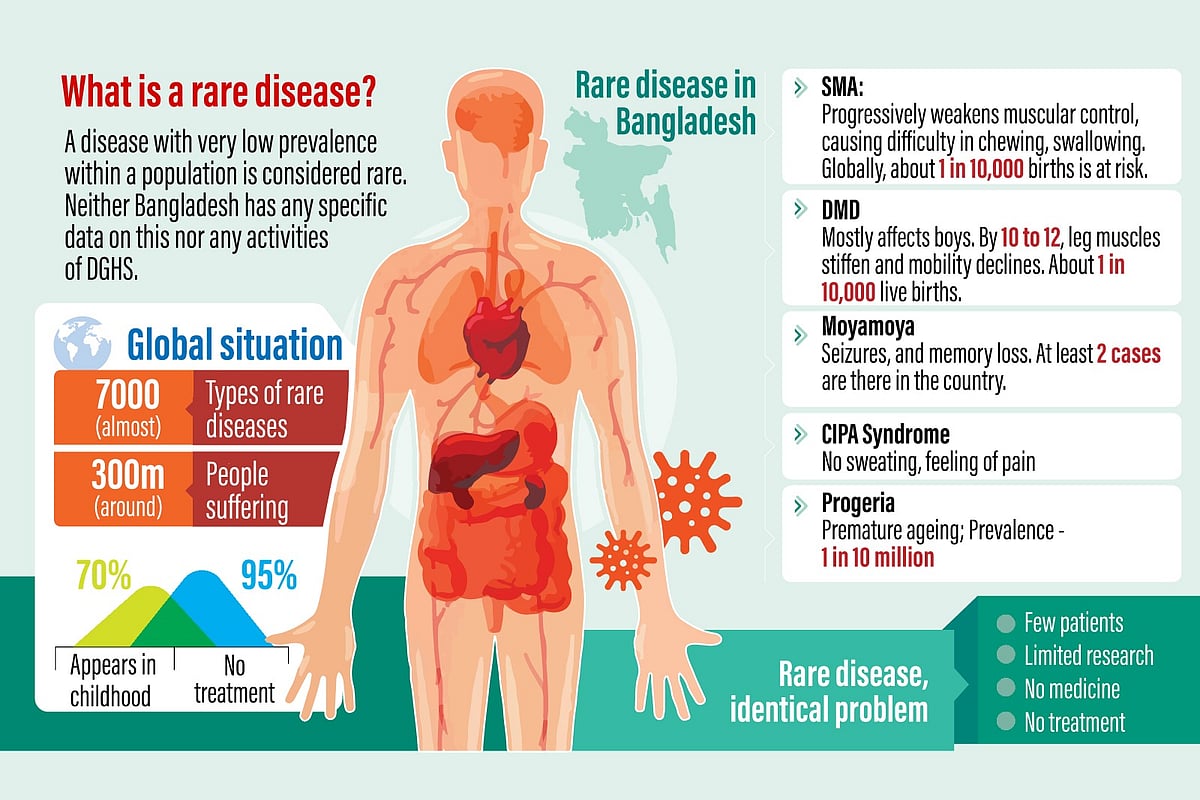
A disease with very low prevalence within a population is considered rare. A WHO document published in February this year defines a rare disease as a particular health condition that occurs in one person per 2,000 or fewer.
Globally, there are about 7,000 rare diseases affecting some 300 million people. Seventy per cent of these conditions manifest in childhood.
The WHO notes that rare diseases are typically complex, often involving multiple organs. Those afflicted usually suffer co-morbidities, the conditions deteriorate rapidly, result in disability, and often cause premature death.
A disease with very low prevalence within a population is considered rare. A WHO document published in February this year defines a rare disease as a particular health condition that occurs in one person per 2,000 or fewer.
Precise data on rare diseases is lacking both in Bangladesh and in many other countries. Research and policy focus on them remains negligible. The United States is considered more advanced in this field.
American law defines a rare disease as one affecting only one person per 200,000 of its population. The country has some 6,000 identified rare diseases, afflicting around 25 million individuals.
Rare diseases in Bangladesh
Between March and late August, this correspondent spoke with the authorities of three hospitals, several physicians, and more than 30 parents and patients to understand the situation in Bangladesh.
During this time, cases of SMA, Duchenne Muscular Dystrophy (DMD), Haemophilia, Moyamoya, CIPA Syndrome, Rett Syndrome, Progeria, Tree Man Syndrome, and Xeroderma Pigmentosum (XP) came to light. The actual number of rare conditions is far greater.
SMA is a genetic disorder that progressively weakens muscular control, causing difficulty in chewing, swallowing, spinal deformities, breathing problems, and ultimately severe disability.
Globally, about one in 10,000 births is at risk. In Bangladesh, there are thought to be 200–300 patients.
I have no time of my own. My entire day is with my daughter. Only when she sleeps do I get a brief respite.Shahin Akhter, Mother of a child suffering from a rare disease
Duchenne Muscular Dystrophy (DMD), another genetic condition, mostly affects boys. By ages 10 to 12, leg muscles stiffen and mobility declines. Bangladesh likely has around 200 such patients, with a prevalence of one in 10,000 live births.
Researchers at the National Institute of Neurosciences & Hospital are studying Rett Syndrome, a genetic neurological disorder. Children develop normally until around 18–24 months, then regress with seizures, halted head growth, and cognitive decline. No prevalence data exists.
The nation’s media spotlight fell in 2016 on Abul Bajandar, the so-called “Tree Man”, whose hands and feet grew root-like formations.
His case was linked to a rare interaction between genetic defect and human papillomavirus. Bajandar has since undergone some 30 major surgeries.
Other rare conditions identified include Progeria, which causes premature ageing; Haemophilia, a blood-clotting disorder usually in males; and XP, which renders patients intolerant to sunlight, leading to rapid skin damage and neurological decline.
When diagnosis is not accurate, wrong treatment follows. The symptoms of one disease sometimes resemble those of another, which creates the risk of wrong treatment. In some cases, no treatment for the disease is known, so treatment is given to stop further deterioration.Shaoli Sarker, Associate professor, Paediatric neurology department, Bangladesh Shishu Hospital and Institute
Physicians at the National Institute of Neurosciences have confirmed at least two cases of Moyamoya disease, a rare cerebrovascular condition that impedes blood flow to the brain, causing headaches, paralysis, seizures, and memory loss.
Professor Md Tito Miah of Dhaka Medical College recalls encountering two patients in Mymensingh with CIPA Syndrome—a congenital insensitivity to pain with inability to sweat. Such patients face life-threatening risks from heatstroke and injuries.
Zubaida Parveen, assistant professor of Paediatric Neurology at the National Institute of Neurosciences, notes, “There are at least 15 identified rare neurological diseases in the country. How many more exist is unknown. The truth is, no one has looked.”
Tales of relentless suffering
Mohammad Parvez, a Dhaka-based private job holder, saw his son Muntasir born in 2014. By age five, the boy showed abnormalities—struggling to stand, complaining of muscle pain. In 2022, physicians diagnosed him with DMD. Today, at only 11, Muntasir has lost mobility.
Parvez laments, “I watched my son become paralysed before my eyes. He is only 11. I could do nothing. Doctors say children like him do not live long.”
It’s not profitable for pharmaceutical companies when the medicine is sold to only a limited number of people, since developing a drug requires huge investment. The few medicines that are developed are therefore expensive.
Physicians say such children do not live long.
Parents of children suffering from rare-disease live in perpetual anguish. For some, the pain is being unable to afford treatment; for others, knowing that treatment cannot save their child. Many fear what will happen to their child after they are gone.
For Shahin Akhter and Shahadat Hossain, their daughter’s SMA has ended all semblance of normal life. Once active in a cultural organisation, they have abandoned it entirely.
Shahin says, “I have no time of my own. My entire day is with my daughter. Only when she sleeps do I get a brief respite.”
Some families face compounded tragedy. Businessman Omar Faruk’s two sons both suffer from rare diseases. “Happiness has disappeared from our lives,” he confides.
One family, who wished to remain unnamed, has endured an even harsher fate. All three of their children were diagnosed with DMD. Living in poverty, the parents shared one bed with their afflicted children. Recently, one child passed away. Now the parents continue to live with their two remaining sons, both still battling the disease.
Not easily detectable
Swastika Saha is the lone child of Sujan Saha and Rama Saha. When she was nine months old, her parents noticed their child was struggling to sit and stand.
There are at least 15 identified rare neurological diseases in the country. How many more exist is unknown. The truth is, no one has looked.Zubaida Parveen, assistant professor of Paediatric Neurology at the National Institute of Neurosciences
Sujan Saha said, “I took my daughter to Mitford Hospital first. Then I took her to the PG Hospital (Bangladesh Medical University). Later, I even consulted a physician at a private hospital in Panthapath. But my daughter was getting weaker. Then I went to Chennai, India with my daughter, where she was diagnosed with SMA. None of the physicians at the three hospitals could detect the disease.”
Parents of several children also shared similar stories. Afreen Akter, who has spinal muscular atrophy (SMA), completed her master’s in law from Dhaka University. She said at first a physician treated her for myopathy. Later, after tests at home and abroad, it was confirmed that she had SMA.
Afreen said, "For more than three years I was under the wrong treatment." She is now working at a private company.
Former principal of Dhaka Medical College Professor Md Tito Miah said that almost all rare diseases lack specific treatment. "We provide some supportive treatment so that the patient feels comfortable and the disease does not progress," he said.
Associate professor Shaoli Sarker of the paediatric neurology department at Bangladesh Shishu Hospital and Institute said, "When diagnosis is not accurate, wrong treatment follows. The symptoms of one disease sometimes resemble those of another, which creates the risk of wrong treatment. In some cases, no treatment for the disease is known, so treatment is given to stop further deterioration. Moreover, in the absence of a proper referral system, patients go to the wrong institutions or wrong persons, and thus they are deprived of correct treatment."
No treatment for 95 per cent rare diseases
The World Health Organization (WHO) has said that the prices of medicines for rare diseases, along with other health-related products, are very high. In many countries, access to such products and medicines is limited. This remains a major challenge.
There is no separate branch in the DGHS for rare diseases. Overall, there is no specific work on rare diseases either. When discussions arise about a particular rare disease, necessary steps are then taken.DGHS director general professor Abu Zafar
According to physicians and pharmaceutical sources, there are three treatments for the case of spinal muscular atrophy (SMA), a rare disease. The first is gene therapy, which is given through an injection only once in a lifetime. Its cost is around Tk 220 million. Another injection, administered into the patient’s spine every two months, costs Tk 10 million per dose. There is also a syrup, each bottle of which costs Tk 1 million. A patient needs one bottle per month.
Two children in Bangladesh have received gene therapy. No one is known to have received the spinal injection. A multinational company began providing the syrup free of charge to three children in the country. At present, only Naboni from Moghbazar continues to receive the syrup free of cost.
It’s not profitable for pharmaceutical companies when the medicine is sold to only a limited number of people, since developing a drug requires huge investment. The few medicines that are developed are therefore expensive. The WHO has said that due to the lack of equitable investment and financial incentives in drug development, there is still no effective treatment for 95 per cent of rare diseases worldwide.
What is the state doing?
Sources in the health ministry and the Directorate General of Health Services (DGHS) said they have no ongoing programme on rare diseases.
Speaking on the matter, director general of the DGHS professor Abu Zafar said, "There is no separate branch in the DGHS for rare diseases. Overall, there is no specific work on rare diseases either. When discussions arise about a particular rare disease, necessary steps are then taken."
The National Institute of Neurosciences and Hospital, particularly its paediatric neurology department, has taken an exceptional role. This department has introduced a weekly special clinic for children with rare diseases. In addition, it holds a large regular seminar once in the middle of every month.
For the 2025–2026 fiscal year, the Ministry of Health has allocated Tk 310 million to the National Institute of Neurosciences and Hospital for the treatment of a rare disease (SMA) and for the purchase of surgical equipment.
The institute’s director, professor Kazi Gias Uddin Ahmed, said, "A decision has been made to buy medicine worth Tk 50 million. The process of spending the remaining amount is ongoing."
Search for inner strength
Several organisations have been formed to support or stand by people affected by rare diseases. These organisations collect information and try to find and share where tests and treatments are available at home and abroad.
One such organisation is Cure SMA Bangladesh. Its general secretary, Omar Faruk, said, "This organisation has been formed with SMA patients and their parents. Alongside raising awareness about the disease, we are working to introduce genetic testing for diagnosis in the country. With the help of pharmaceutical companies and physicians, we are trying to ensure that medicine can be obtained at a lower price."
Similarly, there is DMD Care Foundation Bangladesh for patients with DMD. People with haemophilia have the Bangladesh Haemophilia Society. Such organisations also exist abroad.
What can be done?
The World Health Organization says it is very important to adopt a comprehensive, patient-centred approach according to the needs of those affected. It stresses the need to provide support to enhance their abilities, keep them socially engaged, and remove barriers to access in health, education, and employment.
Some have demanded the establishment of a separate wing for rare diseases under the Directorate General of Health Services, while others have emphasised raising awareness. There have also been calls to build a social movement.
Zubaida Parveen, assistant professor at the National Institute of Neurosciences and Hospital, said, "Skilled manpower must be developed in this field. It is also necessary to set up proper laboratories for diagnosis."
[Prothom Alo has published the names of patients and their guardians in this report with their consent.]