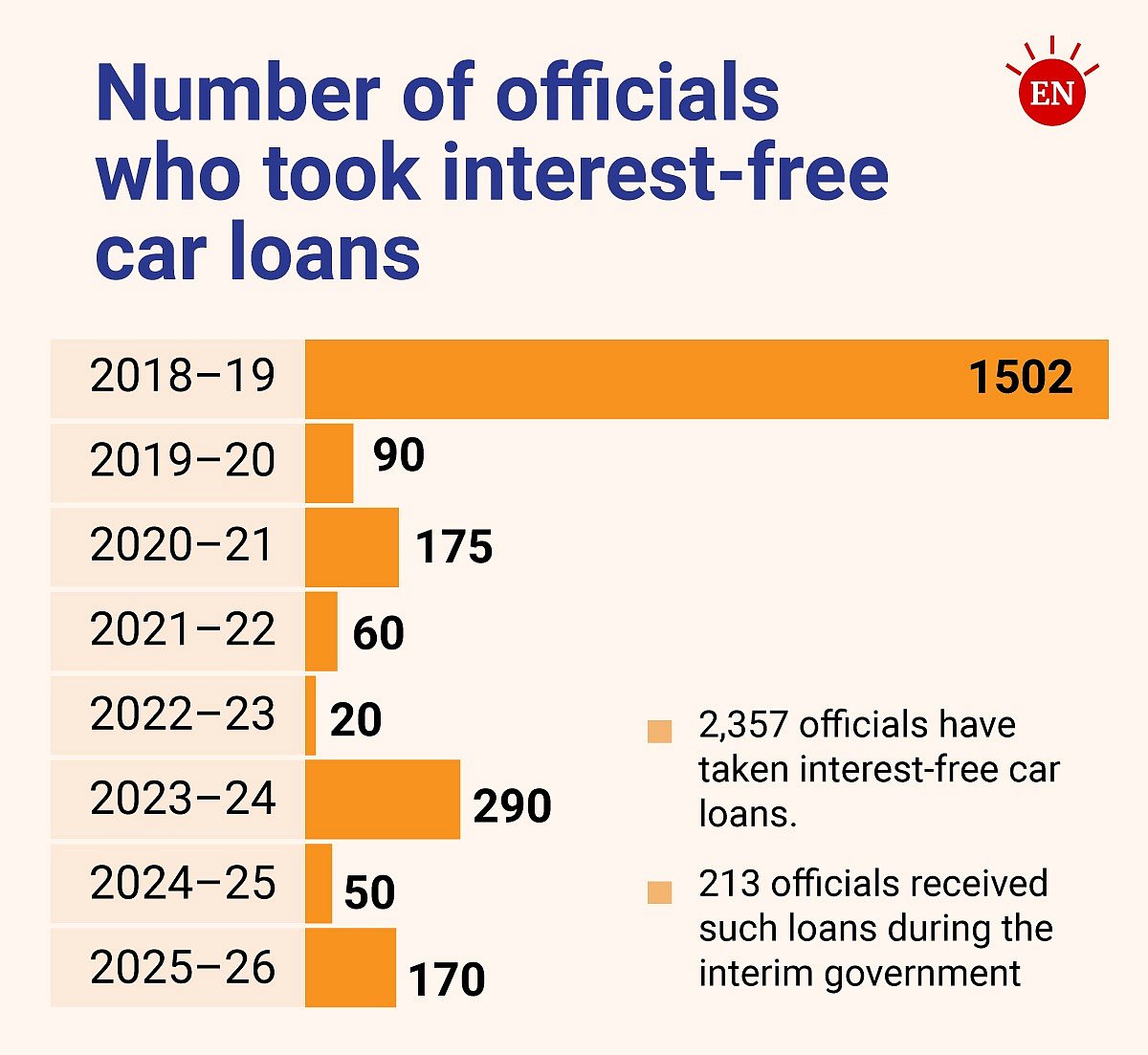
Before the 11th Jatiya Sangsad (national parliament) election of 2018—widely referred to as the “night votes”—the then Awami League government introduced a “special gift” for the administration.
It was an interest-free loan scheme for senior civil servants, including secretaries, additional secretaries, joint secretaries, and deputy secretaries, to purchase cars.
A policy was issued at the time stating that officials would receive loans of up to 3 million taka interest-free for car purchases, with only a 1 per cent service charge applied. The loan was to be repaid in 120 monthly installments. Borrowers would also receive a depreciation benefit of 10 per cent per year over eight years.
According to loan recipients and officials concerned, if an officer took a 3 million taka loan and received the 10 per cent annual depreciation benefit over eight years, the effective repayment amount would fall to around 1.3 million taka. This resulted in monthly installments of roughly 11,000 taka.
The government also provides 50,000 taka per month for vehicle maintenance. Beneficiaries say that in Dhaka, this allowance is often enough to cover loan installments, driver salaries, and fuel costs combined.
According to the Ministry of Public Administration, a total of 2,137 officials (excluding the armed forces and judiciary) received interest-free car loans and maintenance allowances during the Awami League’s tenure.
The interim government continued the facility. Between the 2024–25 and 2025–26 fiscal years, up to 22 February this year, 226 deputy secretaries also received the benefit.
After the BNP government came to power, officials who had not previously received the benefit or had been newly promoted began submitting applications. Sources say that between 17 and 22 February alone—just six working days—at least 60 deputy secretaries had their car loan and allowance approvals processed.
In total, 2,357 officials across three governments have received this facility. There are currently around 3,000 officials from deputy secretary to secretary level.
In response to a broader economic strain caused by conflict in the Middle East, the BNP government adopted several cost-cutting measures.
On 5 April, the Ministry of Finance issued a circular stating that interest-free car loans for government employees would be discontinued.
Transparency International Bangladesh (TIB) Executive Director Iftekharuzzaman described the interest-free car loan as a “waste of public money” and an “unethical and undue reward” designed to appease bureaucrats.
He said the previous Awami League government introduced such benefits to ensure administrative compliance during the “night elections” and to keep bureaucrats under control.
He also noted that newly elected members of parliament have already set examples by refusing tax-free cars or land allocations, arguing that there is no justification for continuing such discriminatory and unethical benefits for bureaucrats. He called for a permanent end to the scheme.
According to investigation commission reports formed during the interim government, elections in 2014, 2018, and 2024 were heavily influenced by the ruling Awami League, with state institutions being used in ways that turned elections into “farces.”
The reports mention the creation of senior secretary posts, elevation of the Inspector General of Police above secretary rank, upgrading police officers’ ranks, and various incentives including interest-free car loans and mass promotions as rewards for officials allegedly involved in facilitating flawed elections.
Although the policy was issued in 2017, it was implemented in 2018—the year of the controversial 11th parliamentary election held on 30 December. The commission report, citing presiding and assistant presiding officers, stated that ballot-stuffing began the night before voting across 80 per cent of polling stations, continuing from 10:00pm to 3:00am.
Returning officers, mainly district commissioners appointed from the deputy secretary level, did not intervene or protest despite the widespread irregularities.
Commission member Abdul Alim told Prothom Alo on 14 March that the government had provided various benefits to silence dissent and prevent questions over controversial elections, using public funds to influence outcomes.
Even they got loan-free car loans
Despite receiving interest-free car loans and maintenance allowances, many officials continue to use government vehicles, particularly project vehicles that are supposed to be returned to the government transport pool after project completion. Media reports have repeatedly highlighted this issue, but the situation has remained unchanged.
During the Awami League government’s tenure, several attempts were made to audit project vehicles used by government officials. Letters were issued in this regard, but the audit reports were never published, and the use of project vehicles by officials did not stop.
After the interim government took office, then Planning Adviser Professor Wahiduddin Mahmud announced on 8 October, 2024 that a full accounting of project vehicles would be carried out.
Subsequently, on 18 November, the Ministry of Public Administration issued a directive stating that details of the number and condition of vehicles must be reported 90 days before a project ends, and that vehicles must be handed over to the government transport pool within 60 days after project completion.
In an April 2025 interview with Prothom Alo, then Local Government Adviser Asif Mahmud Sojib Bhuyain said that ministries and agencies had submitted their reports. However, those records have not been made public, and no visible enforcement action by the interim government has been seen on this issue.
How much does the state spend?
According to sources in the Ministry of Public Administration, the total amount of loans distributed for purchasing cars exceeds 7 billion taka (excluding the judiciary, armed forces, and election commission).
However, the government has never clearly disclosed how much is spent on interest subsidies and depreciation benefits. Based on the monthly maintenance allowance of 50,000 taka for 2,357 officials, the estimated monthly expenditure alone is just over 1.41 billion taka.
In some cases, officials receive dual benefits: a loan-based vehicle and another official vehicle linked to their post. In such cases, the state covers drivers, fuel, and maintenance for both, while the official may receive either 50,000 taka or a reduced 25,000 taka maintenance allowance depending on eligibility.
Two administration cadre officials working at Rajdhani Unnayan Kartripakkha (RAJUK) and the Department of Archives and Libraries, speaking on condition of anonymity, said that when they took the interest-free loan, they were already entitled to an official government vehicle through their posting. As a result, they received 25,000 taka instead of 50,000 taka in maintenance allowance, which they fully used to repay their loan instalments.
Inequality in access
From 2018, deputy secretaries became eligible for interest-free car loans. In August 2020, the Awami League government introduced a revised rule requiring at least three years of service as a deputy secretary to qualify.
Since most deputy secretaries come from the administration cadre, officials from other cadres expressed dissatisfaction over the disparity.
In 2019, officers from the armed forces in designated positions were included in the scheme. After the 2024 parliamentary elections—widely criticised as a “dummy vote”—election commission officials were also brought under the benefit in February.
The interim government later extended the facility to the judiciary in December 2024. Other cadres, however, such as education, health, agriculture, fisheries, and technical services, have never been included.
Bangladesh has 25 BCS cadres in total. A health cadre associate professor, speaking anonymously, said, “If this benefit is given, it should be given to all equivalent ranks, otherwise to none. Why should deputy secretaries get cars while teachers and doctors are excluded? This is not just inequality—it is social injustice.”