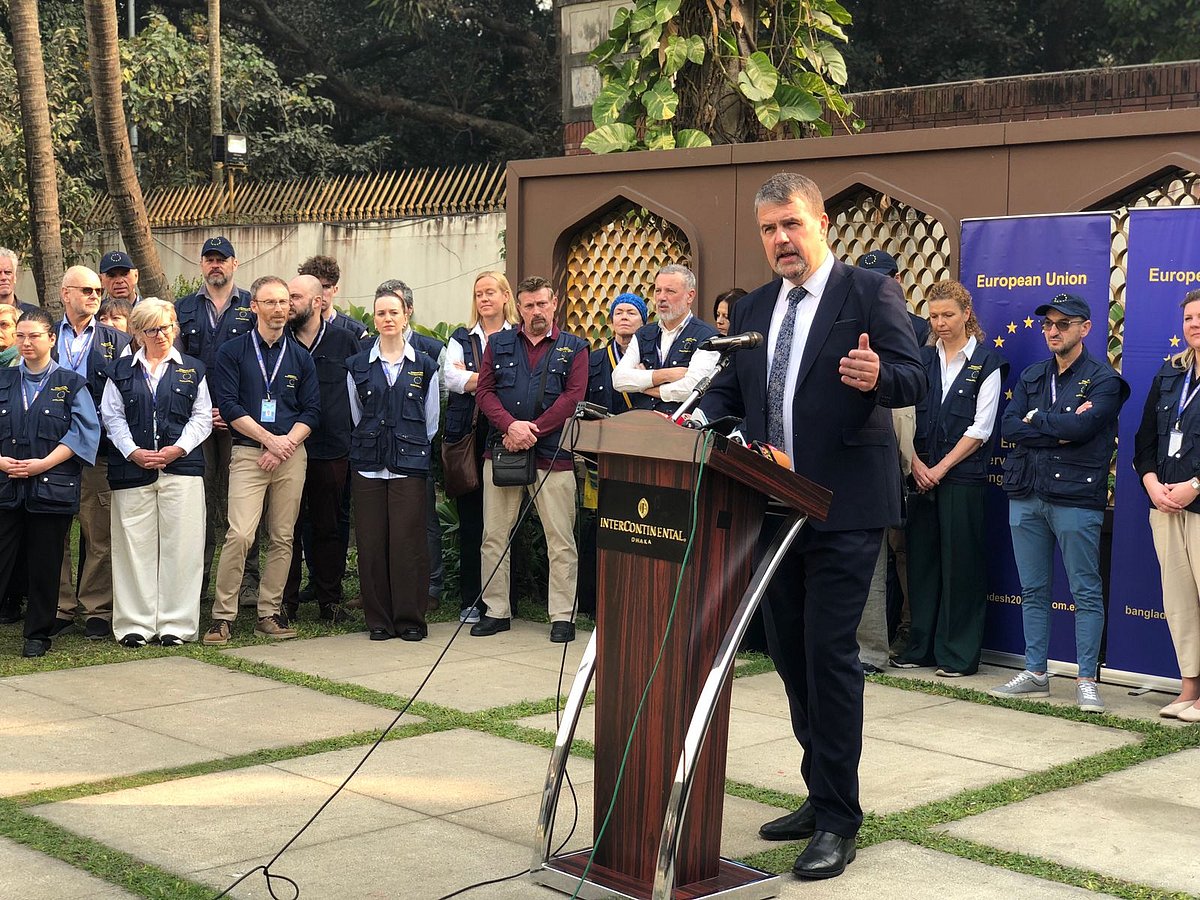
Election environment highly positive: EU election observation mission chief
The head of the European Union (EU) Election Observation Mission (EOM), Ivars Ijabs, has described the overall environment surrounding Bangladesh’s 13th national parliamentary election as “highly positive”.
He also expressed optimism that the country will witness a very good, inclusive, and above all credible election.
The EU EOM chief observer made the remarks while responding to journalists’ questions at a hotel in the capital on Tuesday morning.
Asked about the prevailing election environment, Ivars Ijabs said the overall situation was extremely positive and encouraging.
He noted that most of the people the mission had engaged with strongly believe this election should mark a new chapter in Bangladesh’s history and democratic journey.
For this reason, he said, both the general atmosphere and public expectations surrounding the election appear highly hopeful.
“We want to see a credible and inclusive election,” the EU mission chief said.
He reiterated that the overall electoral environment remains positive and added that the upcoming election could usher in a new chapter in Bangladesh’s democratic history.
Ivars Ijabs said the EU Election Observation Mission is in Bangladesh with the expectation of witnessing a credible and participatory election, guided by shared principles such as democracy, political accountability, and the rule of law.
Speaking on the country’s security situation, he said the mission has held discussions with security agencies, including the armed forces and police. While some areas are considered comparatively higher risk, he said the mission believes the authorities have, overall, kept the situation under control.
Responding to a question on the participation of women and minority communities, Ijabs said this is an important and legitimate issue. To ensure a genuinely inclusive election, he stressed, participation from all communities, particularly minorities and women, is essential.
These matters will remain under close observation by the mission, he stated.
Addressing another question on the electoral environment, the EU mission chief said long-term observers are already deployed across various districts and regions, working at the grassroots. They are maintaining regular contact with candidates, relevant authorities, and other stakeholders.
Based on these engagements, he said, the overall assessment of the electoral environment remains positive, with many viewing the election as the beginning of a new chapter in Bangladesh’s history and democracy.
Despite discussions on various issues overall expectations and the atmosphere remain hopeful, he reiterated.
When asked about monitoring of pre-election campaigning, social media, and the mainstream media, Ivars Ijabs said it would not be appropriate to comment at this stage.
He said the mission’s preliminary report will be released on 14 February, when detailed findings on these issues will be presented.
The EU EOM chief election observer emphasised that election observers must remain neutral and refrain from involvement in political processes. The final report, to be published around two months after the election, will include recommendations on various issues, including social media, which he described as a major challenge for democracies worldwide.
Ivars Ijabs said observers working in the field will act as the “eyes and ears of Europe”, and that their observations will form the basis of a neutral and evidence-based assessment of the electoral process.
He concluded by saying the EU is keen to see a good, inclusive, credible, and widely accepted election in Bangladesh.