Analysis
When diesel prices fell, bus fares didn't, now how justified is a hike?
Following the recent increase in diesel prices, transport owners are pushing strongly for a significant hike in bus and minibus fares. They argue that not only fuel costs but also expenses for spare parts and other operational inputs have risen, and these should be factored into a revised fare structure.
However, questions have emerged over how justified it is to raise public transport fares based on these claims.
In August 2022, the government raised diesel prices by 42 per cent to Tk 114 per litre. At that time, bus fares were increased by up to 40 paisa per kilometre, or about 22 per cent. Subsequently, diesel prices were reduced in several phases. The government also officially lowered bus and minibus fares by 8 paisa per kilometre in two steps. However, transport owners did not implement those reductions, and there was no effective monitoring by the authorities.
Last Saturday, diesel prices were increased again to Tk 115 per litre—an increase of just Tk 1. Experts believe that such a marginal increase does not justify a substantial rise in transport fares.
Most freight and passenger transport in the country runs on diesel, including trucks and covered vans. Fares for freight vehicles are not regulated by the government. Only non-air-conditioned buses and minibuses have their fares set by the Bangladesh Road Transport Authority (BRTA).
Passenger vessels also operate on diesel. In this sector, launch owners have submitted a proposal to the government seeking a 42 per cent fare increase for inland water transport.
A meeting between transport owners, workers’ representatives, and officials was held at the BRTA office at Banani in the capital on Sunday night. According to sources present, transport owners and labour leaders pressed for fare revisions by taking into account increases in various costs beyond fuel prices.
The cost analysis also assumes that buses undergo maintenance every 25 days and every three months, with an estimated expense of around Tk 40,000. However, there is little evidence that such maintenance spending actually takes place.
On the other hand, BRTA maintained that any fare adjustment should be proportionate only to the increase in fuel prices. The meeting ended without any decision.
A BRTA committee analyses overall operating costs before setting or revising fares. The committee is chaired by the authority’s chairman and includes officials from various government departments. It also includes three to four representatives from transport owners’ and workers’ organisations.
Although a representative from the Consumers Association of Bangladesh (CAB) is included to safeguard passenger interests, they are effectively outnumbered and unable to exert meaningful influence.
In determining fares, the committee considers 12 key factors related to buses and minibuses, including the purchase price, lifespan, seating capacity, and passenger occupancy rates. In addition, around 20 components of operating costs—such as fuel—are taken into account. However, an analysis of this system suggests that some of the cost components included may be questionable or even unrealistic.
History of fare adjustments
On 5 August 2022, the government abruptly increased diesel prices by Tk 34 per litre to Tk 114. Immediately afterward, transport owners raised fares arbitrarily. The government later approved a fare increase of up to 40 paisa per kilometre.
Just 25 days later, on 29 August, diesel prices were reduced by Tk 5 per litre to Tk 109. On 1 September, the government announced a 5 paisa per kilometre reduction in fares for diesel-run buses and minibuses. However, transport owners and workers did not comply.
Overcharging also occurs on longer routes. According to government decisions, long-distance bus fares are Tk 2.12 per kilometre. In major cities like Dhaka and Chattogram, bus fares are set at Tk 2.42 per kilometre, while minibus fares are Tk 2.32 per kilometre.
Nearly two years later, on 1 April 2024, diesel prices were reduced again by Tk 3 per litre to Tk 106. Although a further fare reduction of 3 paisa per kilometre was announced, it was never implemented.
Even earlier, bus fares were reduced by 3 paisa in 2016 and by 2 paisa in 2011, but those decisions were also ignored by transport owners.
Sources in the transport sector say that BRTA often incorporates inflated or questionable costs into its calculations when setting fares. Moreover, operators frequently charge more than the officially fixed fares.
For example, the distance from Farmgate to Savar in Dhaka is 19.6 kilometres. On this route, buses operated by Welcome, Labbayek, and Lovely Paribahan charge Tk 50. Even passengers who get off three to four kilometres before Savar Bus Stand are charged the same fare.
In 2022, the fare was Tk 2.5 per kilometre, which would make the Farmgate–Savar fare Tk 49. This means passengers were already being overcharged by Tk 1. After two rounds of fare reductions totalling 8 paisa per kilometre, the fare should now be Tk 47.
Most passengers in Dhaka travel short distances. The minimum fare is Tk 10, which is government-set, and this segment tends to be more profitable for operators.
Overcharging also occurs on longer routes. According to government decisions, long-distance bus fares are Tk 2.12 per kilometre. In major cities like Dhaka and Chattogram, bus fares are set at Tk 2.42 per kilometre, while minibus fares are Tk 2.32 per kilometre.
‘Questionable costs’
According to BRTA’s latest cost analysis, the price of a new bus operating in metropolitan areas is assumed to be Tk 3.5 million, with a lifespan of 10 years. It is further assumed that each bus undergoes renovation once every five years, at a cost of Tk 650,000. These assumptions are used to determine fares.
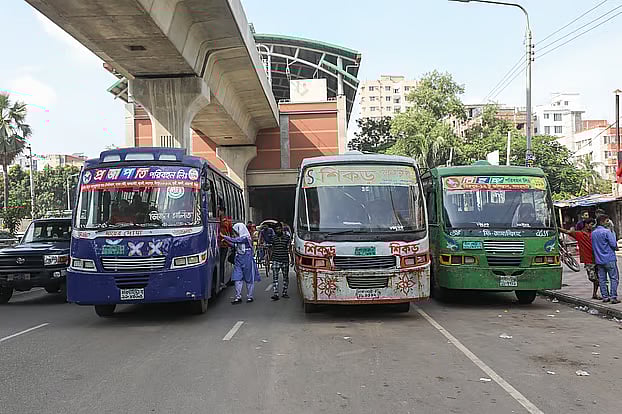
In reality, however, buses worth Tk 3.5 million are rarely seen on Dhaka’s roads. Most buses and minibuses are poorly maintained, worn-out, and have damaged seating.
Another contradiction lies in the fact that government regulations allow buses to operate for up to 20 years in Dhaka, yet fares are calculated based on a 10-year lifespan. This effectively allows operators to charge fares as if the buses were new even when they are between 11 and 20 years old.
The cost analysis also assumes that buses undergo maintenance every 25 days and every three months, with an estimated expense of around Tk 40,000. However, there is little evidence that such maintenance spending actually takes place.
An additional Tk 65,000 is allocated for garage and terminal costs, although most buses in Dhaka do not have designated garages and are instead parked on roadsides.
Around Tk 300,000 per year is assumed for engine overhauling (major repairs).
The fare calculation also includes monthly salaries for drivers and two assistants, along with two festival bonuses per year. However, there is little evidence that such bonuses are actually paid, and regular monthly salary structures are rare in practice.