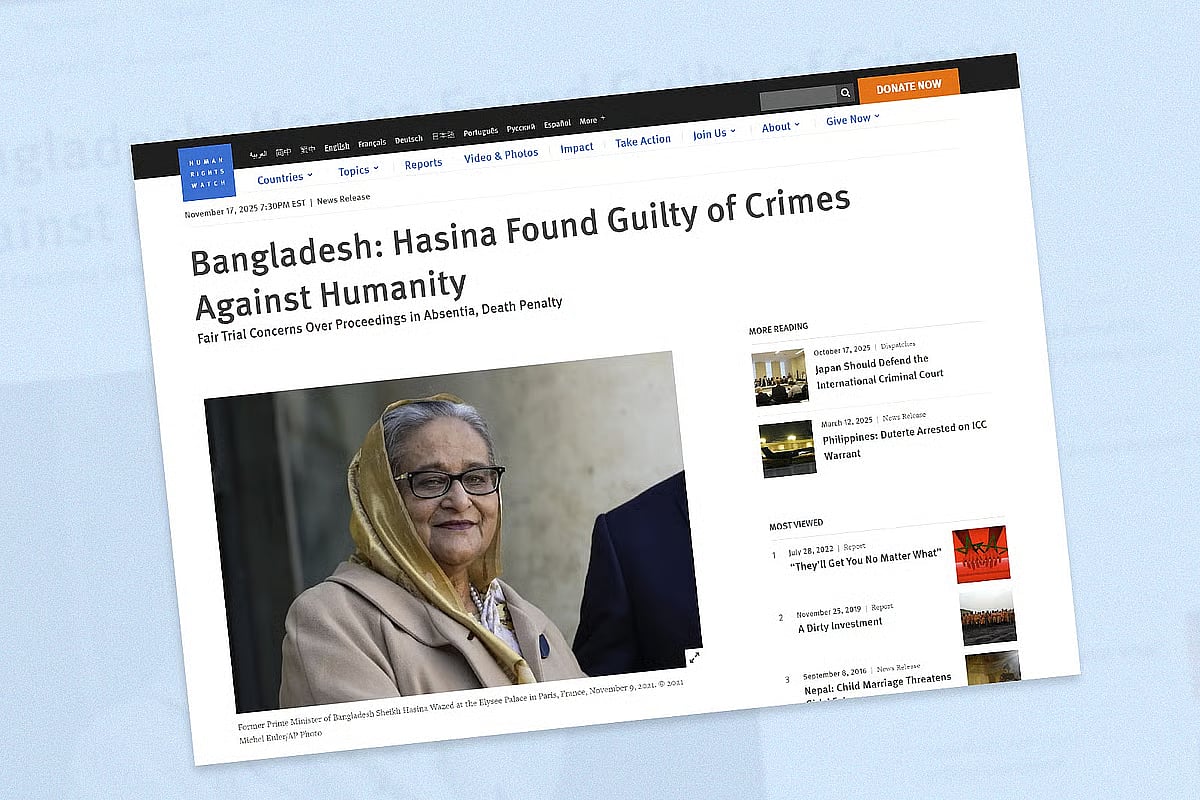
Human Rights Watch (HRW) has raised serious concerns over the fairness of the trial in which Bangladesh’s International Crimes Tribunal (ICT) found former prime minister Sheikh Hasina and former home minister Asaduzzaman Khan Kamal guilty of crimes against humanity.
“Both were prosecuted in absentia, not represented by counsel of their choosing, and sentenced to death, raising serious human rights concerns,” the HRW said in a news release on 17 November.
The tribunal delivered its verdict on 17 November, sentencing both leaders to death in absentia for their roles in the deadly crackdown on student-led protests in 2024.
The judgment also sentenced former inspector general of police (IGP) Chowdhury Abdullah Al-Mamun, who testified for the prosecution and is currently in custody, to five years in prison.
According to the HRW statement, “Bangladesh: Hasina Found Guilty of Crimes Against Humanity Fair Trial Concerns Over Proceedings in Absentia, Death Penalty” HRW said the proceedings lacked fundamental fair trial guarantees and risked undermining confidence in the judicial process.
“There is enduring anger and anguish in Bangladesh over Hasina’s repressive rule, but all criminal proceedings need to meet international fair trial standards. Those responsible for horrific abuses under the Hasina administration should be held to account after impartial investigations and credible trials,” the statement quoted Meenakshi Ganguly, deputy Asia director at Human Rights Watch, as saying.
The HRW further said while those responsible for abuses should be appropriately held to account, the prosecution failed to meet international fair trial standards, including for a full opportunity to present a defence and question the witnesses against them, and the right to be represented by counsel of one’s choosing. Concerns over the fairness of the trial are exacerbated by the death sentences.
“The evidence against Hasina included audio recordings of conversations with officials in which she appeared to order the use of lethal weapons. While a government-appointed defense lawyer for Hasina and Khan, who received no instructions from the defendants, could cross-examine witness, he did not produce any witnesses to counter the allegations,” the HRW statement reads.
The HRW also added that trials in absentia fundamentally undermine the right to a fair trial as set out in article 14 of the International Covenant on Civil and Political Rights (ICCPR), which is crucial to a legitimate legal process. The UN Human Rights Committee, which monitors compliance with the ICCPR, has stated that to guarantee defendants’ rights, “all criminal proceedings must provide the accused with the right to an oral hearing, at which he or she may appear in person or be represented by counsel and may bring evidence and examine witnesses.”
The HRW contends that the need for justice and accountability for serious rights violations by the Hasina government, including enforced disappearances, extrajudicial killings, and torture, is critical. However, Bangladesh authorities have a long history, including under the Hasina government, of bringing politically motivated cases, including before the International Crimes Tribunal, to arbitrarily arrest and detain, unfairly prosecute, and in some cases carry out death sentences against political opponents.
“Such practices have continued under the interim government led by Muhammad Yunus, who took charge in August 2024 after Hasina fled to neighboring India,” the news release said.
The statement also mentioned that the International Crimes Tribunal is a domestic court that Hasina created in 2010, originally to prosecute crimes against humanity during Bangladesh’s 1971 independence movement. Tribunal proceedings during Hasina’s rule repeatedly failed to meet international fair trial standards and imposed the death penalty.
“Human Rights Watch opposes the death penalty in all circumstances because of its inherent cruelty,” the statement reads.
While the Yunus government has not abolished the death penalty, it amended the International Crimes (Tribunals) Act in November 2024 to bring provisions on command responsibility and crimes against humanity closer to the ICC’s Rome Statute. The amendments specifically list enforced disappearances as a crime.
The HRW also urged the Bangladesh government to ensure equal access to constitutional remedies for all defendants, and to impose a moratorium on the death penalty with a plan to abolish it altogether.
The rights body said Bangladesh government should respond to any demonstrations in accordance with the UN Basic Principles on the Use of Force and Firearms by Law Enforcement Official. It also urged Awami League leaders to discourage violence by party supporters opposing the tribunal verdict.
Following the verdict, Bangladesh’s foreign ministry urged the Indian government to extradite Sheikh Hasina and Asaduzzaman, citing an extradition agreement between the two countries.
“While Indian authorities should support accountability efforts in Bangladesh, any extradition request should allow for the individuals sought to contest the extradition in legal proceedings in India that meet due process standards. No one should be extradited if they would face a trial abroad that does not meet international fair trial standards and could result in the death penalty,” the HRW statement reads.
“Victims of grave rights violations committed under the Hasina government need justice and reparations through proceedings that are genuinely independent and fair,” Ganguly said.
“Ensuring justice also means protecting the rights of the accused, including by abolishing the death penalty, which is inherently cruel and irreversible,” Ganguly added.