Bangladesh Mahila Parishad
Efforts to establish misogynistic culture must be curbed
Efforts are underway to establish a misogynistic culture in society. There is a widespread trend of taking the law into one’s own hands, and mob violence has become a serious concern. As a result, incidents of violence against women and girls are rising. To prevent such violence, campaigns promoting misogyny must be strictly curtailed.
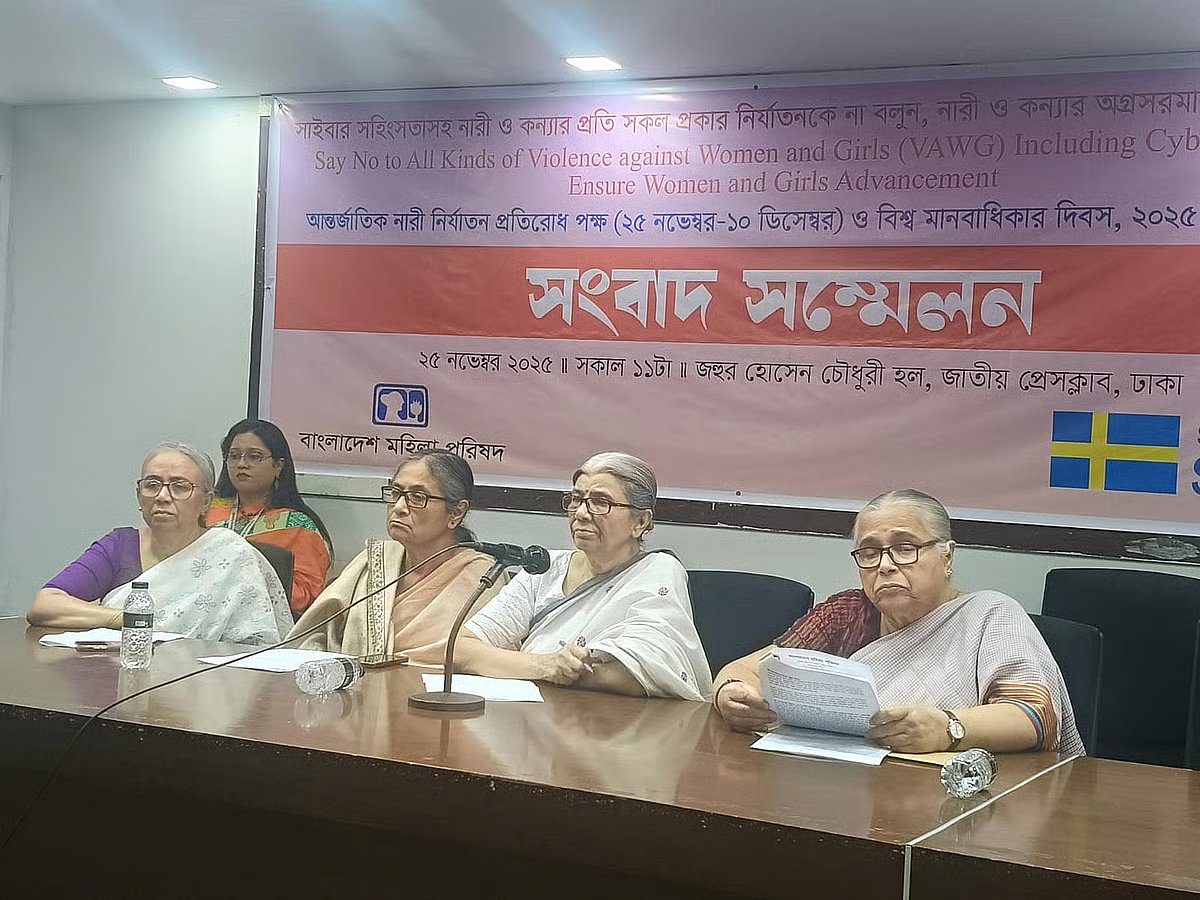
These remarks were made by leaders of Bangladesh Mahila Parishad during a press conference today, Tuesday, marking the 16 Days of Activism against Gender-Based Violence.
During the conference, the organisation highlighted news reports from ten national media outlets published over the past ten months (January to October) detailing violence against women and girls.
According to these reports, a total of 2,468 women and girls faced various forms of abuse during this period. Among them, 713 were victims of rape, gang rape, or suicide following sexual assault. Other forms of violence included dowry-related abuse, domestic violence, murder, child marriage, sexual harassment, abduction, and cyber violence.
Leaders highlighted the history of the observance: in 1981, at a women’s conference in Latin America, the day was proposed as the International Day for the Elimination of Violence Against Women. In 1993, the Vienna Human Rights Conference recognised the day, declaring, “Women’s rights are human rights; violence against women is a human rights violation.” On 7 February 2000, the UN General Assembly officially recognised 25 November as the International Day for the Elimination of Violence Against Women and called for a 16-day campaign until 10 December.
This year, Bangladesh Mahila Parishad launched a 16-day program under the slogan: “Say no to all forms of violence against women and girls, including cyber violence; ensure the advancement of women and girls.”
Replying to a query, Mahila Parishad president Fauzia Moslem said that proper implementation of the law, changing patriarchal mindsets, and mobilising societal institutions to act against violence are essential. Campaigns promoting misogyny must be firmly suppressed. She also noted that media coverage of violence against women should follow clear standards.
Responding to another question, Fauzia Moslem referred to a statement made by Bangladesh Jamaat-e-Islami’s Amir Shafiqul Rahman suggesting a five-hour workday for women, questioning the motive behind such remarks. She said that the awakening and desire for freedom among women cannot be suppressed.
Maleka Banu, General Secretary of Mahila Parishad, said society often justifies violence against women using various excuses, which encourages further abuse. She noted that statements from some groups opposing the recommendations of the interim government’s Women’s Reform Commission reveal an attempt to sideline women’s issues. Unfortunately, the government remained silent against such groups.
Masuda Rehana Begum, Joint General Secretary, said that mob violence has recently become a major concern and is increasing at an alarming rate. A five-year analysis shows no reduction in incidents of violence against women and children.
Another Joint General Secretary, Seema Moslem, said that real empowerment of women will not occur until women gain decision-making power. Reserved seats in the National Parliament should be filled through direct elections. Nominations of relatives or spouses of male leaders for reserved seats will not ensure women’s true representation; only directly elected women can represent women’s interests.
The press conference was moderated by Sabikunnahar, a member of Mahila Parishad’s Legal Aid Subcommittee, and the main report was presented by Legal Aid Secretary Rekha Saha.
The report emphasised that violence not only hinders women’s progress but also obstructs societal and state development. If a significant portion of the female population suffers long-term physical, mental, or financial harm, lags in health, education, and employment, and faces restricted participation in public life and politics, it threatens not only women’s futures but also increases social instability, injustice, personal animosity, and harmful social practices.
The report cited the latest survey by Bangladesh Bureau of Statistics (BBS), which found that 76 per cent of women in the country have experienced some form of physical, mental, sexual, or financial abuse or controlling behaviour by close family members, primarily their husbands.
The press conference concluded with separate recommendations for individuals, families, civil society, the state and government, the media, and the women’s movement. Recommendations included raising awareness at the family level, fostering a culture of tolerance, adopting zero-tolerance policies against all forms of violence, extensive media campaigns, and initiating programs to build women’s self-confidence and empowerment.