Diplomacy
Prime Minister's Malaysia visit: Focus on cooperation in diverse sectors
Decision to draft a new MoU for worker recruitment
The two countries will hold discussions on a free trade agreement
Request for investment in the energy sector
The two countries agreed to cooperate in education and semiconductor industry
Bangladesh and Malaysia have agreed to expand trade and investment by identifying specific priority sectors alongside human resources recruitment. Furthermore, Dhaka and Kuala Lumpur have agreed to formulate a roadmap for a partnership in the defence sector.
This was disclosed in a joint statement issued on Monday, following a bilateral meeting between Bangladeshi Prime Minister Tarique Rahman and Malaysian Prime Minister Anwar Ibrahim.
According to diplomatic analysts, the joint statement reflects a shared commitment to advancing cooperation across various fields in addition to the labour market.
Prime Minister Tarique Rahman’s first state visit to Malaysia, a country in Southeast Asia, signals the beginning of a new chapter in bilateral relations.
On Monday morning, on the second day of the two-day visit, Prime Minister Tarique Rahman, accompanied by his wife Zubaida Rahman, arrived at the Prime Minister’s Office in Putrajaya. They were warmly received by Prime Minister Anwar Ibrahim and his wife Wan Azizah Wan Ismail, where they were accorded a red-carpet welcome.
Following the reception, Tarique Rahman and Anwar Ibrahim initially held a one-on-one meeting. This was subsequently followed by a bilateral meeting between the delegations of the two countries, led by the respective leaders.
After the meeting, the two nations signed a Memorandum of Understanding (MoU) on cultural cooperation. Additionally, Bangladesh and Malaysia exchanged two bilateral documents on investment and cooperation in counter-terrorism research and capacity building.
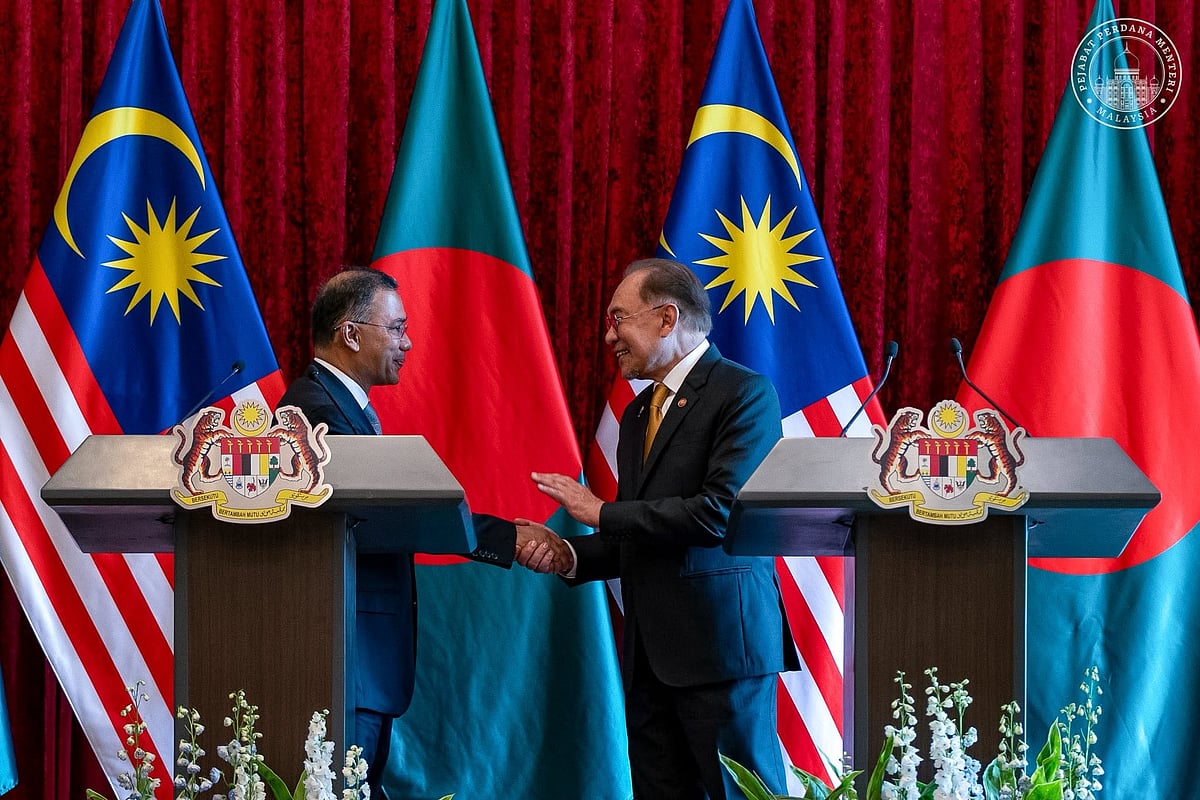
The two top leaders later took part in a joint press conference at the conclusion of the meeting.
Prime Minister Tarique Rahman later attended a state banquet hosted in his honour by the Malaysian Prime Minister. Following the luncheon, Tarique Rahman and his spouse Zubaida Rahman met with the King of Malaysia, Sultan Ibrahim ibni Almarhum Sultan Iskandar. The Queen of Malaysia, Raja Zarith Sofiah, was also present during the audience.
Mahdi Amin, the Prime Minister's Advisor and spokesperson for the Prime Minister's Office, informed journalists that the chief executives of five major enterprises had met with the prime minister. Among them were the Petronas Group, Axiata, AirAsia, Perodua, and MMC Port. The primary objective of these meetings was to bolster Malaysian investment and trade in Bangladesh and to accelerate employment generation in Bangladesh.
Tarique Rahman departed for Malaysia on Sunday on his first state visit, just four months after assuming office as prime minister following a victory in the national elections in February.
From there, he left Kuala Lumpur in the afternoon for a five-day visit to China, arriving in Dalian at night (local time). In Dalian, Prime Minister Tarique Rahman will attend the Annual Meeting of the World Economic Forum, after which he will travel to the Chinese capital, Beijing.
Connecting with the son after the father and mother
Following their formal meeting yesterday, the top leaders of Bangladesh and Malaysia participated in a joint press conference.
Prime Minister Anwar Ibrahim thanked Prime Minister Tarique Rahman for choosing Malaysia for his first state visit. He mentioned that he had been acquainted with the late father and mother of the Bangladeshi Prime Minister. As a youth leader, he had met former President Ziaur Rahman at the Mouchak Camp (an international scouts gathering in Gazipur). Later, as Deputy Prime Minister, he had met former Prime Minister Khaleda Zia for bilateral talks on several occasions.
More importantly, he noted, Tarique Rahman and his family had endured immense hardship and struggle.
Expressing his gratitude to Anwar Ibrahim, Tarique Rahman stated that after assuming office as prime minister last February, one of the first congratulatory messages he received was from Prime Minister Anwar Ibrahim, who had also extended the invitation to visit Malaysia.
He expressed his immense pleasure at being able to visit Malaysia on his first foreign tour as prime minister, accompanied by his wife.
In his address, the Bangladeshi prime minister referenced his late father and former president’s visit to Malaysia in 1979, noting that the visit had strengthened political ties between the two nations and laid the foundation for cooperation on labour issues.
Tarique Rahman also recalled his mother and former Prime Minister Khaleda Zia's visit to Malaysia in 1993.
A new chapter
Prime Minister Tarique Rahman remarked, “I am confident that today's discussions will mark the beginning of a new chapter in Bangladesh-Malaysia relations.”
Tarique Rahman stated that the discussions encompassed enhancing cooperation across various sectors, including trade and investment expansion, energy cooperation, the halal economy, recruitment of workers, the semiconductor industry, agriculture, education, and people-to-people contact.
“I requested Prime Minister Anwar Ibrahim to consider recruiting more Bangladeshi workers and to expedite the reopening of the labour market. Furthermore, I raised the issues of regularising undocumented workers and the potential repatriation of detained Bangladeshi nationals. We agreed that the recruitment process must be transparent, fair, and affordable, thereby reducing the role of middlemen and lowering costs for workers,” Tarique Rahman added.
Regarding human resource cooperation, particularly concerning the workers who sustain the economy, Anwar Ibrahim noted that this sector has simultaneously generated considerable debate and concern. Specifically, there are challenges surrounding humanitarian aspects, the treatment of workers, and making the entire process more transparent and equitable.
Addressing allegations of exploitation and abuse faced by Bangladeshi workers in Malaysia, Anwar Ibrahim asserted that the tendency to exploit workers, mistreat them, and use them solely for self-interest is entirely unacceptable.
He emphasised that both countries must take the lead in ensuring that the recruitment process is transparent, satisfying the needs of both nations while protecting the interests of the workers and their families.
Underscoring the importance of upgrading bilateral ties, Anwar Ibrahim said, “To further solidify relations between our two countries, we must take on the challenge of swiftly signing an FTA (Free Trade Agreement) and forging a major partnership across all sectors.”
New MoU on worker recruitment
Following the meeting, a joint statement declared that it has been decided to convene a meeting of the Joint Working Group (JWG) to ensure the continuous, safe, and mutually beneficial migration of Bangladeshi workers to Malaysia.
The discussions at that meeting will serve as the basis for drafting a new Memorandum of Understanding (MoU) regarding manpower recruitment.
Towards a free trade agreement
Another major focus of the bilateral meeting was the negotiation of the Malaysia-Bangladesh Free Trade Agreement (MBFTA).
Highlighting that Bangladesh is Malaysia’s second-largest trading partner in South Asia, both sides stressed the need to augment bilateral trade and investment.
During the meeting, both parties agreed to advance negotiations to secure a mutually beneficial Free Trade Agreement by 2027.
Energy cooperation
During the talks, the Bangladeshi side emphasised strengthening cooperation in the energy sector. Both sides stressed the importance of capitalising on all opportunities within the existing MoU between the state-owned companies Petronas and Petrobangla regarding LNG supply and the development of LNG infrastructure.
Malaysian companies were invited to invest in Bangladesh’s energy sector, including oil and gas exploration in the Bay of Bengal, the extraction of minerals such as coal and limestone, and the transition to renewable energy.
Digital and semiconductor industries
The two prime ministers agreed to link Malaysia’s expertise and knowledge in the semiconductor industry and services with Bangladesh's rapidly growing IT and engineering sectors.
The Bangladeshi side proposed establishing a bilateral talent cooperation framework under which both nations could exchange experts.
Defence and security cooperation
The joint statement noted that a decision was reached to fully implement the signed MoU on defence cooperation. To determine a roadmap for defence cooperation, both countries agreed to convene a meeting of the joint committee dedicated to this sector.
To prevent and counter terrorism and all forms of violent extremism, both nations agreed to collaborate through the exchange of intelligence, information sharing, capacity-building initiatives, training programmes, and the sharing of best practices.