Foreign Minister pledges to be a ‘full-time president’ of UN General Assembly if elected
Bangladesh Foreign Minister Khalilur Rahman has pledged to serve as a ‘full-time President’ of the 81st Session of the United Nations General Assembly (UNGA) if elected. The foreign minister also asserted that, should he be successful, he would be a President for all.
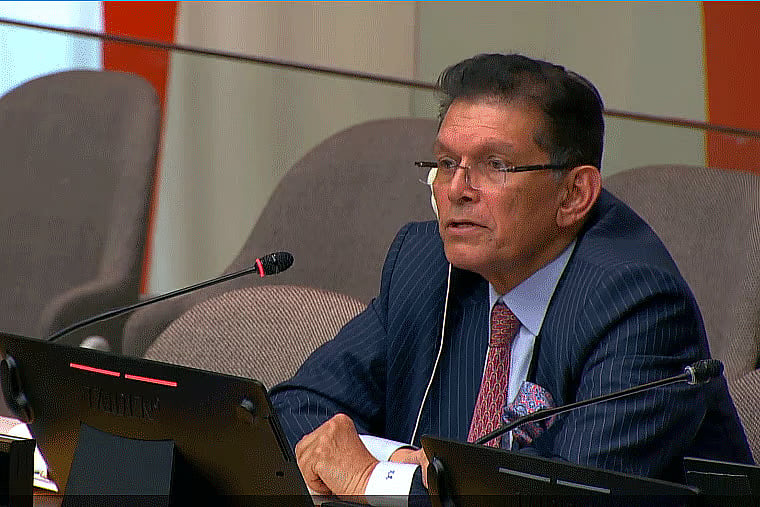
Khalilur Rahman made these remarks while campaigning for the Presidency of the 81st UNGA session at the UN Headquarters in New York on Wednesday afternoon (local time). During the event, he presented a written statement outlining a six-point plan of action.
In presenting his candidacy for the presidency, Khalilur Rahman set out a comprehensive vision aimed at restoring global trust in the United Nations. He identified six core themes for his proposed work plan.
Among these six priorities, Khalilur Rahman emphasised the need to revitalise peacekeeping operations, bridge the gaps in achieving the Sustainable Development Goals (SDGs), and address the urgent threat of climate change.
Drawing on his extensive diplomatic experience, Khalilur Rahman advocated for ensuring the equitable and prudent governance of emerging technologies and championed the protection of the human rights of displaced populations.
A central feature of Khalilur Rahman’s proposal was a commitment to multilateralism and institutional reform, aimed at making the global body more inclusive and effective for all member states.
He highlighted Bangladesh’s contribution of over 200,000 peacekeepers to UN missions, stressing the need for an integrated approach to peacekeeping and peacebuilding.
The Bangladesh foreign minister prioritised conflict prevention, political solutions, the protection of civilians, and increasing the participation of women in peacekeeping activities.
Regarding sustainable development and the 2030 Agenda, Khalilur Rahman noted the significant disparity between commitment and implementation.
He pledged to work towards ensuring that energy insecurity does not lead to a ‘lost decade of development’. He also made a firm commitment to accelerating SDG implementation, addressing financing gaps, and ensuring the meaningful participation of youth, women, and girls. This framework places particular emphasis on the needs of Least Developed Countries (LDCs), Landlocked Developing Countries (LLDCs), Small Island Developing States (SIDS), and Middle-Income Countries (MICs).
Khalilur Rahman also promised to implement existing climate commitments, support the Loss and Damage Fund, and preserve marine ecosystems and biodiversity through science-based ocean action.
To uphold human rights, Khalilur Rahman spoke of strengthening coordination between various institutional human rights mechanisms and protecting the space for humanitarian assistance.
He highlighted the plight of refugees and displaced populations, citing Bangladesh’s experience in sheltering 1.2 million forcibly displaced Rohingyas from Myanmar.
Touching upon emerging technologies such as Artificial Intelligence (AI) and Big Data, Khalilur Rahman argued for prudent and equitable governance. He proposed this to ensure that the benefits of these technologies are accessible to all while mitigating the risks of bias and misuse.
Furthermore, he expressed his desire to transform the UN General Assembly into a driver for member-state-led reform. He aimed to enhance coordination between the General Assembly, the Security Council, ECOSOC, and the Peacebuilding Commission.
In conclusion, Khalilur Rahman vowed that, if elected, he would serve as an impartial and dedicated leader. He committed to serving as a ‘full-time President’—a President for everyone. In discharging his duties, he pledged to uphold the UN Charter, pay special attention to smaller delegations, and work towards building consensus amidst international differences.
An informal ‘interactive’ dialogue took place on Wednesday at the UN Headquarters in New York, where candidates presented written statements regarding their plans of action and subsequently answered questions from member states.
According to the principle of regional rotation, the Presidency of the upcoming 81st UNGA session is designated for the Asia-Pacific Group. Bangladesh and Cyprus are contesting the seat. Foreign Minister Khalilur Rahman is representing Bangladesh, while Andreas Kakouris, Special Envoy for Multilateralism, is contesting on behalf of Cyprus.
The formal election will take place at 10:00 am on 2 June in the General Assembly Hall at the UN Headquarters in New York.
The 81st Session of the UN General Assembly will officially commence on 8 September, with the high-level General Debate, featuring addresses from Heads of State and Government, beginning on 22 September.