Govt signals backtrack on judiciary, corruption and enforced disappearance issues: Iftekharuzzaman
The incumbent Bangladesh Nationalist Party (BNP) government is, in broad terms, signalling a backtrack on central issues relating to judicial independence, human rights, anti-corruption, and the prevention of enforced disappearances, said Iftekharuzzaman, Executive Director of Transparency International Bangladesh (TIB).
He, however, expressed hope that the BNP would, recalling its own past experiences of suffering injustice and its long-standing sacrifices, move forward in line with its commitments to ensure the full independence of the judiciary, the Human Rights Commission, and the Anti-Corruption Commission.
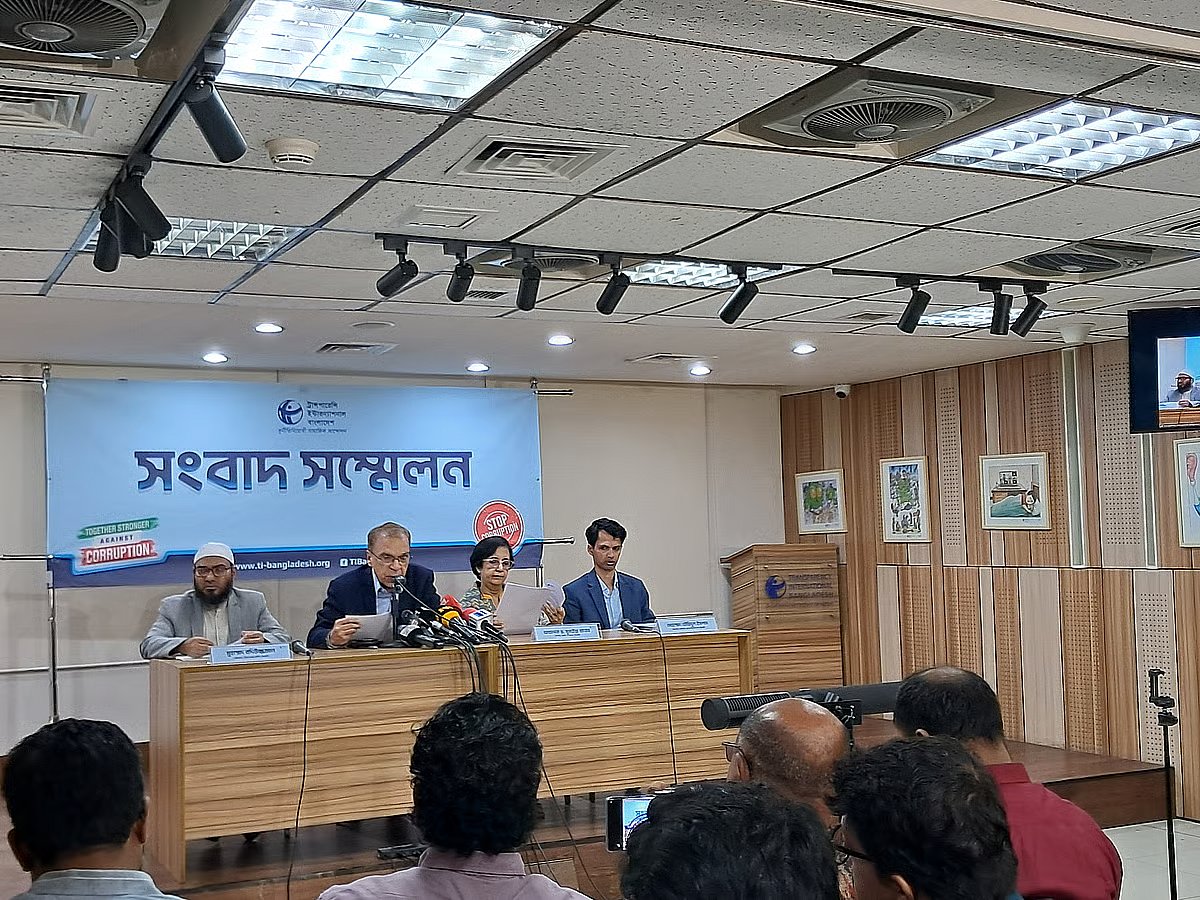
Iftekharuzzaman made these remarks at a press conference held at TIB’s office in Dhanmondi in the capital this afternoon (Monday). The briefing was organised to present TIB’s position on the cancellation and amendment of certain ordinances framed for state reform.
The BNP holds a two-thirds majority in the 13th Jatiya Sangsad (national parliament). A parliamentary special committee has recommended converting 98 of the 133 ordinances issued by the immediate past interim government into law without alteration.
In addition, the committee has recommended that 16 ordinances—including the National Human Rights Commission (NHRC), the Anti-Corruption Commission (ACC), and the prevention of enforced disappearances—should not be enacted immediately but instead be reviewed and reintroduced later.
It has also recommended the repeal of four ordinances, including three related to judicial independence concerning the appointment of Supreme Court judges and the establishment of a separate Supreme Court Secretariat.
Referring to these developments, Iftekharuzzaman said at the media conference that the decision to adopt 98 ordinances in their entirety was commendable.
The TIB Executive Director also described the uncertainty surrounding the National Human Rights Commission Ordinance and the Prevention of Enforced Disappearance Ordinance as alarming.
He, however, cautioned that not all of the ordinances being converted into law were free from weaknesses; in some cases, they had even been deliberately weakened—for example, the Government Audit Ordinance and four amendment ordinances relating to local government.
TIB stated that the Government Audit Ordinance still contains critical shortcomings that undermine the constitutional status and independence of the Comptroller and Auditor General.
This, it warned, would weaken accountability in public revenue management and limit the institution’s effectiveness in preventing irregularities and tax evasion. The four local government amendment ordinances were also criticised for deficiencies in administrative control.
Following the July uprising, the government was granted authority under special circumstances to remove elected representatives of local government bodies (such as city corporations, pourashavas, district councils, and upazila councils) and appoint administrators. Although this power was meant to be exercised only in exceptional circumstances and in the public interest, the elected government has normalised its discretionary use, which is contrary to democratic norms.
TIB has identified three central concerns in the current parliament and government’s approach to the ordinances. Elaborating, Iftekharuzzaman said, first, that by repealing three ordinances related to judicial independence, the government has created a risk of effectively discarding the issue altogether. No timeline has been set, nor has any indication been given for future action. Second, although it has been said that 16 ordinances, including those related to the Human Rights Commission and the ACC, are to be strengthened and reintroduced, no specific timeframe has been provided. Third, 15 ordinances, including the Police Commission Ordinance, are to be revised and passed, but the nature of the proposed changes remains unclear.
TIB has called for retaining the Supreme Court Judges Appointment Ordinance and the Supreme Court Secretariat Ordinance, both of which the current parliament has recommended for repeal.
He noted that issues such as judicial independence, human rights, anti-corruption, and the prevention of enforced disappearances are fundamental to strengthening institutional frameworks for the rule of law, justice, and human rights in the country.
At the same time, he criticised the government’s decision to amend and pass the Police Commission Ordinance—which he described as fundamentally flawed—by incorporating provisions that would further ensure government control over the proposed commission. He termed this move disappointing.
TIB calls for retaining 4 ordinances, amending 6, and repealing 2
TIB has called for retaining the Supreme Court Judges Appointment Ordinance and the Supreme Court Secretariat Ordinance, both of which the current parliament has recommended for repeal.
Iftekharuzzaman argued that repealing the judges’ appointment ordinance would revert the process to its previous system, effectively subjecting it once again to the discretion of the head of government, amounting to “one step forward, two steps back”.
He added that the rationale for repealing the Supreme Court Secretariat Ordinance suggests an intent to obstruct full judicial independence and maintain political, governmental, and administrative control.
The TIB Executive Director also described the uncertainty surrounding the National Human Rights Commission Ordinance and the Prevention of Enforced Disappearance Ordinance as alarming.
Their absence, he warned, could undermine administrative independence, hinder investigations into security forces, and risk transforming judicial authority into executive control. It may also lead to violations of international obligations under instruments such as the Optional Protocol to the Convention Against Torture (OPCAT) and the International Convention for the Protection of All Persons from Enforced Disappearance.
TIB stressed that, rather than reducing the commission to a nominal body, it must be transformed into an effective and independent institution, and any deviation from the legal framework for preventing enforced disappearances would be unacceptable.
The organisation identified six ordinances that require urgent review or amendment: the ACC Ordinance, the Right to Information (Amendment) Ordinance, the Personal Data Protection Ordinance, the Bangladesh Telecommunication Regulation (Amendment) Ordinance, the Government Audit Ordinance, and the Revenue Policy and Revenue Management Ordinance.
Iftekharuzzaman presented detailed arguments in support of these recommendations.
TIB also called for the repeal of two ordinances: the Police Commission Ordinance and the National Data Management Ordinance.
Speaking about this, Iftekharuzzaman argued that the Police Commission Ordinance fails to reflect the need for an independent and impartial body capable of transforming the police into a professional and citizen-friendly force. Similarly, the proposed data management authority would simultaneously act as both regulator and service provider, creating a clear conflict of interest.
‘Ordinances are being played with’
Describing the situation, Iftekharuzzaman said that “ordinances are being played with”.
Responding to a question from journalists, he remarked that resistance, similar to the past, continues to emerge from within, driven by both political and bureaucratic dynamics, with the bureaucracy still acting as the primary controlling force.
He further said, “BNP Secretary General, also the Local Government Minister, Mirza Fakhrul Islam Alamgir has stated that the July Charter will be implemented in letter and spirit. Meanwhile, Law Minister Md Asaduzzaman has said that the Prevention of Enforced Disappearance Ordinance and the National Human Rights Commission Ordinance will be made more relevant to ensure justice. I would like to place trust in their words. However, it is difficult to do so, because their statements are not being reflected in action.”
The press conference was moderated by TIB’s Director of Outreach and Communication, Mohammad Touhidul Islam.
Also present were Sumaiya Khair, Adviser (Executive Management), and Muhammad Badiuzzaman, Director of Research and Policy.